The best 50-watt guitar amp should fit the way it will be played, from quiet practice to rehearsals or a supported live setup. Speaker size, controls, effects and useful connections matter alongside the power rating. These four guitar combos take different approaches to that brief.
For the separate volume-control question with a suitable guitar amp, compare Guitar Amp Attenuators; the attenuator must match the amplifier and speaker load.
For another guitar-amp requirement, compare our separate guide to amp for Cigar Box Guitar.

The Fender Mustang LT50 remains the overall choice for an accessible range of preset sounds. The Champion II 50 Blackout favors direct controls, the Vox Adio Air GT is the portable desktop option, and the BOSS Katana-50 MkII offers flexible effects and power control. The Vox reaches its headline output on an adapter, with lower power when running on batteries.
The 4 50-Watt Guitar Amplifiers
Fender Mustang LT50 (Editor’s Choice)
The Mustang LT50 is the approachable all-round choice for a player who wants to explore different sounds without assembling a pedalboard. Its 12-inch speaker and 50W rating provide a conventional combo format, while a color display makes the preset-based workflow easier to follow than a panel full of unlabelled functions.
Fender provides 20 amp models and a range of onboard effects, with 60 preset locations including 30 factory-loaded sounds. That gives a beginner a useful starting point and leaves room to save personal settings. USB recording and Fender Tone desktop editing add another way to work with the amp from a supported Mac or PC.
The compromise is how the sounds are managed. A preset amp rewards some time learning its menus, and hands-free access calls for an appropriate optional footswitch. It is not the same as a simple two-channel amp with every sound adjusted directly from one set of knobs. Its overall recommendation comes from the breadth of useful tones and accessible practice features, rather than a promise to cover every stage situation.
Pros
- Broad selection of amp models and onboard effects.
- 60 preset locations with 30 factory-loaded starting points.
- 12-inch speaker, headphone output and USB recording.
Cons
- Some menu learning is needed for editing.
- Optional footswitch is needed for convenient hands-free control.
Fender Champion II 50 Blackout (Best for Simple Controls)
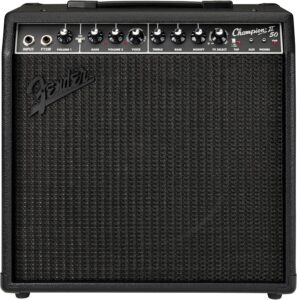
The Champion II 50 Blackout is the direct-control alternative. It provides two channels, a 50W output and a 12-inch Fender Special Design speaker, with dedicated controls for gain, voice and effects. It suits a player who would rather turn a few familiar knobs than build and manage a library of presets.
Its amp voices cover clean, overdrive and stronger distortion sounds, while the effects include reverb, delay, chorus and tremolo. A tap button helps set timing-based effects to the music. The Blackout version adds darker cosmetics and its own Special Design speaker voicing, so it is the particular version being considered here.
The trade-off is less elaborate sound management than a deeper modeling platform. It is aimed at selecting a voice and adjusting it directly, while the compatible two-button footswitch is optional. The auxiliary input and headphone output are useful for practice, and the larger speaker format makes it a more conventional rehearsal companion than a tiny desktop amp.
Pros
- Straightforward two-channel control layout.
- 50W output and a 12-inch Special Design speaker.
- Built-in effects, tap timing, auxiliary input and headphones.
Cons
- Less detailed preset management than a deeper modeling platform.
- Compatible footswitch is sold separately.
Vox Adio Air GT (Best for Portable Practice)

The Adio Air GT is the small, portable option rather than a conventional stage combo. Two three-inch speakers provide stereo playback in a lightweight enclosure, and battery operation makes it easy to move between practice spaces. It is particularly appealing when guitar sounds and backing-track playback need to share one compact box.
VOX provides amp modeling, two effects sections, Bluetooth audio and MIDI, and USB connectivity for compatible recording and editing setups. The Tone Room software expands access to sounds and settings. Those features make it a flexible desktop companion, with a different presentation from the single 12-inch combos in this selection.
The output figure needs context: VOX specifies 25W per side on the adapter, dropping to 2.5W per side on batteries. Its small speakers also will not move air like a larger guitar cabinet. It is best treated as a portable practice and playback amp; a loud rehearsal may call for one of the larger combos. Choose it for portability, stereo playback and convenient low-volume use.
Pros
- Battery operation and a lightweight enclosure.
- Stereo speakers suit guitar and backing-track playback.
- Bluetooth audio/MIDI and USB connectivity.
Cons
- Battery output is much lower than adapter-powered output.
- Small speakers limit its role beside a loud band.
BOSS Katana-50 MkII

The Katana-50 MkII is the effects-focused alternative for a player who wants a more adjustable rig in one combo. Five amp characters, each with a variation, cover clean, crunch and higher-gain sounds as well as an acoustic-electric guitar voice. The 12-inch speaker gives it a familiar guitar-combo format.
Five effects categories can operate together, and BOSS Tone Studio offers deeper editing with more than 60 effect types. Four Tone Setting memories store useful combinations. Its 50W, 25W and 0.5W power settings help adapt the amp to different playing levels, while Power Amp In lets a compatible external preamp or modeler use the power section.
The compromise is the standard 50 MkII’s connectivity and switching. It does not have a conventional effects send/return loop, and its foot-control options are more limited than larger models in the range. Deep editing also involves the appropriate Tone Studio software. It makes sense for a player who will use the effects flexibility, rather than someone seeking only a simple clean channel.
Pros
- Five amp characters with variations and five effects categories.
- Power settings suit different playing levels.
- Power Amp In, USB recording and four stored Tone Settings.
Cons
- No conventional effects send/return loop.
- Limited foot-control options compared with larger models.
Is a 50-Watt Amp Good Enough?
It can be, but wattage alone does not settle the question. A 50W combo with a 12-inch guitar speaker behaves differently from a small stereo desktop unit with the same combined headline rating. Speaker sensitivity, cabinet size, the desired clean level and the band’s volume all affect the result.
For home practice, convenient level control and a good headphone or recording output may matter more than maximum volume. At rehearsal, consider whether the amp can remain clear beside the drummer. At a larger venue, microphone or direct support through the PA can matter more than filling the room from the combo alone.
A 50W rating does not rule out metal, blues, jazz or country. The available voices, distortion character, speaker and required volume matter more than a genre label. If a smaller valve amp is also an option, the guide to low-watt tube amps explains another approach to practice and performance.
Check the exact version before comparing connections and controls. The Katana reviewed here is the standard 50 MkII, the Champion is the II 50 Blackout, and the Adio’s battery output is lower than its adapter-powered rating.
Final Thoughts: The Best 50-Watt Amplifier for Practice
The Mustang LT50 remains the overall choice for a broad, accessible collection of guitar sounds. Pick the Champion II 50 Blackout for direct controls, the Adio Air GT for portable desktop practice, or the Katana-50 MkII for more flexible effects and power settings.
Choose the format and workflow that make practice enjoyable, then check whether its volume and connections meet the rehearsal or recording needs. The right amp is a useful match for the player’s routine, rather than simply the one with the most features.