The best receiver for Pioneer SP-PK52FS should suit a conventional 5.1 speaker system first, then the TV, sources and room around it. Five amplified channels, appropriate speaker-load support, a subwoofer output and useful setup tools matter more than the largest advertised wattage number.

The Denon AVR-S650H remains the overall choice for a straightforward 5.1 system with network streaming and guided setup. The Sony STR-DH590 keeps things simple, Yamaha’s RX-V385 adds YPAO calibration, the Marantz NR1510 saves cabinet height, and the newer Denon AVR-X2900H provides room to expand beyond five speakers. The four older 4K models and the X2900H have different video capabilities, so choose for the sources actually in use.
Best Receivers for Pioneer SP-PK52FS
Denon AVR-S650H (Editor’s Choice)
The AVR-S650H is the well-rounded choice when the Pioneer system will remain a conventional five-speaker surround setup. It provides five amplified channels and two subwoofer outputs, with Audyssey setup tools to help establish speaker levels and timing. That is a practical combination for making the system easier to integrate into a real living room.
HEOS, network streaming and AirPlay 2 make it useful for music as well as television. Its five HDMI inputs and eARC support provide a convenient hub for compatible 4K sources and TV audio. The guided setup and quick-select controls are more valuable day to day than an inflated all-channel power claim.
The limitation is its generation and channel count. This is a 4K/60-era receiver, not the choice for passing 4K/120 video or adding powered height channels for Atmos. For the existing Pioneer 5.1 system and suitable sources, however, its setup tools and connectivity remain a sensible balance. A buyer planning more speakers or high-refresh gaming should look toward the X2900H instead.
Pros
- Five amplified channels suit a conventional 5.1 system.
- Audyssey setup tools and convenient quick-select controls.
- HEOS, AirPlay 2 and eARC connectivity.
Cons
- No powered height-channel expansion.
- Not a 4K/120 video receiver.
Sony STR-DH590 (Close Runner-Up)

The STR-DH590 is the uncomplicated alternative. It focuses on a five-channel surround system, with four HDMI inputs, Bluetooth music playback and automatic speaker calibration. For an owner who mainly wants to connect a TV and a few sources, that narrower feature set can be easier to live with than a network-heavy receiver.
Sony specifies support for 6–16-ohm speakers, covering the Pioneer speakers’ nominal six-ohm load. Its 4K HDR pass-through and ARC connection serve compatible television setups, while Bluetooth offers a quick route from a phone to the main speakers. The appeal is straightforward everyday operation rather than a large ecosystem of apps and streaming services.
The compromise is networking and expansion. It is not a Wi-Fi or HEOS receiver, and it should not be chosen on the assumption of built-in Alexa control or eARC. It also remains a five-channel amplifier without a powered Atmos-height layout. Choose it when the basic connections are enough and the priority is a simple surround system.
Pros
- Straightforward five-channel surround setup.
- Four HDMI inputs and Bluetooth playback.
- Automatic calibration and compatible six-ohm speaker support.
Cons
- Limited networking and streaming features.
- ARC rather than eARC; no powered height-channel expansion.
Yamaha RX-V385

The RX-V385 is a useful choice when automatic setup and a conventional 5.1 layout are the priorities. Yamaha’s YPAO system measures the speakers and room from the supplied microphone position, helping establish levels, distances and correction settings. It gives the Pioneer system a practical starting point before making smaller adjustments by ear.
The receiver provides five amplified channels, Bluetooth playback and 4K HDR connectivity. Yamaha also lists eARC support for this model; the installed firmware and TV settings need to support the intended connection. Its Cinema DSP options offer additional presentation choices without requiring extra physical speakers.
The limitation is its modest expansion path. There is no network streaming platform comparable to HEOS, and the HDMI section is not intended for a 4K/120 gaming chain. It suits a stable 5.1 system more than a growing Atmos installation, particularly when YPAO and straightforward local playback cover the main requirements.
Pros
- YPAO provides a useful automatic setup starting point.
- Conventional 5.1 amplification with Bluetooth.
- 4K HDR connectivity and supported eARC operation.
Cons
- No built-in network streaming platform.
- Limited speaker expansion and no 4K/120 pass-through.
Marantz NR1510 (Best for a Low Shelf)

The NR1510 earns its place through its slim chassis. It is far easier to accommodate on a low equipment shelf than a full-height receiver, while still providing five amplified channels, two subwoofer outputs and a substantial set of connections. It is a useful solution when physical space is the obstacle to a separate AV receiver.
Six HDMI inputs, eARC, HEOS streaming and a phono input make it more versatile than its height suggests. Its nominal 50W-per-channel stereo rating is specified at eight ohms with two channels driven, rather than as an unrealistic promise for every channel simultaneously. In a suitable room at sensible levels, the appeal is a complete conventional surround hub in a smaller enclosure.
The trade-off is headroom and expansion. A large room or very high listening levels can demand more amplifier capacity, and the five-channel layout leaves no powered height channels for Atmos. The case also still needs ventilation: a slim receiver should not be wedged into a closed gap. Choose it for its shape and connections, with realistic expectations of the room and volume.
Pros
- Slim chassis suits a lower equipment shelf.
- Six HDMI inputs, eARC and phono input.
- HEOS adds network music streaming.
Cons
- Less amplifier headroom for demanding rooms or levels.
- Needs ventilation and remains a five-channel design.
Denon AVR-X2900H (Best for Expansion)
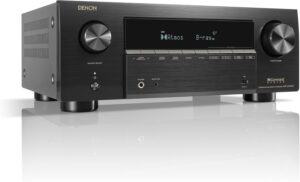
The AVR-X2900H is the expansion choice for an owner who expects to move beyond the existing Pioneer 5.1 layout. Seven amplified channels allow a suitable seven-speaker arrangement or a five-speaker layout with two height speakers. Dolby Atmos and DTS:X decoding provide a more capable foundation when additional speakers become part of the plan.
Its six HDMI inputs include three 8K-capable inputs, and it supports compatible 4K/120 sources, making it more relevant to a modern gaming setup than the older 4K receivers here. Audyssey MultEQ XT is included for room correction, while HEOS handles network music. An optional Dirac Live upgrade is a separate choice, not a requirement for the included setup system.
The extra capability is worthwhile only if it will be used. It is a larger, more involved receiver than a basic five-channel model, and the Pioneer package alone does not provide physical height speakers. It can run the current system while leaving an upgrade path, but spending for unused channels and video features is unnecessary when the existing TV and 5.1 arrangement already meet the need.
Pros
- Seven amplified channels provide a useful expansion path.
- Modern HDMI options include compatible 4K/120 operation.
- Audyssey MultEQ XT and HEOS are included.
Cons
- More receiver than a basic unchanged 5.1 system needs.
- Physical Atmos height effects require additional speakers.
How Important Is a Receiver for a Home Theater?
The AV receiver decodes the source, amplifies the passive speakers and routes low-frequency audio to the powered subwoofer. It also switches between connected sources and manages levels, timing and bass crossover settings. In a conventional Pioneer 5.1 installation, those practical tasks are the foundation of the system.
The speaker family uses a nominal six-ohm load. Follow both the speaker and receiver instructions for connections, impedance settings and ventilation, and avoid excessive volume or bass boost. Receiver features should match the sources and room rather than a promise of permanent future-proofing.
How to Choose the Best Receiver for the Money?
Budget
Start with the number of speakers and the video sources. A suitable five-channel receiver can be enough for the existing system. Seven channels and newer HDMI capabilities become more useful when height speakers, extra surrounds or high-refresh gaming are genuine plans.
2-Channel Audio and Analog Inputs
Count the required HDMI, optical and analog audio connections. A turntable without its own phono stage needs either a suitable receiver phono input or an external phono preamp. Connect the powered subwoofer to the appropriate pre-out, rather than treating it as another passive speaker.
App-Based And Remote Control
Look for a control method that fits everyday use. A clear remote and HDMI control may be enough for a TV-focused system; network apps can be useful for music. Voice-control and streaming features may require compatible devices, accounts or regional services, so check the actual setup rather than assuming they work independently.
Networking
Bluetooth playback is different from built-in Wi-Fi or network streaming. HEOS models can participate in a compatible multiroom system, but playing in additional rooms still requires suitable equipment there. Ethernet can provide a useful alternative where wireless coverage is unreliable.
Room Correction
Automatic calibration helps establish a consistent starting point for speaker levels, distances and tonal balance. Use the supplied microphone as directed, then check dialogue clarity and subwoofer integration. It cannot completely overcome poor placement or difficult room acoustics.
Audio Features
Match channel count, decoding and TV-audio return to the actual equipment. The five-channel models here suit conventional surround; the X2900H offers an expansion route. A receiver supporting Atmos does not create physical overhead speakers, and older 4K HDMI hardware should not be assumed to pass 4K/120 video.
Conclusion: The Best Receiver for SP-PK52FS
The Denon AVR-S650H remains the overall recommendation for a straightforward Pioneer 5.1 system with useful streaming and guided setup. The Sony suits simpler needs, the Yamaha adds a practical YPAO setup route, and the Marantz solves a shelf-height problem. Choose the AVR-X2900H when modern HDMI and additional speaker channels are priorities.
Allow room for ventilation, use appropriate speaker and subwoofer connections, and choose for the listening space and sources. Good placement and calibration are as important as the receiver’s feature list.