What is the best receiver for Klipsch RP-600M? The answer depends on whether these bookshelf speakers will anchor a surround system or a straightforward stereo setup. These four choices cover both approaches, with different strengths in room correction, digital connections and everyday convenience.
For a different system requirement, see our separate guide to amp for Klipsch RP-8000F; check the speaker and amplifier specifications for that setup.
The original RP-600M combines a horn-loaded titanium tweeter with a 6.5-inch Cerametallic woofer. Its published sensitivity makes moderate amplifier power a practical starting point, but speaker placement and listening distance still matter. The Marantz SR7013 remains the overall choice for a system that needs both music and multichannel movies; the Cambridge and NAD are stereo integrated amplifiers rather than surround receivers.
The 4 Best Receivers for Klipsch RP-600M
| Image | Model | Price |
|---|---|---|
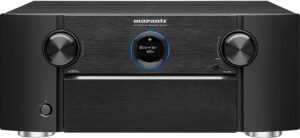
| Marantz SR7013 (Editor's Choice) | Check Price |
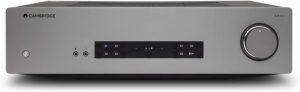 | Cambridge Audio CXA61 | Check Price |
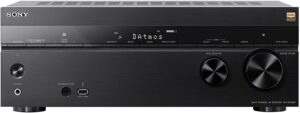 | Sony STR-DN1080 | Check Price |
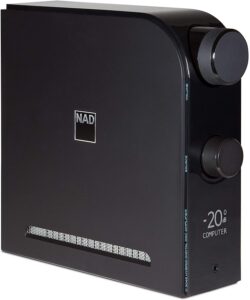 | NAD D 3045 | Check Price |
Marantz SR7013 (Editor’s Choice)
The SR7013 makes the most sense when the RP-600M pair is the front end of a larger home theater. Nine powered channels can run a 5.1.4 or 7.1.2 Dolby Atmos layout without a separate power amplifier. Its 11.2-channel processing also leaves room for a 7.1.4 system if an external two-channel amplifier is added.
Audyssey MultEQ XT32 is a particularly useful feature here: it measures the installed system and applies room correction, rather than expecting a speaker change to solve every placement problem. HEOS and AirPlay 2 add music-streaming options, while the HDMI connections handle 4K/60Hz video and eARC TV audio. The appeal is a single control center for movies and music.
Marantz rates it at 125 watts per channel into 8 ohms over 20Hz–20kHz at 0.05% THD with two channels driven. That is a useful stereo reference, not a promise of the same continuous power from all nine channels at once. The substantial chassis needs ventilation, and its older HDMI platform does not provide 8K or 4K/120Hz passthrough. It earns the overall choice for surround-system flexibility and room correction, rather than for having the longest feature list on paper.
Pros
- Nine powered channels with processing for up to 11.2 channels.
- Audyssey MultEQ XT32 room correction.
- HEOS, AirPlay 2 and eARC for a combined music-and-TV system.
Cons
- Large chassis needs space and ventilation.
- No 8K or 4K/120Hz HDMI passthrough.
Cambridge Audio CXA61
The CXA61 is the cleaner fit for a two-speaker music system. Its Class AB amplifier is rated at 60 watts per channel into 8 ohms, rising to 90 watts into 4 ohms. The design concentrates on stereo amplification and source selection rather than dividing attention between surround channels and video switching.
USB audio lets a computer use the built-in DAC, while optical and coaxial inputs accommodate other digital sources. Bluetooth with aptX HD is convenient for compatible phones, and RCA inputs plus the front 3.5mm input cover analog equipment. A headphone socket, preamp output and subwoofer output give the system useful ways to expand.
There is no HDMI input, surround decoding or built-in phono stage. A TV therefore needs a suitable optical or analog connection, and a turntable needs its own phono preamp. It also has no bass and treble controls. Choose it when a compact collection of stereo sources matters more than automated room correction or a home-theater upgrade path.
Pros
- 60 watts per channel into 8 ohms with a focused stereo design.
- USB audio, optical, coaxial and aptX HD Bluetooth inputs.
- Headphone, preamp and subwoofer outputs.
Cons
- No HDMI, surround decoding or built-in phono stage.
- No bass and treble controls or network streaming.
Sony STR-DN1080
The STR-DN1080 is the seven-channel home-theater option. Dolby Atmos and DTS:X support let an RP-600M front pair become part of a 5.1.2 system, with the remaining speakers supplying the center, surrounds and height effects. Sony’s D.C.A.C. EX calibration uses the supplied microphone to account for speaker distances, levels and the room.
Its Phantom Surround Back feature simulates extra rear-speaker positions; it does not turn five physical speakers into seven independent speaker channels. The receiver supports 4K HDR video and, with the appropriate firmware, eARC TV audio. Bluetooth provides another way to play music without adding a separate source box.
An important limitation is the age of its connected platform. Sony has announced that supported network services, including Google Cast and Spotify, will end for this model on November 17, 2026. It should therefore be considered primarily for a wired-source movie system, not bought for those built-in streaming services. Its HDMI platform also lacks 8K and 4K/120Hz passthrough.
Pros
- Dolby Atmos and DTS:X in a seven-channel receiver.
- D.C.A.C. EX automatic speaker calibration.
- 4K HDR switching and eARC with suitable firmware.
Cons
- Sony has announced network-service termination for November 17, 2026.
- No 8K or 4K/120Hz passthrough.
NAD D 3045
The D 3045 packs a surprisingly useful range of connections into a narrow case. Its HybridDigital amplifier delivers a manufacturer-rated 60 watts per channel into either 4 or 8 ohms over 20Hz–20kHz at 0.03% THD, with both channels driven. That makes it a practical stereo partner when a full-size AV receiver would dominate the furniture.
HDMI ARC is its standout convenience for a TV-based stereo system. It also includes a moving-magnet phono input, USB computer audio, optical and coaxial inputs, and Bluetooth with aptX HD. A turntable, computer and television can therefore share the same amplifier without each needing a separate DAC or phono box. The headphone output adds a useful private-listening option.
The case can sit vertically or horizontally, and preamp and subwoofer outputs provide expansion options. The compromise is that this remains a two-channel amplifier: HDMI ARC does not give it Dolby Atmos decoding or extra speaker channels. It is a strong fit for a small music-and-TV setup, particularly when vinyl and computer audio both need a place.
Pros
- Compact enclosure with vertical or horizontal placement.
- HDMI ARC, USB audio and a moving-magnet phono stage.
- 60 watts per channel into 4 or 8 ohms with both channels driven.
Cons
- Stereo only, without surround decoding or room correction.
- Compact layout offers fewer direct controls than a full-size amplifier.
Klipsch RP-600M: Recommended Receiver Power and Nominal Impedance
Klipsch specifies the original RP-600M at 96dB sensitivity at 2.83V/1m and describes it as 8-ohms compatible. Its 100-watt continuous and 400-watt peak figures describe speaker power handling, not power produced by the speaker or a minimum amplifier requirement. Neither figure means that a 400-watt receiver is needed.
Use an amplifier suited to the speaker load and the room. Listening farther away or asking for large peaks needs more headroom than quiet near-field listening. Keep the links between the RP-600M’s dual binding posts in place for ordinary single-wire connection, and give the rear port room to breathe. Other speaker-and-receiver combinations involve different loads and should not be treated as interchangeable specifications.
Do Expensive Speakers Require Expensive Receivers?
No fixed price ratio determines a good match. A more expensive receiver may add channels, HDMI connections, room correction or installation features that a stereo system does not need. A simpler amplifier can still be the more useful choice if it has the right inputs and enough clean output for the intended listening level.
Compare power ratings under similar conditions, including impedance, distortion and the number of channels driven. Then consider the actual system: a turntable needs a suitable phono stage, a TV needs a compatible audio connection, and a surround setup needs enough powered channels. A guide to receivers for another speaker system can illustrate the different connection requirements, but price alone does not establish better sound.
So, the Best Receiver to Pair with RP-600M Is…
The Marantz SR7013 remains the overall choice for an RP-600M system that will handle multichannel movies as well as music. Its nine powered channels and Audyssey XT32 give it more room to grow than a basic stereo amplifier. For two-speaker listening, the Cambridge CXA61 offers a conventional stereo layout, while the NAD D 3045 makes particularly good use of limited space and adds HDMI ARC.
The Sony STR-DN1080 is another surround option, but its announced network-service termination is a meaningful limitation. Choose around the connections and speaker layout that will actually be used. If space is the deciding factor, the compact surround receiver guide offers another starting point.