Looking for the best small 5.1 receivers for a living room or bedroom? A slimline AV receiver can save valuable shelf height while keeping proper connections for surround speakers, a subwoofer and HDMI sources. The important distinction is a low-profile chassis—not a promise that the whole home theater will fit in a tiny space.
For the separate placement question in a Vizio 5.1 setup, see Speaker Stands for Vizio 5.1; confirm the speaker mounting details before ordering stands.
These four receivers can run a conventional 5.1 speaker setup. Some offer a second subwoofer output or extra amplifier channels as well. They remain roughly standard component width, so check depth, cable clearance and ventilation alongside height. The selection includes both a more modern HDMI-equipped option and established slimline models with different strengths.
Top 4 Best Small 5.1 Receivers
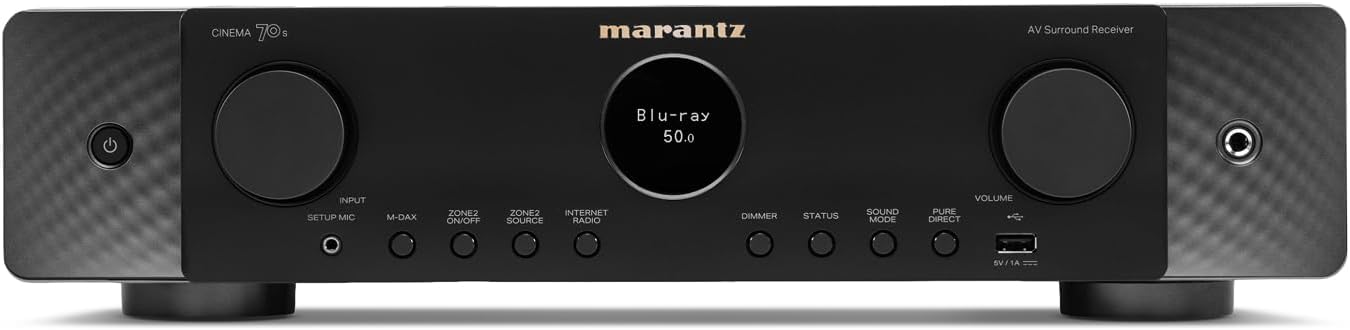
Marantz CINEMA 70s (Editor’s Choice)
The original CINEMA 70s is the overall choice for a slim surround system that also needs relatively modern video connections. Its seven amplifier channels can serve a standard 5.1 layout, with room to move to a 7.1 or 5.1.2 arrangement later. The low-profile case keeps the receiver from dominating the equipment shelf.
Its HDMI section supports video formats up to 8K/60Hz and 4K/120Hz on the appropriate inputs, making it more useful for a compatible modern console or display than the older receivers here. eARC brings supported TV audio back to the receiver, while HEOS provides network music playback.
Audyssey MultEQ helps set speaker levels, distances and room-response correction. Full-channel preamp outputs also provide a route to external amplification, a useful distinction when the system may grow beyond what the compact built-in amplifier is comfortable driving.
The limitation is amplifier headroom. The 50W-per-channel rating is specified with two channels driven into 8 ohms, not all seven at once. Pair it sensibly with the speakers and listening level, and allow ventilation above the case. This is the original CINEMA 70s, not the Series 2 or the two-channel STEREO 70s.
Pros
- Slim case with seven amplifier channels for flexible speaker layouts
- 8K/60Hz and 4K/120Hz support on suitable HDMI inputs
- Audyssey setup, HEOS streaming and multichannel preamp outputs
Cons
- Less power reserve than a larger high-output receiver
- Slim height still requires a full-width shelf and ventilation
Marantz NR1506 Slimline Receiver

The NR1506 remains relevant when the main goal is a low-profile receiver for a conventional surround setup. At about 4.1 inches high with its antennas lowered, it saves shelf height while providing five amplified speaker channels and two subwoofer outputs. It is slim rather than narrow: the case is still around 17.3 inches wide.
Six HDMI inputs provide useful source flexibility, including a front connection for temporary equipment. Dolby TrueHD and DTS-HD Master Audio decoding suit Blu-ray soundtracks, and Audyssey MultEQ helps establish speaker settings for the room.
Wi-Fi, Bluetooth and original AirPlay add music-playback options beyond the HDMI sources. Those older network features should be considered in the context of the services and devices still supported, rather than as a guarantee that every streaming app remains available.
The compromise is age. This archived model is not an 8K or 4K/120Hz receiver, and its ARC connection is not eARC. It makes more sense for a stable, conventional setup than for someone building around the latest gaming features. Its 50W stereo power specification also calls for sensible speaker and volume expectations.
Pros
- Low-profile 5.2-channel design
- Six HDMI inputs and lossless surround decoding
- Audyssey MultEQ plus wireless music connections
Cons
- Older HDMI and streaming generation
- No Dolby Atmos height channels or eARC
Marantz NR1510 Slimline Receiver
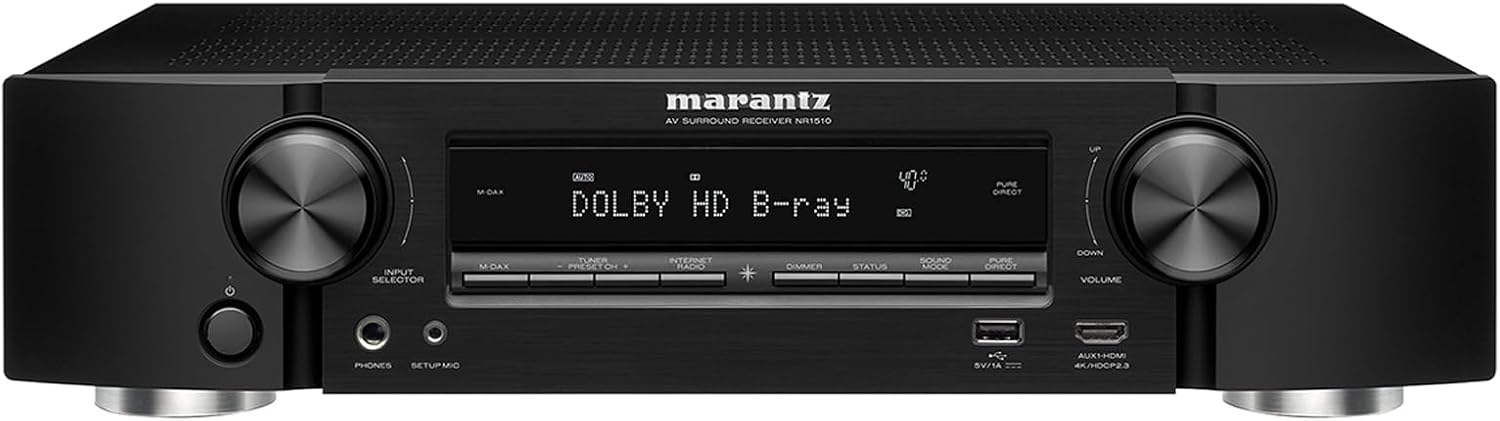
The NR1510 is the focused choice when five main speaker channels are enough and a slim receiver with network features is the priority. It keeps the low-profile Marantz format while adding HEOS-based music playback to a straightforward 5.2-channel system.
Six HDMI inputs and eARC provide a useful balance for a television, disc player and streaming sources. The video section is built around 4K/60Hz rather than the 8K and high-frame-rate features of the CINEMA 70s, so it suits a conventional TV system better than a demanding current-generation gaming setup.
Audyssey MultEQ handles automatic speaker setup and room correction, while HEOS, AirPlay 2 and Bluetooth offer several ways to play music. The moving-magnet phono input is also useful if a turntable forms part of the same system.
The trade-off is expansion. Five amplifier channels do not provide a 5.1.2 Atmos layout, and the compact amplifier’s 50W-per-channel stereo rating is not a promise of that output from every channel simultaneously. For a well-matched 5.1 system, though, it is a practical way to keep surround sound and music streaming in one low enclosure.
Pros
- Slim 5.2-channel layout with HEOS and AirPlay 2
- Six HDMI inputs, eARC and an MM phono input
- Audyssey MultEQ speaker setup
Cons
- No Atmos height-channel layout or 8K/4K120 video
- Moderate power reserve compared with larger receivers
Yamaha RX-S602 Slimline Receiver
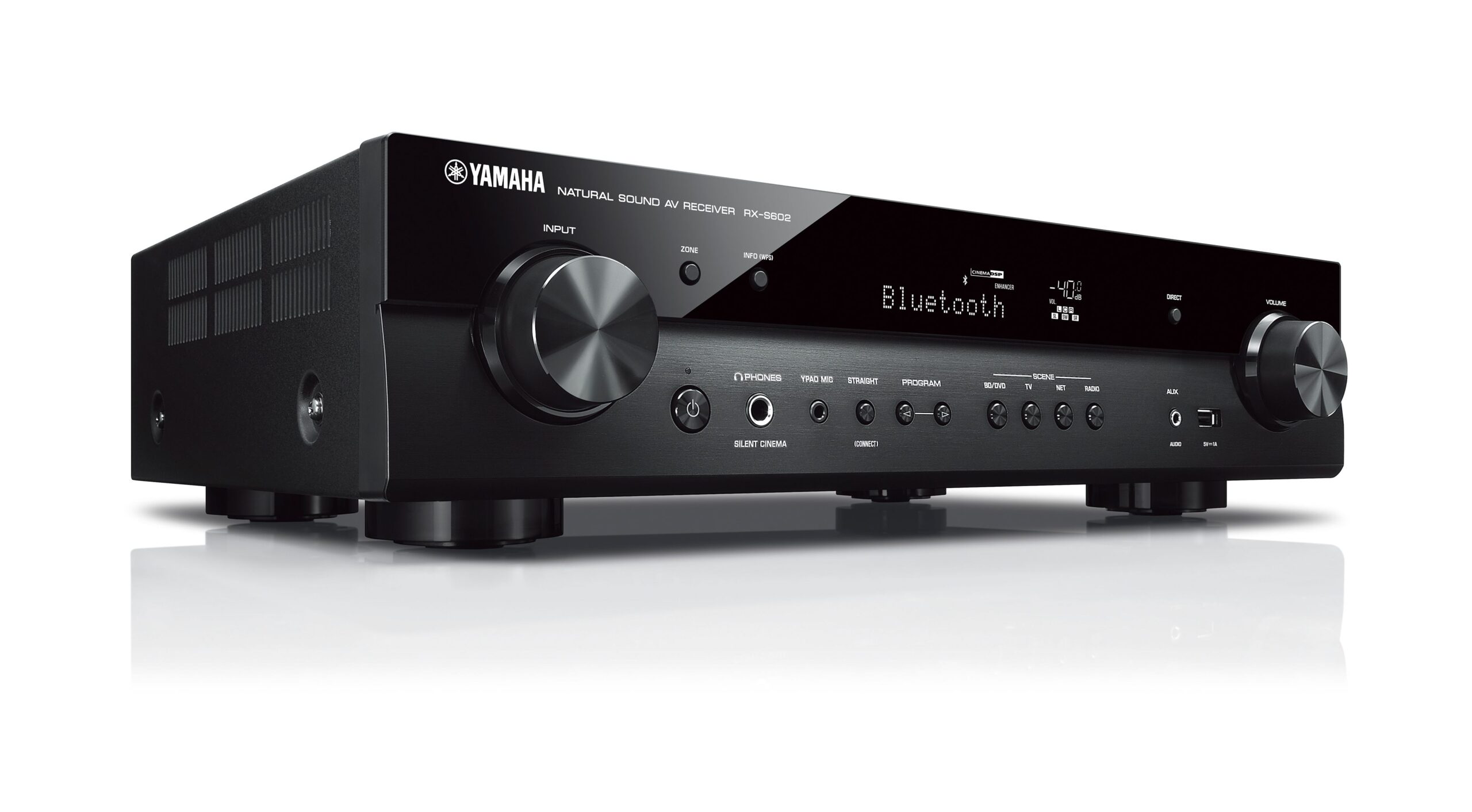
The RX-S602 is a genuinely slim Yamaha alternative, measuring about 4.4 inches high with the antenna lowered and 12.9 inches deep before cable clearance. It provides five main amplifier channels and a line-level output for a powered subwoofer, keeping the system centered on a conventional 5.1 layout.
YPAO automatic setup is the practical attraction for getting speaker distances and levels established without adjusting everything by ear. MusicCast, Wi-Fi and Bluetooth also make the receiver useful for everyday music, rather than only as an HDMI switch for movies.
The four HDMI inputs support 4K/60Hz video, HDR10, Dolby Vision and HLG. Yamaha’s current US specifications list eARC and AirPlay 2 through firmware updates, so those features depend on the installed firmware. The rated stereo output is 55W per channel into 8 ohms across the audio band.
The RX-S602 is discontinued, and its video and five-channel layout are more limited than the CINEMA 70s. It is still a useful established design for a shallow shelf and an existing MusicCast setup. Choose it for that combination of dimensions and integration, not for Atmos expansion or 4K/120Hz gaming.
Pros
- Low-profile case with relatively shallow depth
- YPAO setup and MusicCast integration
- 4K HDR support, with eARC and AirPlay 2 available through firmware
Cons
- Discontinued model with four HDMI inputs
- No Atmos height channels or 8K/4K120 capability
So, What’s the Best Compact 5.1 Receiver?
The CINEMA 70s is the overall recommendation for its combination of slim height, more modern HDMI support and room for a larger speaker layout. The NR1510 is a more focused 5.1 choice with HEOS and eARC, while the NR1506 remains an older low-profile option for a conventional setup. The Yamaha RX-S602 is worth considering when shallow depth and MusicCast matter.
Small height does not mean a tiny footprint
These receivers save height, but they are still approximately standard component width. Leave space for HDMI plugs, speaker wires, antenna position and the ventilation clearance specified in the manual. A receiver squeezed into a shelf with no airflow is not a successful compact installation.
Understand 5.1, 5.2 and 7.2
A 5.1 system has five main speaker channels and one subwoofer channel. A receiver described as 5.2 usually adds a second subwoofer output, not another main speaker amplifier. A seven-channel model can run 5.1 and may offer an alternative such as 5.1.2 height speakers when the receiver supports that format. The extra outputs do not make it unsuitable for a smaller system.
Match the HDMI features to the sources
4K/60Hz, 4K/120Hz, HDR and eARC are separate capabilities. Check the receiver, source, TV and relevant HDMI ports together. Older receivers can still serve a suitable system, but a general “4K” label does not establish support for every modern gaming or TV-audio feature.
Choose speakers and power sensibly
Power figures measured with one or two channels driven are not the same as continuous output from all channels at once. Speaker sensitivity, impedance, listening distance and desired volume affect the demands placed on the receiver. A slim design can be a good fit for a modest system without being the best choice for difficult speakers at high levels.
For a compact 5.1 setup, prioritize the dimensions, connections and speaker layout you actually need. That is more useful than choosing a receiver solely because it has the largest wattage on the specification list.