Looking for the best low-watt tube amp? These four compact combos cover simple vintage-style controls, switchable Marshall gain, Fender voicings and a one-watt Blackstar built for home use.

A good small tube amp should feel rewarding at the volume the room allows. Compare the speaker, gain controls and practice outputs as well as the wattage: lower power helps, but it does not automatically mean whisper-quiet playing.
Best Low-Watt Tube Amps (Comparison)
Monoprice Stage Right 5-Watt Tube Amp (Editor’s Choice)
The Stage Right is the overall choice for a straightforward small tube combo. A 12AX7 preamp tube, 6V6GT output tube and eight-inch Celestion Super 8 speaker keep the design focused on the essentials. With volume and tone controls rather than a bank of presets, it encourages small adjustments to the guitar and playing dynamics instead of constant menu diving.
The five-watt/one-watt selector adds a useful way to manage output at home. Turning up the volume brings more drive into play, while the tone control shapes brightness and the balance of the sound. It is an appealing setup for rootsy riffs, blues phrasing and recording a simple guitar part without building an elaborate rig.
The simplicity is also the limit: there is no built-in reverb, channel switching or separate gain and master-volume arrangement. The small speaker keeps the cabinet compact, but does not have the low-end scale of a larger combo. Even the lower-power setting can be noticeable in a quiet room; this is a small real-speaker amp, not a substitute for silent headphone practice.
Pros
- Simple volume and tone controls
- Five-watt/one-watt output selection
- Compact cabinet with a Celestion Super 8 speaker
Cons
- No built-in reverb or switchable drive channel
- Small speaker limits low-end weight
Marshall DSL5CR Tube Combo Amplifier
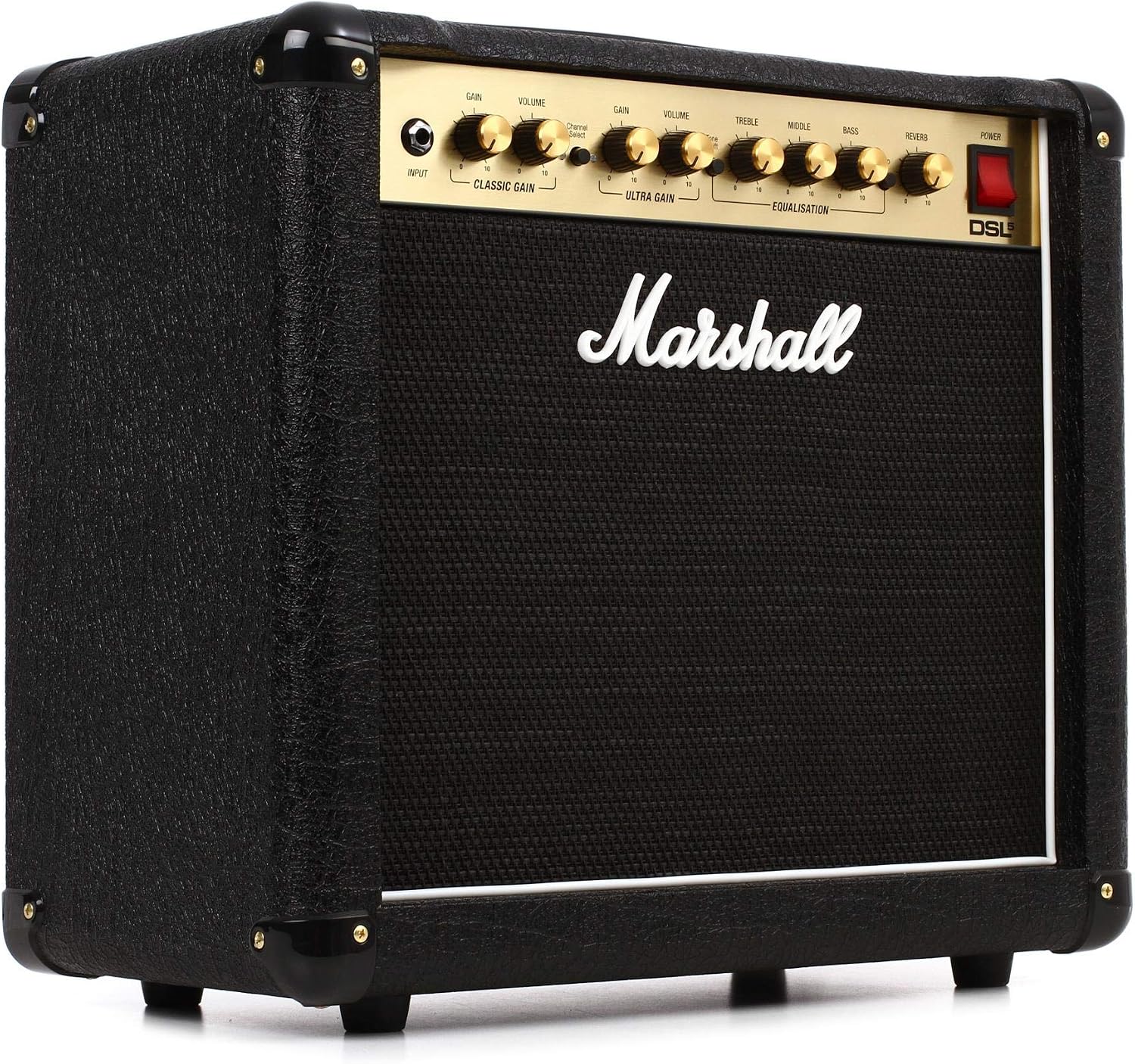
The DSL5CR brings the familiar Marshall clean-to-crunch approach into a five-watt combo with a ten-inch Celestion Ten-30 speaker. Classic Gain and Ultra Gain each have their own gain and volume controls, so a cleaner rhythm setting and a more saturated lead sound can coexist without rebuilding the settings between songs.
A shared three-band EQ, Tone Shift and Deep switches offer considerably more shaping than the Monoprice’s single tone control. Digital reverb adds space, while the series effects loop gives delay and modulation pedals a useful connection point after the preamp. The supplied footswitch handles channel selection, making the two-channel layout practical rather than merely decorative.
Power reduction takes the output down to half a watt, and the speaker-emulated output is useful for practice and recording connections. Neither feature makes the ten-inch speaker sound exactly like a large stage cabinet, and half a watt can still be lively at home. It is the stronger choice for players who want several levels of gain and more pedal-routing flexibility, though its roughly 28-pound weight is less convenient than the smallest combos here.
Pros
- Two gain channels with separate gain and volume controls
- Three-band EQ, digital reverb and a series effects loop
- Half-watt mode and included channel footswitch
Cons
- Shared EQ rather than a separate EQ for each channel
- Heavier and more involved than the simplest practice combos
Fender Super Champ X2 Tube Amplifier

The Super Champ X2 combines a fifteen-watt tube power section with digital voicings and effects. Its pair of 6V6 output tubes feeds a ten-inch Fender Special Design speaker, giving it a different brief from the one- and five-watt practice amps: it has more room for clean playing and a broader built-in sound palette.
Channel one concentrates on a Fender-style clean voice. Channel two offers sixteen voicings, covering tweed and blackface-inspired sounds alongside British and heavier options. Fifteen effect selections include reverb, delay, chorus and tremolo, with a tap button for timing or modulation adjustments. These are useful tools for exploring styles without immediately assembling a pedalboard.
The USB output supports speaker-emulated recording, and the line output offers another connection for recording or sound reinforcement. The trade-off is a hybrid approach rather than a purely analog signal path, plus fewer dedicated effect controls than separate pedals provide. Fifteen watts can also be quite loud when pushed. Choose it for variety and clean headroom, not because it is the quietest way to drive a tube output stage.
Pros
- Fifteen-watt tube power section and ten-inch speaker
- Sixteen channel-two voicings and fifteen effect selections
- USB recording and a line output
Cons
- Digital voicing approach will not suit analog purists
- No low-power selector for quieter output-stage drive
Blackstar HT-1R Tube Combo Amplifier

The original HT-1R is the smallest-output choice here, using an ECC83 and an ECC82 in a one-watt combo with an eight-inch speaker. Its low-powered push-pull output stage is designed around home and studio use. It makes sense when a large amplifier’s stage volume is unnecessary and the guitar needs a compact, self-contained voice.
Gain and volume controls work with a clean/overdrive switch, rather than blending channels through a single knob. Blackstar’s ISF control changes the character of the tone network between American- and British-inspired responses, while reverb gives sustained notes some space. That is a useful amount of tonal range from a deliberately small control panel.
The speaker-emulated headphone/recording output disconnects the internal speaker when a plug is inserted, an important advantage for quiet practice. A line input also makes it easy to play along with an external source. The compromises are limited clean headroom and less detailed EQ adjustment than the Marshall; the compact speaker also cannot provide the physical bass response of a larger cabinet. Its strengths are convenience and accessible drive, not competing with an unmic’d drummer.
Pros
- One-watt design suited to home and studio use
- ISF tone shaping, overdrive switch and reverb
- Speaker-muted headphone/recording output and a line input
Cons
- Limited clean headroom for louder playing
- Single ISF control offers less precise EQ adjustment
The Main Features of Low-Watt Tube Amps
Low-watt tube amps can make a small guitar setup more manageable, but output power alone does not establish how quiet an amp will be. Speaker efficiency, cabinet size, gain settings and the room all matter. One watt through a guitar speaker can still be surprisingly loud, particularly in an apartment.
Separate preamp distortion from output-stage drive. Gain and master-volume controls can produce a driven sound at a lower listening level without requiring the power section to be pushed hard. A power-reduction switch offers another option, but it does not remove the need to set a sensible volume. For silent practice, a suitable headphone output is more useful than a small wattage figure by itself.
A smaller combo can be convenient for recording or a quiet rehearsal, while a louder band may need microphone support or more clean headroom. For a broader comparison, the guide to 50-watt guitar amps covers a different scale of setup. Battery operation is a separate feature: a compact mains-powered tube amp is not automatically suitable for busking away from an outlet.
Consider the controls as carefully as the tube complement. The Monoprice keeps things simple; the Marshall adds channel switching and an effects loop; the Fender supplies a wide digital palette; and the Blackstar includes a useful quiet-practice output. Guides to affordable tube amps and clean tube amps offer related starting points if budget or clean headroom is the priority.
Tube type is only one part of the sound. The Fender and Monoprice use 6V6 output tubes, but their circuits, speakers and controls give them very different roles. Use the specified replacement type and appropriate servicing rather than assuming a tube swap will turn one design into another.
Conclusion: The Best Low-Watt Tube Amp?
The Monoprice Stage Right remains the overall choice for a compact, uncomplicated tube combo with a useful low-power setting. The Marshall DSL5CR offers more gain control and pedal flexibility, while the Fender Super Champ X2 suits players who want clean headroom and a wide range of built-in voices.
The Blackstar HT-1R is especially appealing when a small footprint and headphone practice matter. Pick the features that fit the room and playing style: the best choice is the one that sounds useful at the level it will actually be played.