The best melodica combines a comfortable keyboard with a sound that responds to the breath. It is a genuinely portable acoustic instrument: no amplifier is required for practice, and changing the airflow can shape a phrase in a way a basic electronic keyboard cannot.

These five melodicas offer either 32 or 37 keys, with different cases, mouthpieces and construction details. A 32-key model keeps the instrument compact; 37 keys give more room for melodies and accompaniment. The useful choice depends on how you plan to hold, play and carry it.
Best Melodicas — Comparison Table
| Image | Model | Price |
|---|---|---|
| Hohner 32B (Editor's Choice) | Check Price |
 | D'Luca M37-BK | Check Price |
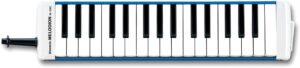 | Suzuki M-32C Alto Melodion | Check Price |
 | Yamaha P-32D Pianica | Check Price |
 | Yamaha P-37D Pianica | Check Price |
Hohner 32B (Editor’s Choice)
The Hohner 32B is the overall choice for a straightforward, portable melodica with a manageable 32-key layout. Its range runs from F3 to C6, giving enough room for many melodies without the length of a 37-key instrument. The ergonomic mouthpiece is a practical part of that simple, hand-held format.
Its sound comes from free reeds driven by the breath, so note starts and volume can be shaped directly. That makes it rewarding for short melodic phrases, sustained lines and rhythmic chord accents. The appeal is expression through airflow, rather than a selection of electronic voices or effects.
A plastic hard case protects the keyboard during transport. The compromise is range: pieces that extend beyond its upper C need a different arrangement or a larger model. Choose the 32B for a clear, uncomplicated playing format, and follow the instrument’s care instructions to remove moisture after use.
Pros
- 32-key range in a compact format.
- Ergonomic mouthpiece.
- Included plastic hard case.
Cons
- Less upper range than the 37-key models.
- Sustained chords require more breath than single-note lines.
D’Luca M37-BK
The D’Luca M37-BK offers 37 piano-style keys for a player who wants a wider keyboard than the 32-key options. The extra keys can make an arrangement easier to keep in its original register, particularly when a melody and simple accompaniment need to share the available space.
A direct mouthpiece and extension hose support two practical ways of playing. The short mouthpiece suits holding the instrument, while the hose lets it rest on a table so both hands can approach the keys. The supplied zippered protective bag holds the instrument and accessories without the bulk of a molded hard case.
The wider keyboard gives the player more room while retaining a simple, breath-powered format. The trade-off is carrying protection: a soft bag is convenient to pack but less rigid than the hard cases elsewhere in this group. Choose the D’Luca for its 37-key layout and flexible playing position when straightforward portability is the priority.
Pros
- 37 piano-style keys.
- Direct mouthpiece and extension hose.
- Zippered protective bag.
Cons
- Soft bag provides less rigid protection than a hard case.
- Longer keyboard takes more carrying space than a 32-key model.
Suzuki M-32C Alto Melodion
The M-32C has the clearest construction distinction among the 32-key options: a steel cover and phosphor-bronze reeds. Suzuki positions it as an educational alto Melodion, but the familiar keyboard and breath-shaped notes also suit a musician looking for a compact instrument for melodic parts.
Its 32-key F-to-C range keeps the keyboard relatively short. A direct mouthpiece and flexible playing tube are included, and the hard case can open into a music-rest arrangement. That is useful for learning from a page without needing to balance the instrument and sheet music in the same hand.
At 765 g for the instrument alone, it is a substantial compact instrument rather than an ultralight novelty. The range remains smaller than a 37-key model, so check the music you want to play. Choose the M-32C for its metal cover, specified reed material and useful case design.
Pros
- Steel cover and phosphor-bronze reeds.
- Direct mouthpiece and flexible playing tube.
- Hard case can serve as a music rest.
Cons
- 32 keys offer less range than the 37-key models.
- 765 g instrument weight, before adding the case.
Yamaha P-32D Pianica
The P-32D is a strong choice for a player who wants the compact 32-key format with Yamaha’s familiar blue Pianica design. Its F3-to-C6 range covers a little over two and a half octaves, providing useful melodic space while keeping the body shorter than the P-37D below.
The included fixed mouthpiece and flexible tube let it move between hand-held and table-top playing. A hard plastic case keeps those parts together and gives the keyboard rigid protection in a bag. The controls remain entirely acoustic: the breath starts the sound, and the keys select the notes.
The limitation is the same useful distinction that defines this model: compactness comes with fewer keys. For music that regularly reaches above C6, the P-37D offers more room. Choose the P-32D for a practical lesson-and-practice instrument with both playing attachments and a hard case, rather than buying extra range that will rarely be used.
Pros
- 32-key F3–C6 range.
- Fixed mouthpiece and flexible tube included.
- Hard plastic carrying case.
Cons
- Upper range ends at C6.
- No built-in electronic effects or amplified output.
Yamaha P-37D Pianica
The P-37D is the natural step up when range matters more than the smallest possible body. Its 37 keys extend from F3 to F6, covering three full octaves. That extra upper space can make a melody or accompaniment easier to arrange without shifting notes to another register.
The maroon body and matching case give it a distinctive look beside the blue P-32D. Yamaha supplies playing attachments for direct and tube-based use, so it can be held or placed on a table. The wider keyboard remains fully acoustic, with phrasing and dynamics shaped by airflow rather than a volume control.
The trade-off is carrying size: a longer keyboard takes more room and more reach than a 32-key model. Routine moisture removal matters just as much as on the smaller instruments; the drain facility is for normal care, not a reason to dismantle the body. Choose the P-37D when its three-octave range solves a real musical need.
Pros
- 37 keys and a full F3–F6 range.
- Direct and tube-based playing options.
- Matching carrying case.
Cons
- Larger than the 32-key alternatives.
- Requires breath control for sustained chords and phrases.
Best Melodica: Buying Guide
What Is a Melodica?
A melodica is a free-reed wind instrument with a keyboard. Air from the mouthpiece makes the reeds sound when keys open their air passages. It shares aspects of harmonicas and accordions, but its keyboard and breath control give it a playing approach of its own. Pianica and Melodion are names used by Yamaha and Suzuki for their instruments.
Keys and Octave Range
Count the actual notes needed, rather than choosing by key count alone. The 32-key F3–C6 format covers two octaves plus a fifth; the 37-key F3–F6 format covers three octaves. A compact instrument can suit single-line playing, while more keys provide room for wider melodies and accompaniment.
Sound
Airflow, articulation and the number of notes played together shape the result. A melodica produces its sound acoustically; comparisons with harmonicas or accordions describe its reedy character, not separate selectable voices. Listen to examples of the exact model when possible, and consider how it will sit beside the other instruments.
Weight and Durability
Compare the instrument’s weight with the total carrying weight, including its case. A hard case offers more rigid protection, while a soft bag can be easier to pack. Plastic construction alone does not make a melodica a toy or prove that it will last for years. Protect the keyboard and playing attachments during transport.
Tuning
Reference pitch is a model-specific specification, not an automatic consequence of price. Check the manufacturer’s specification for the exact model. Breath pressure and temperature can affect pitch, so compare sustained notes with a tuner under normal playing conditions. Reed adjustment is specialist work, not a routine beginner repair.
Breath and Action
Single-note phrases and full chords place different demands on the airflow. Start with relaxed, steady breathing and avoid forcing the instrument. A flexible tube lets the body rest on a table; a short mouthpiece makes hand-held playing more direct. Pick the arrangement that suits the music and the player’s posture.
Cleaning
Follow the exact model’s moisture-removal instructions after playing. Yamaha’s Pianica instructions use the water-drain button for clearing moisture; removable playing attachments should be cleaned and dried as directed. Do not immerse the instrument, pour cleaning liquid into the reed body or open the covers for ordinary care. Clean hands and dry storage help keep the keyboard and case in good condition.
The Best Melodica: Final Thoughts
The Hohner 32B is the overall choice for a compact, uncomplicated 32-key instrument. Suzuki’s M-32C adds a steel cover and phosphor-bronze reeds, while Yamaha’s P-32D combines the smaller format with a hard case and both playing attachments. When more range is needed, compare the D’Luca M37-BK and Yamaha P-37D. Choose the keyboard size and carrying format that support the music, then develop the breath control that makes a melodica expressive.