The best 6.5 component speakers give you more freedom to position the tweeters and build a balanced front soundstage. That can be a useful step beyond tired factory speakers, provided the system suits the mounting space, amplifier and installation.

These seven component systems offer different approaches to that upgrade. The Rockford Fosgate P165-SI is the overall pick for its integrated crossover and practical mounting design; the Alpines offer useful choices for compact or more powerful systems. To find the best 6.5 component speakers for the money, compare the features you will actually use rather than the largest peak-power number.
Top 7 Best 6.5 Component Speakers
Rockford Fosgate P165-SI (Editor’s Choice)
The P165-SI is the overall choice for someone who wants the placement advantages of separate tweeters without finding room for external crossover boxes. The filtering is built into the woofer basket, so the amplifier feeds the main terminals and the tweeter connects to the designated secondary terminals. It is a tidy solution for a crowded door installation.
The 6.5-inch mineral-filled polypropylene woofer uses a Santoprene surround, while a separate 1-inch PEI dome handles the treble. Rockford’s VAST surround arrangement makes more of the available cone area within the frame. The system is rated at 60 watts RMS per channel at 4 ohms, a useful fit for a modest amplified setup rather than an invitation to chase peak wattage.
FlexFit2 mounting slots allow adjustment when lining up the woofer with the fixing points, and the tweeters have flush and angled surface-mount options. Those are worthwhile installation features because tweeter position can strongly affect the soundstage. Neither the slots nor the nominal size guarantee a direct fit in every factory opening.
The trade-off is less crossover adjustment than some separate-network systems provide. Choose the Rockford for a cleaner installation and a sensible full-range foundation; choose a more adjustable network if fine control of the tweeter level is central to the project.
Pros
- Integrated crossover avoids separate filter boxes
- FlexFit2 slots and multiple tweeter mounting options
- 60W RMS per channel with a conventional 4-ohm load
Cons
- Less crossover adjustment than some external-network systems
- Separate tweeters still need suitable mounting positions
Alpine S-S65C

The S-S65C is the compact Alpine option for a straightforward component upgrade. Its 6.5-inch woofer uses a carbon-fiber-reinforced plastic cone and Alpine’s HAMR surround, pairing a reinforced diaphragm with a surround designed to accommodate controlled cone movement. The 58mm woofer mounting depth is a useful starting point when space behind the trim is limited.
The separate silk-dome tweeter can be angled to suit its location. That gives the installer a practical way to work on the balance and direction of the high frequencies, rather than accepting the position of a tweeter fixed over the woofer. It is particularly relevant when the factory tweeter location points away from the listener.
Alpine rates the system at 80 watts RMS per channel. That provides useful scope for suitable amplification, while the compact network arrangement keeps the installation from becoming unnecessarily bulky. This is the original S-S65C; its specifications should not be confused with the later S2-S65C.
Its strength is the combination of a reinforced cone, adjustable tweeter direction and manageable physical dimensions. The limitation is the familiar one for a door-mounted midwoofer: it can support the main body of the music, but deep bass still benefits from a dedicated subwoofer and appropriate filtering.
Pros
- CFRP woofer cone and HAMR surround
- Angled tweeter positioning helps with placement
- 58mm woofer depth and 80W RMS handling per channel
Cons
- Not a substitute for a subwoofer
- Fewer tuning options than the more elaborate Type-R network
Alpine SPR-60C

The SPR-60C makes sense when the installation is being built around an amplifier and the tweeter balance deserves more attention. Its 110-watt RMS rating per channel at 4 ohms is higher than the Rockford and original S-Series ratings here. That gives more power-handling scope, although it is not a guarantee of better sound at every volume.
The woofer combines a hybrid multilayer cone, HAMR surround and a compact neodymium motor. Alpine also uses a waveguide over the center of the cone as part of its approach to controlling the response. With a 59mm mounting depth, the woofer remains relatively manageable for this type of amplified component installation.
The separate 1-inch ring tweeter swivels, and the compact network offers four attenuation settings: 0, -2, -4 and -6dB. That is useful adjustment when a dashboard or sail-panel location makes the tweeter too prominent. The network is also bi-amp ready for an appropriately designed system.
The additional capability brings more setup decisions. Tweeter level, amplifier settings and placement need to work together; the speaker does not become distortion-proof because it carries a Type-R badge. Choose it for power-handling headroom and practical tuning options, rather than expecting a louder version of the simpler S-Series.
Pros
- 110W RMS per channel at 4 ohms
- Swiveling ring tweeter with four attenuation settings
- Compact network with bi-amp-ready design
Cons
- More setup decisions than the integrated-crossover Rockford
- Requires suitable amplification and adjustment to use its extra capacity
Infinity Reference 6030cs

The Reference 6030cs is the low-impedance alternative in this group. Its 2-ohm rating is a meaningful system-design difference, not just another number on the specification sheet: the amplifier must be comfortable with the resulting load. That deserves attention before replacing a conventional 4-ohm factory speaker.
Infinity specifies 90 watts RMS handling per channel, with a separate tweeter and outboard crossover for each side. The tweeter mounting hardware offers options for positioning it apart from the woofer, which is one of the main reasons to choose a component system. The crossover then divides the frequency ranges between the two drivers.
The published 93dB sensitivity figure uses a 2.83V, one-meter reference. On a nominal 2-ohm load, that is not the same input power as a one-watt sensitivity measurement, so the figure should not be used as a shortcut to call this the loudest system here.
The 6030cs is worth considering when the amplifier and mounting arrangement suit its design. The compromise is the need to plan around that lower impedance and find protected space for the external networks. A more powerful amplifier alone will not turn its midwoofers into a source of subwoofer-depth bass.
Pros
- 90W RMS handling per channel
- Separate tweeters and external crossover networks
- Flexible tweeter installation hardware
Cons
- 2-ohm load requires a compatible amplifier
- External networks need mounting space
Polk Audio DB6501

The DB6501 stands out for its combination of a separate soft-dome tweeter, an adjustable crossover and marine-certified construction. The woofer uses a polymer/mica composite cone with a butyl-rubber surround, a purposeful combination for a speaker that may face heat and humidity in a vehicle.
The 1-inch silk/polymer dome gives the high-frequency driver its own mounting location. Its external crossover includes tweeter-level adjustment, allowing the balance to be altered without changing the entire amplifier equalization. That is useful when the chosen tweeter position makes the treble more prominent than expected.
Polk rates the 4-ohm system at 100 watts continuous per channel. The supplied adapter arrangement can help with some 6.5- and 6.75-inch applications, but the cutout, mounting depth and grille clearance remain specific to the vehicle. Marine certification is an environmental-resistance feature, not permission to submerge the speakers or leave the wiring unprotected.
The appeal is a well-equipped component system for someone who wants a soft-dome tweeter and some adjustment at the network. The compromise is installation space: the external crossovers need a secure, dry location, and the separate drivers take more planning than a coaxial replacement.
Pros
- Separate silk/polymer tweeters with level adjustment
- Polymer/mica woofers and butyl surrounds
- Marine-certified design and 100W continuous rating per channel
Cons
- External crossovers need a protected mounting location
- Certification does not make the installation waterproof
JBL GTO608C

The GTO608C brings a different high-frequency design to the list: JBL’s edge-driven MyTi tweeter, paired with a Plus One woofer cone. The separate tweeter can be positioned independently of the woofer, while the outboard crossover provides the filtering and tweeter-level control needed to bring the two together.
The system is rated at 70 watts RMS per channel and presents a nominal 2-ohm load. As with the Infinity, amplifier compatibility matters more than a blanket claim that it works with every factory radio. The lower impedance can demand more current from the amplifier, so check the equipment specification rather than relying on the size of the speaker opening.
JBL specifies a 52mm woofer mounting depth, which is a useful physical detail in a component installation. The tweeter mounting options add flexibility, but its position and level still influence the balance at the listening seat. The level control is there to help with that integration, not to promise the same result in every cabin.
Choose the GTO608C for its compact woofer depth, separate MyTi tweeter and adjustable external network when the amplifier supports the load. It is less convenient for a simple plug-in replacement, because the crossover and separate tweeter both need appropriate mounting space.
Pros
- 52mm woofer mounting depth
- Separate edge-driven MyTi tweeters
- External crossovers with tweeter-level control
Cons
- 2-ohm load needs an appropriate amplifier
- More installation work than a single coaxial speaker
JL Audio C2-650
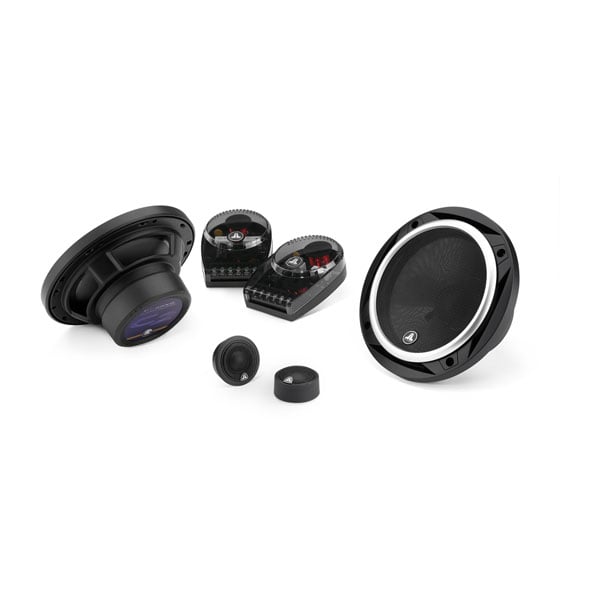
The C2-650 is the option for someone who values a conventional component layout with separate crossover filtering. Its 6.5-inch mineral-filled polypropylene woofer is paired with a separate 3/4-inch silk-dome tweeter, keeping the lower and higher frequencies in drivers that can be positioned for their different jobs.
The external networks provide the division between the woofer and tweeter, and the tweeter mounting hardware supports flush or surface installation. That gives the system more placement freedom than a coaxial speaker, but also makes careful planning worthwhile. There is little benefit in buying separate drivers and then putting the tweeters wherever the wiring happens to reach.
JL rates the 4-ohm system at 60 watts RMS per channel. The 62mm woofer mounting depth is another useful planning detail; the magnet and frame must clear the structure behind the trim. The midwoofer remains part of a full-range front system rather than a substitute for dedicated low-bass reinforcement.
The C2’s appeal is its coherent set of component-system features: a separate silk dome, external filtering and several mounting options. Its limitation is the extra hardware to install and accommodate. Choose it when that flexibility is useful to the build, rather than expecting the brand alone to remove the need for setup.
Pros
- Separate 3/4-inch silk-dome tweeters
- Mineral-filled polypropylene woofers
- Flush and surface tweeter mounting options
Cons
- 62mm woofer depth needs adequate clearance
- External crossover boxes add installation work
How to Choose the Best 6.5 Car Speakers
Start with the installation and the system you want to build. A component set offers more placement freedom than a coaxial, but that freedom is useful only when there is room to mount and connect the drivers properly.
Basics
A typical two-way component system includes midwoofers, separate tweeters and passive crossover networks. The midwoofers handle the lower and middle frequencies; the tweeters handle the high frequencies. Some systems conceal the filtering in the woofer assembly, while others use separate boxes.
Moving the tweeters away from a low door position can help with soundstage placement, but aiming and level matter. Use the supplied network and wiring arrangement rather than connecting an unprotected tweeter directly to a full-range amplifier output.
Features You Should Know
Check continuous power handling, nominal impedance and the actual mounting dimensions. A low-impedance system needs an amplifier rated for that load. Peak power is not the normal operating target, and a larger sensitivity number is not automatically comparable when the measurement reference differs.
Cone and tweeter materials describe the construction, not a guaranteed listening result. Reinforced cones, silk domes and metal-composite tweeters each form part of a wider design. The door mounting, grille and equalization also affect what reaches the listener.
How Serious of a Buyer Are You?
For a straightforward refresh, practical mounting hardware and an integrated or compact network may be more useful than extensive adjustment. For a planned amplified system, tweeter-level settings and a network designed for the intended wiring can be worth the extra installation work.
A secure mounting surface, a good seal and sensible filtering help the speakers work as intended. If deep bass is the main goal, plan for a subwoofer rather than forcing a door midwoofer to reproduce the lowest notes with heavy bass boost.
Something You Should Know About Crossover Systems
A passive crossover divides the amplified signal between the drivers. It does not need a separate power supply, and a supplied network is designed around the matching speakers. It still needs mounting space unless it is integrated into a driver assembly.
An active crossover or DSP normally divides the signal before the power amplifiers. That can provide more control over level, crossover points and timing, but it usually needs separate amplification channels and careful setup for the individual drivers. Active operation is not automatically better; incorrect settings can damage a tweeter.
The Best 6.5 Component Car Speakers: Final Thoughts
The Rockford Fosgate P165-SI remains the overall pick for a practical component upgrade, with integrated filtering and useful mounting options. The Alpine S-S65C keeps the design compact, while the SPR-60C adds higher power handling and more tweeter adjustment.
The Infinity and JBL offer low-impedance alternatives for a compatible amplifier, the Polk adds marine-certified construction, and the JL Audio provides a conventional silk-dome component system. Choose the set that fits the actual vehicle and the way you plan to use it; a good installation is part of the upgrade.