Looking for the best guitar amp attenuators to bring a loud valve amp under control? A speaker attenuator sits between the amplifier and its speaker, reducing the power reaching the cabinet while letting you use the amp settings you prefer.
For another guitar-amp requirement, compare our separate guide to 50-Watt Guitar Amp.
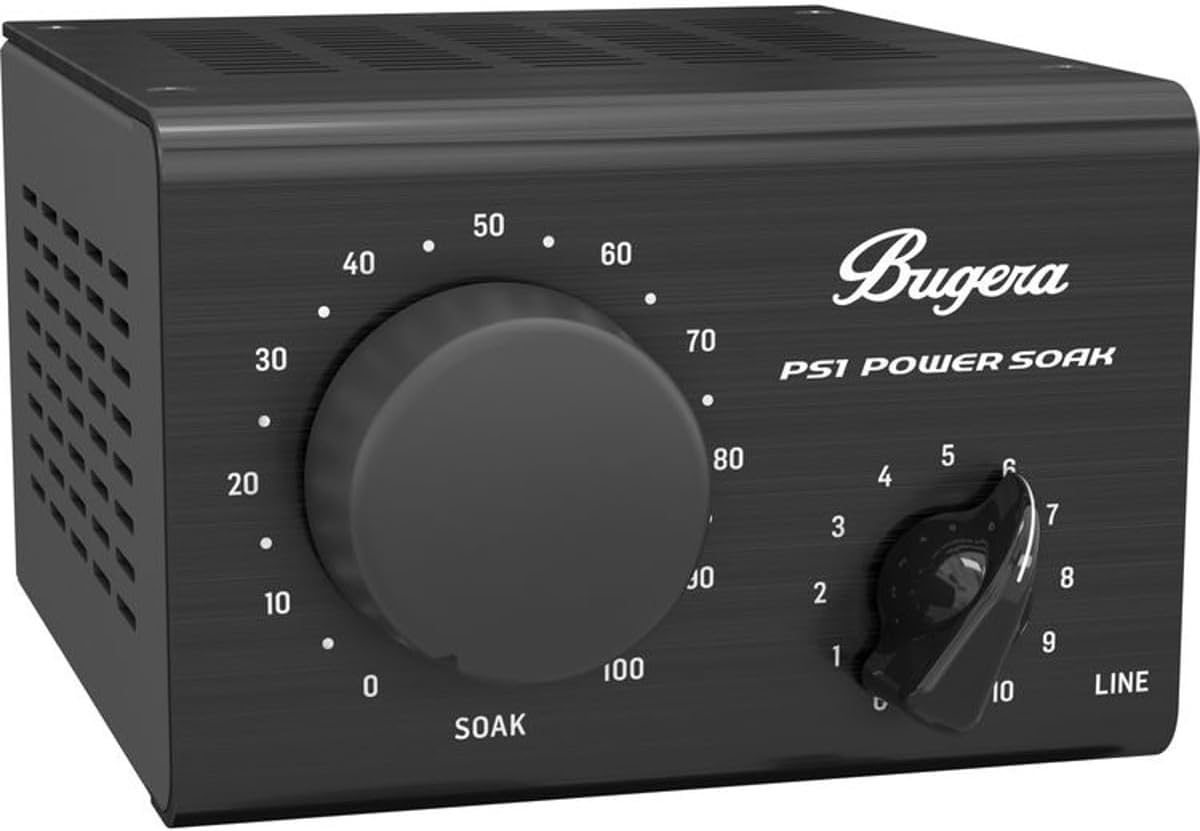
These five options range from simple volume controls to a reactive loadbox with recording outputs. The Bugera PS1 is the overall pick for straightforward adjustment and separate impedance inputs. For any model, power handling and the correct amplifier connection matter more than the number of extra features.
Top 5 Best Guitar Amp Attenuators
Bugera PS1 (Editor’s Choice)
The PS1 keeps the main job refreshingly simple. A large Soak control adjusts the level reaching the speaker, while separate 4-, 8- and 16-ohm input jacks make it useful across different compatible amp-and-cabinet setups. It is a passive speaker attenuator, so its basic operation needs no external power supply.
There are useful recording connections beyond that large knob. The balanced XLR Emulated Mic output supplies a speaker-and-microphone-style signal for a mixer, while the separate line output has its own level control and no speaker simulation. Those are different tools for different destinations, not interchangeable speaker connections.
The PS1 earns the overall recommendation for direct volume adjustment and a practical selection of connections. Its limitations are worth understanding: it has no full-volume bypass, and the manual says the speaker receives about half the amp’s output power even with Soak at 100. The 100-watt input limit also calls for care with powerful amps; prolonged operation at that limit can trigger thermal protection.
Pros
- Continuously adjustable speaker level
- Separate 4-, 8- and 16-ohm amp inputs
- Emulated XLR and independently controlled line outputs
Cons
- No full-volume bypass
- Thermal and input-power limits matter with powerful amps
Two Notes Torpedo Captor 8 Ω
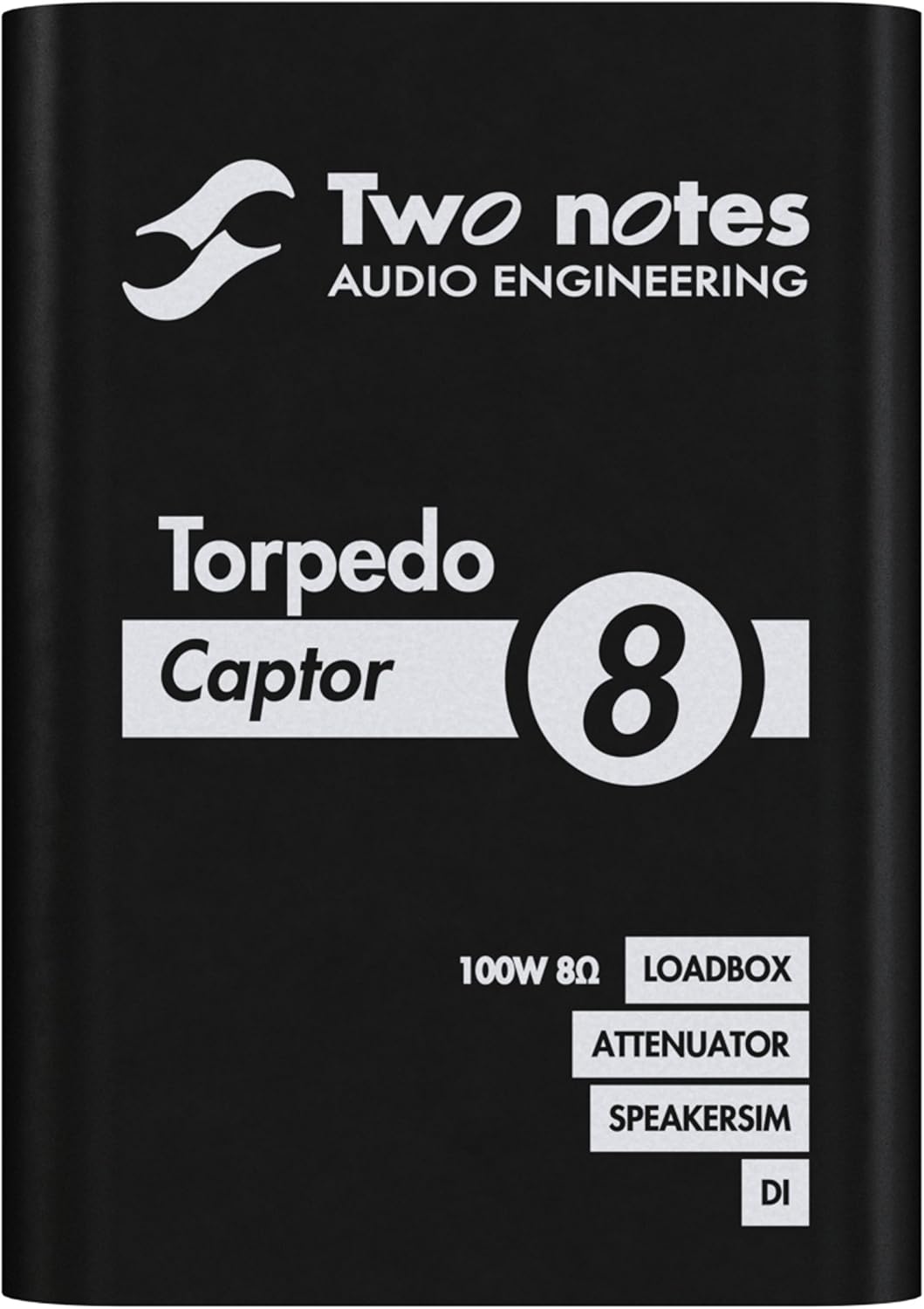
The Captor combines a reactive loadbox, attenuator and direct-recording connections in one compact unit. This is the original 8-ohm Captor, not the Captor X. Its reactive load is designed to present a speaker-like load to the amplifier, making it particularly interesting when recording is as important as reducing cabinet volume.
The cabinet connections offer a clear choice: Thru passes the unattenuated signal, while Att provides a fixed 20 dB reduction. That substantial reduction is convenient when it lands at the level you need, but there is no knob for smaller steps. A dry line output and an active XLR DI with analog guitar/bass speaker simulation provide further routing options.
The loadbox and attenuation functions work without external power; the XLR DI and speaker simulation need phantom power or a suitable supply. The 8-ohm input must match the amp’s selected speaker output, and the maximum admissible power is 100 watts RMS. Choose the Captor for its loadbox and direct-recording flexibility, accepting that its cabinet attenuation is fixed rather than continuously adjustable.
Pros
- Reactive loadbox supports use without a cabinet
- Fixed attenuation plus an unattenuated Thru output
- Dry line output and active DI with analog speaker simulation
Cons
- Fixed 20 dB reduction rather than adjustable speaker level
- This version has a fixed 8-ohm input impedance
KLD/PAN PB-1

The PB-1 takes a useful two-stage approach to volume control. Its Attenuation switch provides repeatable settings, while the Studio Level control offers finer adjustment once a deeper reduction is needed. The controls are easy to distinguish, which is helpful when returning to a familiar stage or practice setting.
KLD describes the design as resistor-based. The rotary switch includes true bypass and attenuation steps of 1.8 dB; the Studio Level rheostat extends the adjustment from 7.2 dB down to 30 dB of reduction. The aluminum enclosure also forms part of the heat-dissipation arrangement.
This is a straightforward choice for someone who prefers a stepped main control with additional fine adjustment. The trade-off is that a resistive load does not duplicate a speaker’s changing impedance, and a large reduction can alter the feel and tonal balance. Use it within the manufacturer’s power limits and match the amp and cabinet correctly; it is not an unrestricted impedance converter.
Pros
- Stepped settings are easy to repeat
- Studio Level adds finer adjustment
- True-bypass setting
Cons
- Resistive design does not reproduce a speaker impedance curve
- Deep attenuation can change tonal balance
Carl’s Custom Guitars Speaker Soak 16 Ω
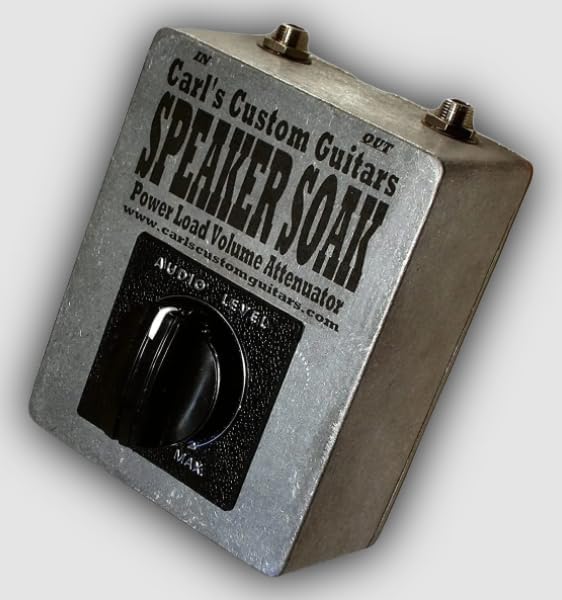
The Speaker Soak is the stripped-back option for a compatible amplifier. One control sets the attenuation, with speaker-level In and Out connections rather than a bank of recording features. This exact model is the 16-ohm version, intended for amps of 50 watts or less.
That simplicity is its strongest quality. It lets a player reduce cabinet volume without adding another set of effects or amp voices to learn. The compact metal enclosure and single-knob layout suit a small rig where the amp already supplies the desired sound.
The limitations follow from the same focused design: there is no separate DI or cabinet-simulated recording output, and the fixed impedance restricts its application. Connect it between the amp’s speaker output and a suitable speaker load, not in an effects loop. It is a practical choice for basic attenuation when the amplifier fits its specifications, rather than a universal solution for every amp.
Pros
- Simple single-control operation
- Compact metal enclosure
- Dedicated 16-ohm speaker-attenuator version
Cons
- Fixed 16-ohm application and 50-watt limit
- No separate DI or speaker-simulation output
Weber MicroMASS

The MicroMASS is particularly appealing for a small valve amp that still needs taming. Weber uses a moving speaker motor as part of the load, giving the amplifier a more speaker-like interaction than a purely resistive design. Despite the 15-watt model name, Weber recommends it for amplifiers rated at 10 watts or less.
Its two controls split the task between Lows-Mids and Mids-Highs. The first sets the main volume behavior, while the second lets you shape the upper range as attenuation increases. The treble control’s effect depends on the main setting, so the knobs work together rather than acting like independent amplifier EQ controls.
Weber specifies compatibility with 4-, 8- and 16-ohm amps, plus bypass and an unbalanced line output. The line signal follows the amp settings and has no dedicated level knob. This is a useful specialist choice for lower-powered amps and tonal adjustment; the limited power capacity rules it out as a general-purpose partner for larger heads.
Pros
- Speaker-motor load
- Separate control over lower and upper frequency ranges
- Supports 4-, 8- and 16-ohm amp applications
Cons
- Recommended for amps of 10 watts or less
- Line output has no dedicated level control
How to Choose the Right Guitar Amp Attenuator
Start with the amplifier and cabinet, then choose the features. A speaker attenuator connects to the amp’s speaker output and must handle the actual output power and required load. Use proper speaker cables for the amplifier-to-attenuator and attenuator-to-cabinet connections. An effects-loop volume control operates at a different point in the circuit and cannot replace a speaker load.
Passive or Active Attenuator?
A passive attenuator reduces the power reaching the speaker without needing a powered amplification stage. Its load can be resistive or reactive; those terms describe the electrical behavior, not simply whether a power supply is present.
Some active load-and-reamp systems absorb the original amp’s output and use another powered stage to drive a cabinet. They can offer additional level control, but not every loadbox with a powered DI is an active reamplifier. The Captor, for example, needs power for its DI functions while its load and attenuation remain passive.
Power Scaling
Power scaling changes how the amplifier’s output stage operates, rather than absorbing power between the output and the speaker. It is a different approach from an external speaker attenuator. Use an amp’s built-in implementation as instructed; adding it internally is a job for a qualified amplifier technician.
Reliability and Heat
An attenuator turns unwanted output power into heat. Give it the ventilation the manufacturer specifies, and respect its power limits. Driving an amp hard still places demands on its valves and other components even when the cabinet is quieter.
Power ratings also need interpretation. A valve amp driven into distortion can exceed its nominal clean output, and manufacturers may recommend substantial headroom. Weber’s 15-watt MicroMASS, for example, is recommended for amps of 10 watts or less. Follow each model’s instructions rather than assuming equal wattage figures make a safe pairing.
Impedance Matching
Match the amplifier’s speaker-output setting to the attenuator’s required input impedance. Follow its instructions for the cabinet connection too, especially when bypass or Thru disconnects the internal load. An 8-ohm Captor and a 16-ohm Speaker Soak are not interchangeable versions of a universal box.
A valve amp must always see a suitable load when operating. Disconnecting the cabinet for silent recording is appropriate only when the connected loadbox explicitly supports that use and is configured correctly. A line output alone does not establish that a device can replace the speaker load.
Conclusion: the Best Guitar Amp Attenuators
The Bugera PS1 is the overall choice for straightforward speaker-level adjustment and useful output connections. The Captor is more attractive when reactive loading and direct recording matter, while the MicroMASS suits lower-powered amps and more tonal adjustment. The PB-1 and Speaker Soak keep the focus on simpler volume control.
Choose the right electrical match first, then decide whether you need stepped or continuous adjustment, a recording output or genuine silent-load operation. A guitar amp with suitable low-volume features or an amp with a headphone connection may be a simpler solution when quiet practice is the main aim.
For switching or routing an instrument between amplifiers, see ABY Pedal; routing is a different function from attenuation.