What is the best subwoofer under $500? A useful choice adds weight to music and movie soundtracks while blending with the speakers already in the room. Driver size, connections and adjustment controls matter more than the largest peak-wattage figure on the box.

The six models below include established 12-inch designs and two smaller Yamaha options. Several are older models, so treat the budget as a ceiling to check against current availability rather than a fixed price promise. The PL-200 remains the overall pick here; the individual reviews explain where each design fits and what it asks of the rest of the system.
Best Subwoofers Under $500 – Comparison Table
| Image | Models | Features | Prices |
|---|---|---|---|
| BIC America PL-200 Subwoofer (Editor's Choice) | 12-inch driver | Check Price |
 | Klipsch R-12SW Subwoofer | 12-inch driver | Check Price |
 | BIC America F12 Subwoofer | 12-inch driver | Check Price |
 | Polk Audio PSW505 Subwoofer | 12-inch driver | Check Price |
 | Yamaha YST-SW216 Subwoofer | 10-inch driver | Check Details |
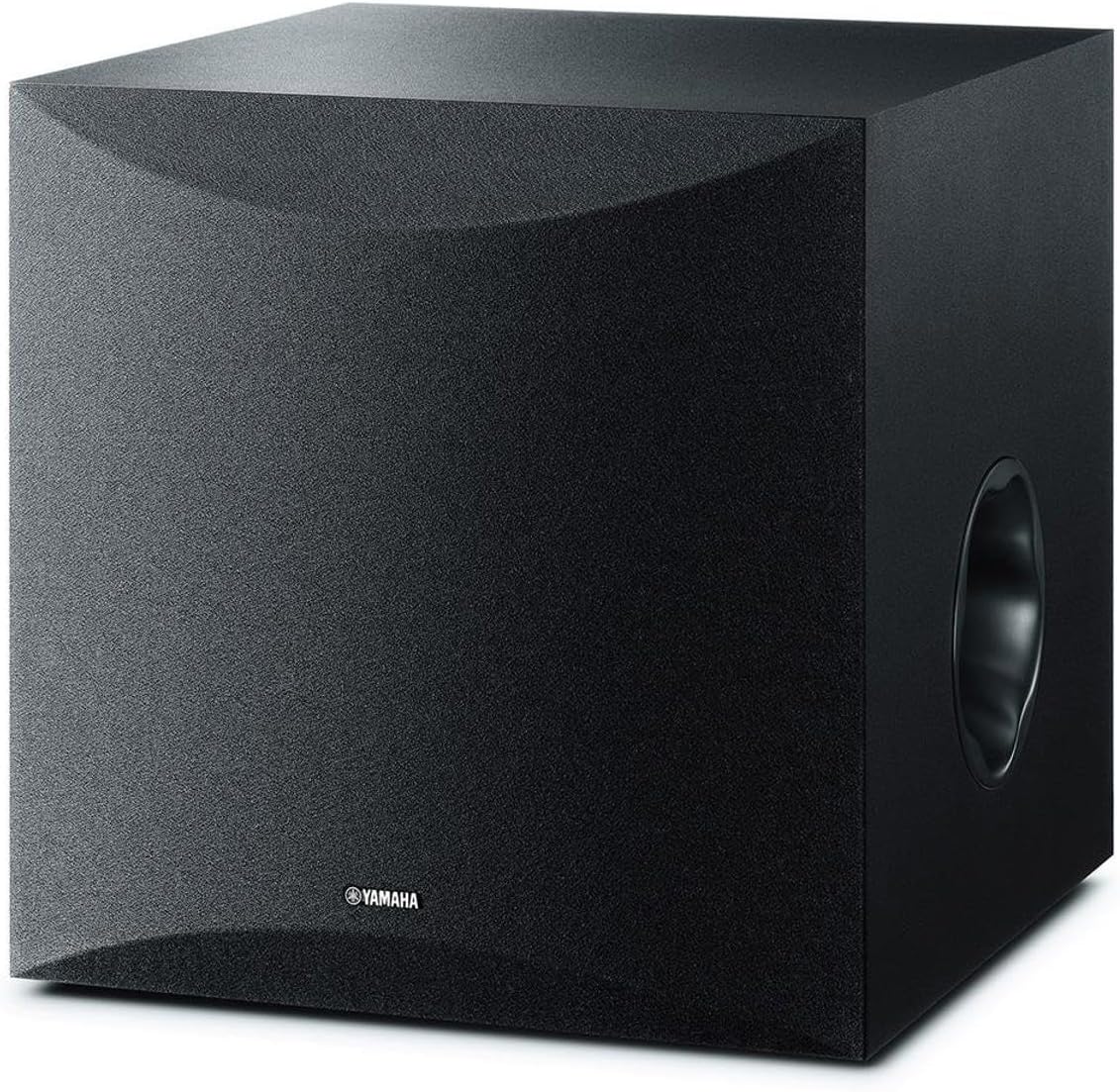 | Yamaha NS-SW100 Powered Subwoofer | 10-inch driver | Check Price |
BIC America PL-200 Subwoofer (Editor’s Choice)
The original PL-200 is a substantial 12-inch powered subwoofer with a front-firing long-throw driver and a rear bass port. The gloss-trimmed black cabinet and removable grille give it a fairly traditional appearance, but it needs real floor space rather than a spare corner of a bookshelf. Leave room for the rear port, amplifier ventilation and cable connections.
The BASH amplifier is rated at 250 watts RMS continuous and 1,000 watts dynamic peak. Those are different ratings: the peak figure is not continuous output. The combination of a large driver and a built-in amplifier makes this an appealing starting point for a conventional home theater, without needing a separate bass amplifier.
The rear panel provides level and crossover adjustments, a phase switch, automatic signal-sensing power and a crossover-bypass option. There are both a subwoofer-level RCA input and speaker-level terminals, giving it useful flexibility with different amplifiers. The controls are there to help blend the sub with the main speakers; turning them all up is not the same as achieving deeper or cleaner bass.
The PL-200 keeps the overall recommendation for its combination of amplifier capacity, a 12-inch driver and useful connection and adjustment options. Its main compromise is the large ported cabinet. Placement and room acoustics still determine how evenly the bass reaches the seat, so the specification is a starting point rather than a guarantee of cinema-scale output in every room.
Pros
- 12-inch long-throw driver with a 250-watt RMS BASH amplifier
- RCA and speaker-level connection options
- Level, crossover, phase and automatic-power controls
Cons
- Large cabinet and rear port need space
- Room placement still matters for balanced bass
Klipsch R-12SW Subwoofer
The R-12SW pairs a copper-colored 12-inch front-firing woofer with a black bass-reflex cabinet. It is unmistakably part of the Klipsch Reference family, especially with the grille removed. The built-in digital amplifier is advertised at 400 watts dynamic power, a peak-style figure that should not be compared directly with another subwoofer’s continuous rating.
Its line-level inputs make the normal home-theater connection straightforward: use the Left/LFE input with a receiver’s subwoofer output. Left and right preamp outputs can also feed the corresponding inputs. There are no speaker-level binding posts, so an older amplifier with only speaker outputs is a less direct match.
Level, low-pass and phase controls provide the main integration tools, with signal-sensing power for everyday use. When the receiver handles bass management, Klipsch instructs the user to turn the subwoofer’s low-pass control to its highest setting and set the crossover in the receiver. That avoids treating two separate filters as independent volume or bass-boost controls.
The R-12SW is an appealing fit for a receiver-based system that needs a conventional powered 12-inch sub. The substantial cabinet and rear port need breathing room, and corner placement should be a starting point to compare rather than a universal rule. It is a useful music-and-movie design, without a promise that every seat will receive the same bass response.
Pros
- 12-inch front-firing woofer and built-in digital amplifier
- Line/LFE inputs for a receiver or suitable preamp
- Adjustable low-pass, level and phase with automatic power
Cons
- No speaker-level inputs for a speaker-output-only amplifier
- Large rear-ported cabinet needs suitable placement
BIC America F12 Subwoofer
The F12 is the straightforward black-box option: a 12-inch front-firing driver, a removable grille and a rear port in a substantial cabinet. Its BASH-designed amplifier is rated at 150 watts RMS continuous and 475 watts dynamic peak. The continuous figure is the more useful reference when comparing it with the original PL-200’s stated continuous rating, though watts alone do not establish acoustic performance.
Connection flexibility is a strong part of the design. An RCA sub input works with a receiver’s bass output, while high-level inputs support an amplifier without that connection. The receiver/sub crossover selector lets the system use the receiver’s bass management or the F12’s own crossover as appropriate.
The rear panel also includes level, phase and power controls. Automatic signal sensing wakes the amplifier when bass arrives and returns it to standby after the signal stops. The phase switch is a way to compare how the sub and main speakers combine at the listening seat; it does not magically synchronize every driver throughout the room.
The F12 makes sense when a simple 12-inch sub with both low- and high-level connection options is the priority. Its controls are on the rear, and the large cabinet is less discreet than the Yamaha options below. Its strongest feature is the combination of familiar setup controls and connections that work with both receiver-based and older stereo systems.
Pros
- 12-inch driver and 150-watt RMS BASH-designed amplifier
- RCA and high-level inputs for different systems
- Crossover bypass, phase control and automatic signal sensing
Cons
- Large cabinet is not especially discreet
- Controls and status indicator are on the rear
Polk Audio PSW505 Subwoofer
The PSW505 combines a 12-inch Dynamic Balance woofer with a slot-loaded cabinet and a 300-watt RMS amplifier. The rear slot vent is designed to manage airflow and reduce port turbulence. That is a useful engineering feature, but it does not mean that distortion or room resonance disappears at every level.
Polk provides several ways into the system: speaker-level connections, filtered line-level inputs and a separate unfiltered LFE input. The LFE connection bypasses the subwoofer’s variable low-pass filter so that a receiver can handle bass management. Use the connection method that matches the amplifier rather than assuming every RCA socket behaves identically.
Level, low-pass and phase controls help integrate the PSW505 with the main speakers, while automatic power handles signal detection. Polk specifies a total response of 23–160Hz and a narrower 28–125Hz range at the stated −3dB limits. Those figures describe different conditions; neither establishes the response at a particular seat in a real room.
The attraction is a substantial powered design with useful input flexibility and a slot vent rather than a simple round rear port. It takes up significant floor space, and the older design lacks the app-based control found on some newer subs. For a traditional receiver or amplifier setup, the physical controls remain entirely workable.
Pros
- 12-inch Dynamic Balance driver and 300-watt RMS amplifier
- Separate LFE, line-level and speaker-level connection options
- Slot vent, adjustable controls and automatic power
Cons
- Substantial cabinet needs floor space
- Physical rear-panel adjustment rather than app-based control
Yamaha YST-SW216 Subwoofer
The YST-SW216 is the older, compact 10-inch Yamaha in this group. Its plain black cabinet and covered front driver are relatively unobtrusive, and Advanced YST II combines the amplifier, driver and ported enclosure as a coordinated bass system. It is a practical contrast to the larger 12-inch cabinets rather than a promise of equivalent output from a smaller box.
The useful feature is its range of connections. Line-level inputs accept a suitable amplifier output, while speaker-level inputs and outputs provide another route with an older stereo amplifier. The high-cut switch offers two settings, alongside the volume control, instead of the continuously adjustable crossover found on several larger models.
The amplifier is rated at 100 watts dynamic power. Its modest cabinet is easier to accommodate than the larger 12-inch designs, although the room and listening level still set the limits. The manual power switch and two-position high-cut control keep operation simple, at the expense of the automatic standby and finer crossover adjustment offered elsewhere in this group.
The YST-SW216 is useful to understand if one is already part of a system or an older example is being considered. The connection flexibility and smaller cabinet are appealing; the two-position high-cut control and manual power are the compromises. For a current Yamaha with a simpler receiver-oriented connection, the NS-SW100 below is another route.
Pros
- Compact 10-inch design with Advanced YST II
- Line-level and speaker-level connection options
- Simple volume and two-position high-cut controls
Cons
- Manual power rather than signal-sensing standby
- High-cut adjustment offers only two positions
Yamaha NS-SW100 Powered Subwoofer
The NS-SW100 is a current Yamaha option for a straightforward receiver-based system. A 10-inch driver sits behind the curved front grille, while the side-mounted Twisted Flare Port gives the compact black cabinet its distinctive detail. Yamaha shapes that port to reduce airflow turbulence rather than relying on a plain round opening.
Advanced YST II coordinates the amplifier and driver to support low-frequency output from a relatively compact ported cabinet. Yamaha rates it at 100 watts dynamic power, rather than 100 watts continuous. The design focuses on adding a dedicated bass channel to a simple stereo or home-theater system without a large enclosure or a complicated control panel.
The rear connection is a line-level RCA input for a subwoofer or suitable preamp output. There are no speaker-level terminals or adjustable crossover dial, so bass management in an AV receiver is especially useful. Volume and power are adjusted on the subwoofer, with manual switching rather than an automatic standby mode.
The NS-SW100 suits a listener who wants a modestly sized cabinet and a simple connection to an existing receiver. The Twisted Flare Port and 10-inch driver are useful features for that job. The trade-off is limited adjustment and connection flexibility: an older amplifier without a line-level output is better served by one of the alternatives with speaker-level inputs.
Pros
- 10-inch driver and side-mounted Twisted Flare Port
- Advanced YST II in a relatively compact cabinet
- Simple RCA connection to a suitable receiver output
Cons
- No speaker-level inputs or adjustable crossover dial
- Manual power switching rather than automatic standby
Buying a Good Subwoofer Under $500
Driver Size
A larger driver can move more air when other factors are comparable, but cone diameter does not determine speed or musical accuracy on its own. Motor design, excursion, enclosure, amplifier and equalization all matter. A large subwoofer is not inherently too slow for rapid music, and a small one is not automatically accurate.
Frequency Response
Look for the conditions attached to a frequency range. A lower limit at −10dB is not equivalent to one at −3dB, and neither tells you maximum clean output at that frequency. Room boundaries and listening position also change the result. Use published figures to understand the design, not as a promise that every bass note will have equal strength at the sofa.
Passive vs. Powered
Every model here is powered, with a built-in amplifier and a mains connection. A passive subwoofer needs an appropriate external amplifier. There is no universal minimum wattage that guarantees accurate bass or freedom from distortion; compare the rating conditions and the complete system. The home-audio subwoofer overview gives further context.
Front-Firing vs. Down-Firing
Driver direction is a design choice, not a simple ranking of sound quality or neighbor-friendliness. Low bass interacts with the whole room, and structural vibration can travel through a building regardless of which way the cone faces. Stable placement, sensible levels and room positioning matter more than assuming a front-firing design cannot disturb the floor below.
Enclosure
A ported cabinet uses a tuned vent to support low-frequency output; a sealed cabinet behaves differently around its bass roll-off. Neither design is automatically more musical or less accurate. Leave the clearance specified by the manufacturer around ports and amplifier ventilation rather than fitting the cabinet tightly into an enclosed space.
Crossover
The low-pass filter limits the higher frequencies sent to the sub. A complete crossover also depends on how the main speakers are filtered by the receiver or system. When the receiver provides bass management, follow both manuals for the subwoofer’s bypass or maximum low-pass setting. There is no single ideal crossover frequency for every speaker combination.
Size and Placement
Measure the cabinet and allow room for cables, the port and ventilation. Compare a few practical positions using familiar material at a moderate level; corners can increase output but may also emphasize uneven bass. Set level and phase from the listening seat, aiming for a blend rather than the loudest possible rumble. For a stereo system, consider the bass capabilities of the main speakers as well; the bookshelf speaker guide explains the different powered and passive options.
The Best Home Theater Subwoofer Under $500: Our Verdict
The original BIC PL-200 remains the overall choice for its 12-inch driver, stated continuous amplifier output and flexible controls and connections. The Klipsch R-12SW is a straightforward receiver-based alternative, while the F12 and PSW505 add useful connection options for older stereo equipment. Yamaha’s YST-SW216 remains relevant to an existing older setup, and the NS-SW100 offers a current, simpler line-level option. Choose for the room and amplifier connections first, then use the controls to blend the bass with the speakers.