Looking for the best underseat subwoofer to add bass without giving up valuable trunk space? These compact powered subs combine a speaker and amplifier in one low-profile enclosure, making them a practical upgrade for a car that needs more low-end weight.
The appeal is simple: fuller bass without a large box in the cargo area. Fit matters more than the biggest wattage on the packaging, though. The four models below offer different footprints and controls; measure the space beneath your seat before choosing one.
Top 4 Best Underseat Subwoofers
| Image | Model | Price |
|---|---|---|
| Rockford Fosgate PS-8 (Editor's Choice) | Check Price |
 | Rockville RW10CA | Check Price |
 | Kenwood KSC-SW11 (Best for Tight Spaces) | Check Price |
 | BOSS Audio BASS1400 | Check Price |
Rockford Fosgate PS-8 (Editor’s Choice)
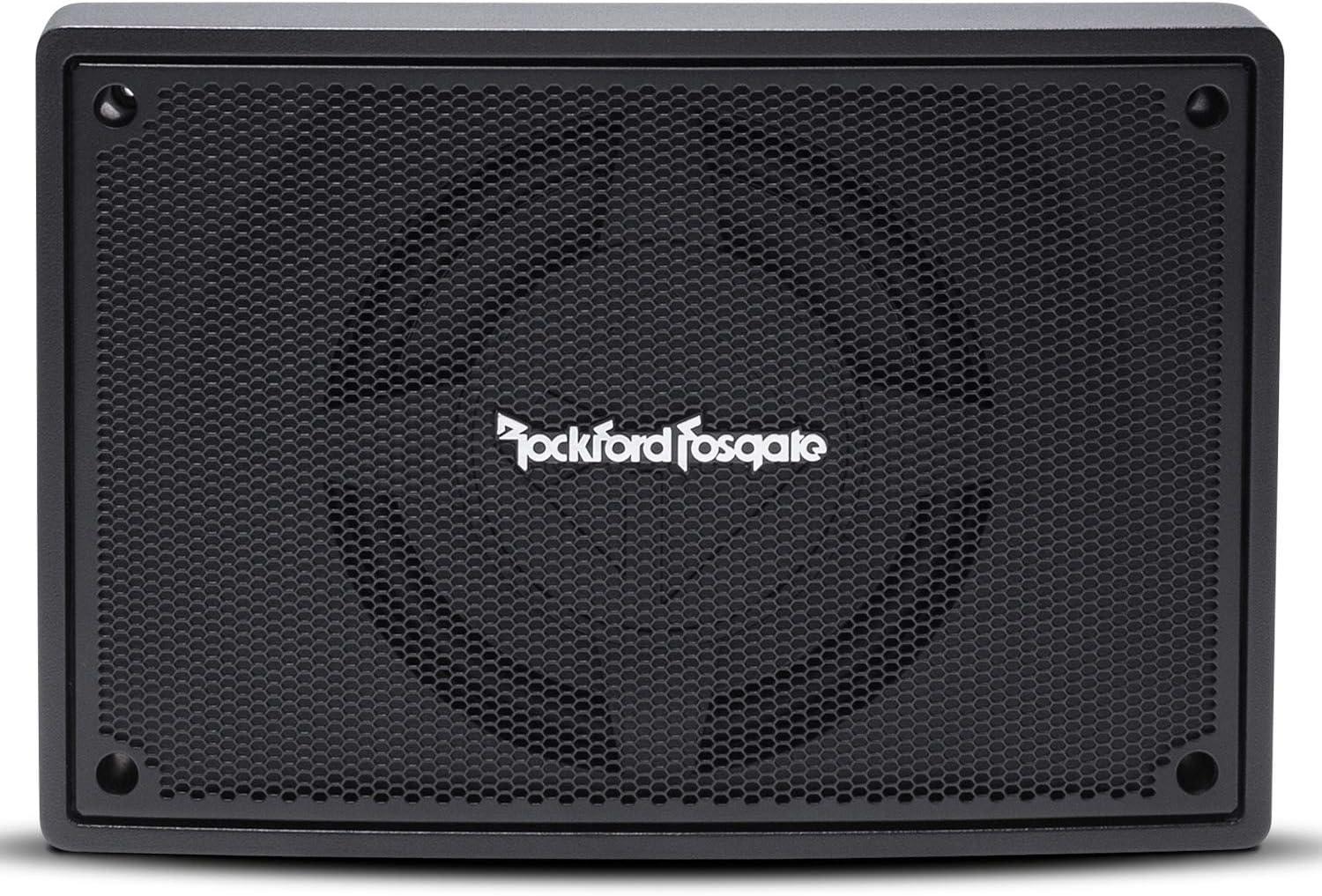
The PS-8 brings Rockford’s Punch approach to a genuinely compact enclosure: an 8-inch driver, a built-in 150W RMS amplifier and a housing about 3.3 inches high. It is a strong overall choice for adding bass to a factory system while keeping the trunk available for everyday use.
The useful feature here is control. Its adjustable 50–120Hz low-pass crossover helps the sub blend with the door speakers, while the phase switch gives another way to improve the handover between them. A remote level knob lets you adjust the amount of bass from the driving position rather than reaching under the seat.
RCA and speaker-level inputs support different head units, and the selectable turn-on modes provide more installation flexibility than a basic remote-wire-only design. Punch EQ adds a focused boost around 45Hz, although restraint is worthwhile: turning up bass boost is no substitute for setting the gain and crossover properly.
The trade-off is height. At roughly 13.9 by 9.4 by 3.3 inches, the PS-8 needs more vertical clearance than the Rockville or Kenwood, plus room for connections and cooling. For a car with sufficient space, its combination of a specified continuous power rating, flexible integration and accessible tuning earns the overall recommendation.
Pros
- 150W RMS amplifier paired with an 8-inch driver
- RCA and speaker-level inputs with selectable turn-on modes
- Adjustable crossover, phase, Punch EQ and remote level control
Cons
- Taller than the other compact options here
- Small enclosure limits the output and deep-bass scale available from a larger system
Rockville RW10CA
The RW10CA makes a persuasive case when height is the main constraint. Its 10-inch driver sits in an enclosure only about 2.7 inches tall, and Rockville specifies a built-in 200W RMS amplifier. That combination is worth considering when a taller enclosure simply will not clear the seat.
It also gives you plenty to work with during setup: an adjustable low-pass filter, phase switch, bass boost and a subsonic filter. The included remote level knob is especially useful for moving between recordings with very different bass levels. Speaker-level inputs and signal-sensing turn-on help when retaining a factory stereo.
The shallow profile does not mean a tiny footprint. At about 12.4 by 13 inches, it needs a broad, unobstructed area beneath the seat. Check the seat rails, heating ducts and cable exits as carefully as the height; a slim sub that fouls the seat mechanism is no space-saving solution.
This is a practical choice for listeners who want a 10-inch powered sub and extensive adjustment in a shallow package. Treat the 800W figure as a peak rating, not continuous output, and do not assume that a higher wattage alone guarantees cleaner or louder bass than every alternative.
Pros
- Low 2.7-inch enclosure
- 10-inch driver with a manufacturer-specified 200W RMS amplifier
- Remote level control and a useful range of tuning adjustments
Cons
- Broad footprint may conflict with seat rails or vents
- Power and signal wiring still require a proper installation
Kenwood KSC-SW11 (Best for Tight Spaces)
The KSC-SW11 is the easiest model here to make a case for when floor space is scarce. Its enclosure measures approximately 11 by 7.5 by 2.75 inches, with a compact rectangular aluminum-diaphragm woofer rather than a large round driver. That small footprint is its main attraction.
Kenwood puts the everyday adjustments on the wired remote: level, crossover frequency and phase. Having all three within reach makes it easier to blend the sub with the main speakers without repeatedly moving the seat. RCA and speaker-level connections allow integration with an aftermarket head unit or an appropriate factory-speaker signal.
The published 150W figure is maximum output, not an RMS rating. This is better approached as a discreet bass supplement for a modest system than as a substitute for a large subwoofer enclosure. Its small driver and enclosure are a sensible trade for the space saved, not a reason to promise window-rattling output.
For drivers who want to keep the cabin unobtrusive, that restraint is part of the appeal. The KSC-SW11 offers a neat way to fill out the bottom end, with useful controls close at hand. Choose a larger system if maximum output and very deep bass matter more than preserving every inch beneath the seat.
Pros
- Smallest footprint in this comparison
- Level, crossover and phase adjustment on the wired remote
- Aluminum enclosure and RCA or speaker-level inputs
Cons
- Limited scale compared with larger-driver enclosures
- 150W maximum rating should not be compared directly with RMS figures
BOSS Audio BASS1400
The BASS1400 combines a 10-inch driver with a three-inch-high enclosure and a built-in amplifier. Its most useful selling point is the breadth of adjustment: a variable low-pass crossover, phase switch, bass boost and an adjustable subsonic filter give it more setup flexibility than the simple exterior suggests.
The subsonic filter can reduce very low-frequency content that a compact enclosure may struggle to reproduce, while the crossover helps keep voices and higher bass out of the sub. A remote level control provides convenient adjustment from the cabin. RCA and speaker-level inputs mean it can work with different head-unit arrangements.
Its footprint is the main practical drawback. At about 15.5 by 11.9 inches, it is the longest enclosure in this comparison, so the three-inch height tells only part of the fit story. Measure the usable floor area and leave space for the side-panel connections before deciding it will go beneath a particular seat.
The 1400W headline is a maximum-power claim, not a reliable basis for declaring this the loudest or best-sounding sub here. The stronger reason to consider the BASS1400 is its combination of a low enclosure, a 10-inch driver and adjustable filtering. Those are concrete advantages; claims of superior output or long-term reliability would need more than a specification sheet.
Pros
- 10-inch driver in a three-inch-high enclosure
- Adjustable low-pass and subsonic filters
- Remote level control plus high- and low-level inputs
Cons
- Longest enclosure in the group
- Headline maximum wattage is not a useful direct comparison with continuous-power ratings
Small Subs for Small Places
Underseat subs are useful anywhere a conventional enclosure takes up too much space, including a tight cargo area. They are particularly appealing in cars where keeping the trunk free matters more than achieving maximum bass output. A powered design includes its amplifier, but it still needs suitable power, ground and signal connections.
Measure the whole installation space
Check width, depth and height with the seat in every position you use. Allow for cables, ventilation, floor contours, heating ducts and seat mechanisms. Do not obstruct airbag wiring or other vehicle equipment. Follow the mounting instructions rather than wedging the enclosure tightly against the seat or carpet.
Compare continuous power, not just peak figures
Peak or maximum wattage is not interchangeable with RMS power. Driver size, enclosure design, installation and tuning also affect the result. A larger number on the box does not establish which model will sound cleaner or reach deeper in your car.
Plan the wiring and tuning
A built-in amplifier removes the need for a separate amplifier chassis, not the wiring work. Use the manufacturer’s specified cable and fusing, a suitable ground and an appropriate audio signal. Factory systems with complex processing may need an integration interface; speaker-level inputs alone do not guarantee a straightforward connection in every vehicle.
Start with bass boost low, set the gain to match the source and adjust the low-pass filter so the sub supports the main speakers. Compare the phase settings from the listening position. The aim is a coherent low end, not a separate source booming beneath the seat.
Conclusion: The Best Underseat Subwoofer?
The Rockford Fosgate PS-8 is the overall choice for its continuous-power specification and flexible integration controls, provided its 3.3-inch height leaves enough clearance. The Rockville RW10CA offers a shallower 10-inch option, while the Kenwood KSC-SW11 is especially appealing for a small floor area. The BOSS BASS1400 adds extensive filtering in a longer enclosure.
Choose the model that fits the car and the listening goal. A well-installed compact sub can add welcome weight to music without filling the trunk; listeners seeking very deep bass at high volume should leave room for a larger enclosure.