Looking for the best amp for Kicker L7 12-inch or 15-inch subs? Match the amplifier to the exact L7 model, its continuous power recommendation and the final wired impedance. The L7 name covers several subwoofer families, so size alone is not enough to choose the amp.
For the other subwoofer model, see our separate guide to amp for Kicker CVR 12″; impedance and power matching need to be checked for that model.

The Rockford Fosgate R2-1200X1 remains the overall choice for its useful output range, gain-setting indicators and adjustable infrasonic filter. The other amplifiers offer different power and control combinations. All four are mono subwoofer amplifiers; the right match depends on the subwoofer system rather than a promise that one amp suits every L7.
If you are choosing amplification for a Rockford Fosgate subwoofer instead of the Kicker L7, see our separate guide to amplifiers for Rockford Fosgate subwoofers and check the exact load and power requirements.
Best Amps for Kicker L7 (12-inch and 15-inch Amps Comparison)
| Image | Model | RMS 4/2/1Ω | Price |
|---|---|---|---|
| Rockford Fosgate R2-1200X1 (Editor's Choice) | 400 / 800 / 1200 W | Check Price |
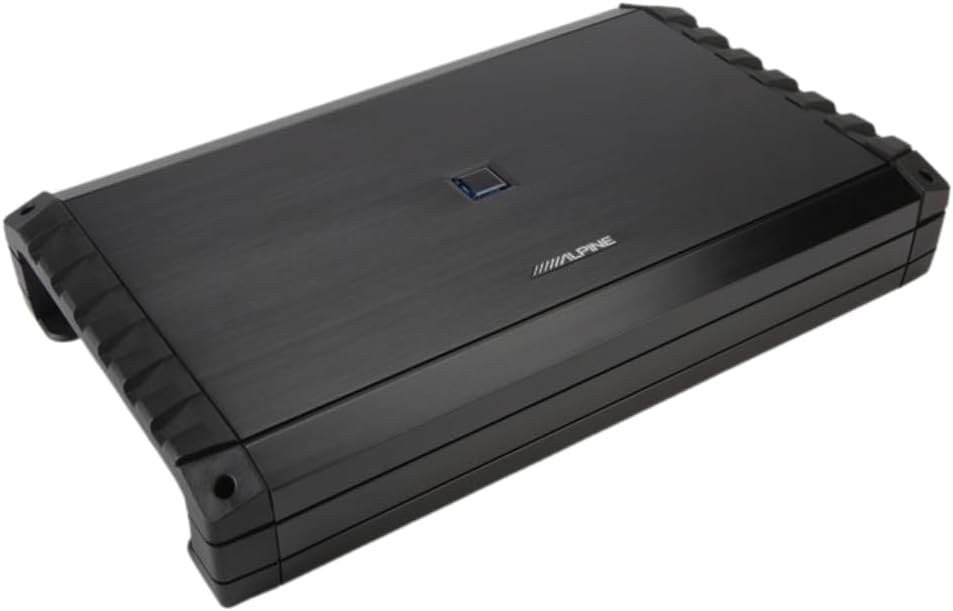 | Alpine S2-A120M | 600 / 1200 / 1200 W | Check Price |
 | Rockford Fosgate Punch P1000X1bd | 300 / 500 / 1000 W | Check Price |
 | Kicker 46CXA1200.1 | 600 / 1200 / 1200 W | Check Price |
Rockford Fosgate R2-1200X1 (Editor’s Choice)
The R2-1200X1 earns the overall choice for combining substantial subwoofer power with controls that help set the system up properly. Rockford rates it at 400W RMS into 4 ohms, 800W into 2 ohms and 1200W into 1 ohm. Its 2-ohm rating makes it a particularly useful starting point for a single dual-4-ohm L7S12, with output set appropriately for that sub.
C.L.E.A.N. indicators help the installer match signal levels instead of treating the gain knob as a volume control. A variable low-pass crossover handles the upper bass transition, while the adjustable infrasonic filter is useful when the enclosure needs protection below its intended operating range. The remote level control adds convenient everyday adjustment.
The trade-off is that its full 1200W rating is available only at 1 ohm. A 4-ohm system gets much less power, and a large multi-sub setup may call for more output. Choose it for the combination of useful setup tools and flexible 1-, 2- or 4-ohm operation, with proper wiring and electrical support.
Pros
- C.L.E.A.N. indicators assist gain setup.
- Adjustable low-pass and infrasonic filters.
- Remote level control for convenient bass adjustment.
Cons
- Much lower output at 4 ohms than at 1 ohm.
- High-output use requires suitable power wiring and charging capacity.
Alpine S2-A120M
The S2-A120M offers a useful advantage for system planning: its rated output remains 1200W RMS at both 1 and 2 ohms, with 600W at 4 ohms. That gives more freedom to choose an appropriate coil arrangement without having to chase the lowest possible load for maximum rated power.
The Class-D design includes a variable low-pass filter and selectable input/turn-on settings for different source-unit arrangements. Side-mounted controls and removable connection covers help keep the installation tidy. An optional remote level knob can make routine bass adjustment easier after the system has been correctly set up.
Its output capability is more than some individual L7 models need, so the target level must suit the actual subwoofer and enclosure. The remote knob is an additional accessory, and the chassis still needs adequate mounting space and ventilation. Choose the Alpine for its consistent 1- and 2-ohm power capability and straightforward system integration, not as a reason to overpower a smaller sub.
Pros
- 1200W RMS rating at both 1 and 2 ohms.
- Selectable input and turn-on arrangements.
- Side controls and removable connection covers.
Cons
- Remote level knob is optional.
- Output must be limited appropriately for lower-rated subwoofers.
Rockford Fosgate Punch P1000X1bd
The P1000X1bd is the focused 1-ohm choice in this selection. Its Class-bd design is rated at 1000W RMS into 1 ohm, compared with 500W into 2 ohms and 300W into 4 ohms. It is worth considering for a correctly wired single dual-2-ohm L7S15, where the final 1-ohm load can make use of its rated output.
C.L.E.A.N. setup indicators help establish a clean signal path, while the low-pass crossover and infrasonic filter let the installer shape the operating band. The optional PLC2 remote level control also provides clipping indication. These are useful setup and monitoring features, rather than guarantees that clipping or overheating can never occur.
The main limitation is the steep power difference between loads. A dual-4-ohm sub wired to 2 ohms will not receive the amp’s headline 1000W rating. The remote control is also an optional addition. Choose the Punch when the system’s final load and power target fit its strengths, rather than matching it to the sub by brand reputation alone.
Pros
- 1000W RMS capability at a 1-ohm load.
- C.L.E.A.N. setup indicators.
- Low-pass and infrasonic filtering for subwoofer use.
Cons
- Only 500W RMS at 2 ohms and 300W at 4 ohms.
- PLC2 remote control is optional.
Kicker 46CXA1200.1
The 46CXA1200.1 is a strong Kicker-made option with the same rated 1200W output at 1 and 2 ohms, plus 600W at 4 ohms. That broadens the useful wiring choices for an L7 system, especially when a 2-ohm load is more convenient than 1 ohm.
Its variable low-pass filter covers 50–200Hz, while the fixed 25Hz subsonic filter rolls off the very lowest frequencies. The amplifier also accepts high-level signals through its input arrangement, which can simplify integration with an appropriate factory audio system. The optional CXARC remote provides convenient level adjustment after installation.
The fixed subsonic filter is the important trade-off: it cannot be moved to suit every vented-box tuning in the way an adjustable filter can. Its power must also be matched to the exact L7 variant, despite the shared Kicker badge. Choose it for useful 1- and 2-ohm capability and a straightforward subwoofer-focused control set, with the enclosure and output target planned together.
Pros
- 1200W RMS rating at both 1 and 2 ohms.
- High-level input capability.
- Variable low-pass filter and optional remote level control.
Cons
- Fixed 25Hz subsonic filter offers less adjustment flexibility.
- CXARC remote is optional.
How to Match a Kicker L7 to an Amp
Identify the full subwoofer model before choosing power. An L7S12, L7S15, L7R or shallow L7T does not have the same power recommendation simply because it carries the L7 name. For example, Kicker recommends 750W for an L7S12 and 1000W for an L7S15. Use the specifications for the actual model and enclosure.
RMS Rating of Your Amp
The table gives rated RMS output in the order shown by its heading: 4/2/1 ohm. Compare the rating at the final wired load with the subwoofer’s recommended power. A large maximum or peak-power figure is not a substitute for a continuous rating under stated conditions.
An amplifier capable of more power than the sub needs requires careful output setup. Conversely, a lower-powered amp can play cleanly within its limits, but turning the gain up does not create extra clean power. The installer should set the target output for the subwoofer system, not simply turn the gain to match a number printed on the case.
Dual-Voice-Coil Wiring
Use both voice coils as specified by Kicker. Common configurations for identical subs are:
- One dual-2-ohm sub: 1 ohm with parallel coils, or 4 ohms in series.
- One dual-4-ohm sub: 2 ohms with parallel coils, or 8 ohms in series.
- Two dual-2-ohm subs: a common series/parallel arrangement gives 2 ohms. Wiring all four coils in parallel gives 0.5 ohm, below the minimum rating of these amplifiers.
- Two dual-4-ohm subs: common arrangements give 1 or 4 ohms, depending on the series/parallel wiring.
The coil rating is not the final load at the amplifier. A loaded enclosure may already be wired to a particular impedance; use its rated terminal impedance rather than assuming it matches an individual coil.
A Practical Example
A single dual-4-ohm L7S12 can present 2 ohms when its coils are wired in parallel. The R2-1200X1 is rated for 800W at that load, close to the sub’s 750W recommendation, with the final output set appropriately. The Alpine and Kicker amps can produce 1200W at 2 ohms, so their setup must respect the same subwoofer limit. The P1000X1bd is rated for 500W at 2 ohms.
Two L7S12 subs have a combined recommended power of 1500W. A 1200W amp is a lower-powered choice for that pair, not a 1500W system simply because both subs are connected. Plan the power target and wiring together.
Enclosure, Filters and Electrical Supply
The subwoofer uses a sealed or vented enclosure; the amplifier needs a ventilated mounting location. Set the low-pass crossover to blend with the main speakers. For a vented box, match infrasonic protection to the enclosure’s tuning rather than assuming one fixed frequency is ideal for every box.
Use correctly sized power and ground cable, suitable fusing and an electrical system capable of supporting the planned output. Class-D efficiency reduces wasted energy, but a high-power amplifier still places a substantial demand on the vehicle. Bass boost also uses headroom and should be applied with restraint.
Conclusion: The Best Amplifier for L7 15-inch and 12-inch Subs
The R2-1200X1 remains the overall pick for its setup indicators, filtering and useful output range. The Alpine S2-A120M and Kicker 46CXA1200.1 offer their full rated power at either 1 or 2 ohms, while the P1000X1bd is strongest at 1 ohm. Choose by the exact L7 model, enclosure and wired load, then set the system for clean output within those limits.