Looking for the best bookshelf speakers for under $500? Start with the system you want to build: passive speakers make sense with a separate amplifier, while powered speakers keep a desktop setup simpler.

The five designs below cover compact home-theater satellites, traditional hi-fi speakers and powered desktop pairs. Several are established older models, so compare availability and the total system cost rather than assuming every option always falls below the budget ceiling. The ProMonitor 1000 is sold individually; the other linked options are pairs.
Best Bookshelf Speakers Under $500 – Comparison Table
Klipsch RB-61 II Bookshelf Speakers (Editor’s Choice)
The RB-61 II has the proportions of a proper hi-fi speaker rather than a tiny desktop accessory. Its copper-colored 6.5-inch Cerametallic woofer and horn-loaded 1-inch titanium tweeter give it a distinctive look, while the black woodgrain vinyl finish keeps the cabinet fairly understated. At 15.4 inches tall and 12.25 inches deep, it deserves a stable shelf or speaker stand with enough room around it.
The horn is the defining feature. It controls how the tweeter distributes high-frequency sound, and the efficient design is attractive when the system needs useful output without relying on a huge amplifier. That makes the pair an appealing foundation for music and movie playback, particularly when lively dynamics matter more than having the smallest possible boxes.
These are passive speakers: a phone, computer or television cannot drive them directly. They need an amplifier or receiver, and the final sound still depends on placement, the room and listening level. The front bass port is convenient when arranging a system, but it does not make positioning irrelevant or remove the benefit of experimenting with distance from walls.
The Klipsch remains the overall choice here for a traditional stereo system. Its substantial woofer, horn-loaded tweeter and efficient design provide a convincing balance of scale and flexibility. The trade-off is space and extra equipment: a powered pair is a neater route for someone who simply wants speakers beside a laptop.
Pros
- 6.5-inch Cerametallic woofer and horn-loaded titanium tweeter
- Efficient passive design for a separate hi-fi amplifier
- Front bass port and understated woodgrain finish
Cons
- Large cabinets for a small desk
- Requires a separate amplifier or receiver
Definitive Technology ProMonitor 1000

The ProMonitor 1000 takes a different approach to compact sound. A 5.25-inch BDSS mid/bass driver and 1-inch aluminum dome tweeter sit in a curved cabinet, while a top-mounted 5.25-inch passive radiator helps extend the bass without needing a larger conventional enclosure. The shape is compact enough to make sense on a crowded shelf or as part of a discreet home theater.
That passive radiator is a useful distinction: it responds to pressure inside the cabinet rather than acting as a second powered woofer. Keep its top surface clear. The included pedestal foot supports shelf placement, and the rear mounting provisions offer alternatives when used with suitable mounting hardware.
This is a passive satellite speaker, not a powered desktop monitor. A stereo setup needs two units and an amplifier; the linked product is a single speaker. It can also serve as a surround channel in a larger system. A powered subwoofer is a sensible partner when deep movie effects or substantial low bass are priorities.
The appeal is practical rather than oversized: a small cabinet, flexible placement and a driver arrangement that makes good use of the available space. It is less convincing as a shortcut to a complete stereo system because a second speaker, amplification and potentially a subwoofer all affect the final cost.
Pros
- Compact curved cabinet with a 5.25-inch passive radiator
- Included pedestal foot and rear mounting provisions
- Useful for stereo or home-theater surround channels
Cons
- Sold individually; stereo requires two
- Separate amplification required; not a substitute for a deep-bass subwoofer
Bowers & Wilkins MM-1 Bookshelf Speakers

The MM-1 is a desktop system first and a conventional bookshelf speaker second. The compact fabric-covered cabinets and metal trim suit a computer workspace, and the amplification is built in. One powered speaker connects to its companion, keeping the equipment count lower than a passive pair and separate receiver.
USB carries digital audio from the computer into the speaker system. That gives the MM-1 a direct desktop connection without relying on the computer’s analog headphone output. There is also a 3.5mm auxiliary input for an analog source, plus a headphone socket that mutes the speakers when headphones are connected. The remote and speaker-mounted volume controls are useful everyday touches.
USB does not power these speakers: the external power supply still needs a mains outlet. They are intended for close listening on either side of a monitor, not as miniature replacements for a room-sized hi-fi system. Their age also matters for a computer-based setup; the analog input is a useful alternative where USB compatibility with a particular modern system needs attention.
The MM-1 makes the most sense when a tidy desk, direct USB audio and accessible headphone listening matter more than expansion. Larger passive speakers offer a different route for listening across a room, while the Audioengine below provides analog powered-speaker connections in a more substantial cabinet.
Pros
- Built-in amplification and USB digital-audio input
- Auxiliary input, headphone output and remote control
- Compact cabinets designed for close desktop listening
Cons
- Requires its external mains power supply
- Older computer-focused design; less suited to a large-room system
Audioengine A5+ Bookshelf Speakers

The wired A5+ Classic brings a familiar hi-fi layout to a powered pair: a 5-inch aramid-fiber woofer and 0.75-inch silk-dome tweeter in each cabinet, with Class AB amplification built into the system. It avoids the separate amplifier that the Klipsch and Polk require, while offering a more substantial speaker than a tiny computer accessory.
Connections are deliberately straightforward. RCA and 3.5mm inputs accept analog line-level audio, and the variable RCA output allows a powered subwoofer to follow the main volume setting. A turntable needs a phono stage somewhere in the signal chain; the speakers do not turn a raw phono output into a line-level input on their own.
The USB socket supplies power for charging or an accessory; it is not a USB audio input. This linked version is also wired rather than the separate Bluetooth model. A computer with USB-only audio therefore needs an external DAC, and a television with digital-only outputs needs an appropriate audio converter.
Those limitations are easy to live with if the source already has analog outputs. The reward is a simple powered stereo system with room to add a subwoofer, rather than a network device that needs an app. Choose it for its analog flexibility and built-in amplifier, not for wireless or digital features it does not have.
Pros
- Powered pair with 5-inch woofers and silk-dome tweeters
- RCA and 3.5mm analog inputs
- Variable RCA output for a powered subwoofer
Cons
- No Bluetooth or USB digital-audio input on this version
- Digital-only sources need additional equipment
Polk Audio RTi A3 Bookshelf Speakers
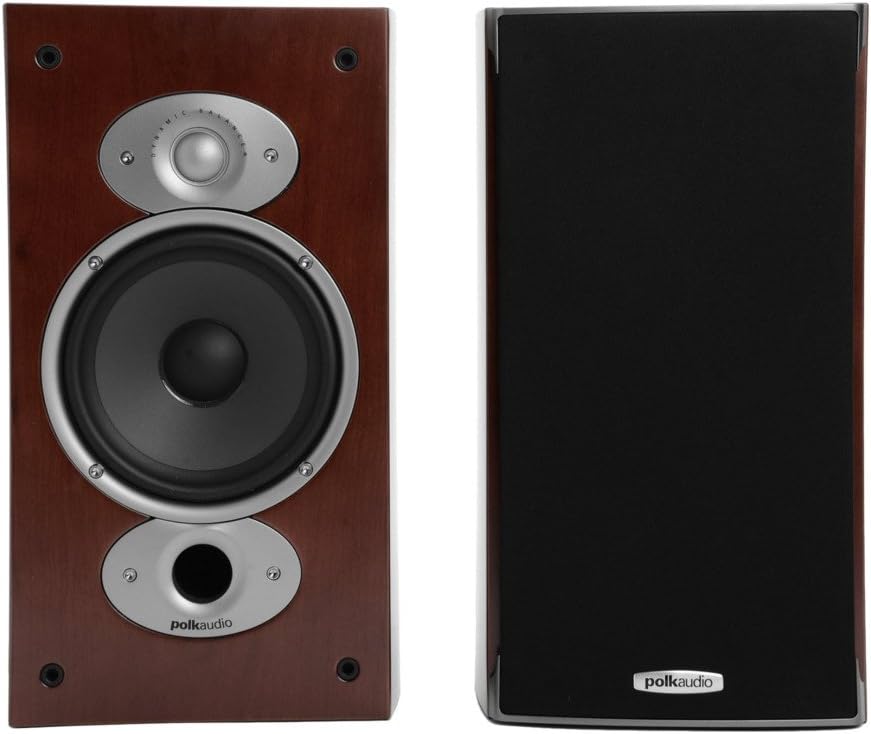
The RTi A3 is a substantial passive bookshelf pair with one 6.5-inch polymer-composite mid/woofer and one 1-inch silk/polymer dome tweeter in each cabinet. The cherry finish gives the linked pair a warmer visual character than the black options above. These are full-sized speakers for a shelf or stands, rather than a compact plug-and-play computer system.
Polk’s PowerPort and ARC Port arrangements address airflow and port-related resonance. Their purpose is to make the bass-reflex design work more cleanly, not to guarantee that every room or volume setting will be free of coloration. The cabinet is about 14 inches deep, so leave enough physical room for the speaker, its connections and sensible placement.
The dual binding posts allow conventional wiring or bi-wiring with suitable equipment; ordinary speaker cable is enough for a standard connection. With an 8-ohm nominal impedance and a manufacturer-recommended amplifier range of 20 to 150 watts per channel, the RTi A3 belongs with a suitable stereo amplifier or AV receiver. It does not accept a computer’s headphone signal directly.
This pair is appealing for a conventional music system or the front channels of a home theater where a larger bookshelf cabinet is welcome. Its main compromise is the same as the Klipsch: amplification and space are part of the purchase. For a desk without an existing amplifier, a powered model is the more direct choice.
Pros
- One 6.5-inch mid/woofer and one silk/polymer tweeter per speaker
- PowerPort and ARC Port design
- Dual binding posts and a traditional cherry finish
Cons
- Requires a separate amplifier or receiver
- Deep cabinets need more space than compact desktop speakers
How to Choose the Best Bookshelf Speakers for You
Watts, Hertz, and Decibels
These numbers answer different questions. An amplifier’s wattage describes electrical output under stated conditions; a passive speaker’s power rating is not a promise of loudness. Sensitivity indicates acoustic output for a specified input, while maximum sound-pressure level is a different measurement. Compare like-for-like specifications rather than assuming the largest wattage number wins.
Frequency response describes the range a speaker reproduces, but the tolerance matters. A bass limit quoted without a tolerance is not directly equivalent to a response measured within ±3 dB. Compact speakers can reproduce a useful part of a bass line without delivering the deepest movie effects; a subwoofer addresses that different job.
Drivers
A woofer handles lower frequencies, a tweeter handles higher frequencies, and the crossover divides their work. Driver count alone says little about the finished speaker. A passive radiator, such as the one in the ProMonitor 1000, is not another electrically driven woofer. Cabinet volume, crossover design and placement matter alongside cone size.
Purpose
For a computer desk, powered speakers reduce the need for extra boxes. Check whether the source needs USB audio, analog inputs or another connection: the MM-1 accepts USB audio, while the wired A5+ uses analog audio inputs. For a stereo receiver or home theater, passive speakers are a natural fit. A bookshelf speaker is a cabinet category, not a guarantee that it includes an amplifier.
Design and Placement
Measure the available depth as well as the width. Use stable supports, bring the tweeters reasonably close to ear height, and start with the speakers and listening position forming a roughly equal-sided triangle. Adjust spacing and distance from walls for the room. A shelf that physically holds a speaker is not automatically its best-sounding position.
Budget
For the best bookshelf speakers under $500, count the complete system: a pair of speakers, any required amplifier, cables and stands. A single-speaker price cannot be compared directly with a stereo-pair price. Older models may vary widely in availability, so treat the budget as a ceiling to check rather than a fixed price attached to every model here.
Sound Performance
Choose for the listening distance and material you actually use. Clear voices at a desk, stereo music across a room and deep cinema bass put different demands on a speaker. If a comparison is possible, use familiar recordings at similar listening levels; a louder demonstration can seem more impressive without being the better match. For another perspective on driver arrangements, see the guide to full-range speakers.
Wrap-Up: The Best Bookshelf Speakers Under $500
The Klipsch RB-61 II remains the overall choice for a traditional amplified stereo system, thanks to its substantial woofer and efficient horn-loaded design. The Audioengine A5+ offers a simpler analog powered setup, while the MM-1 is more specifically tailored to a computer desk. The ProMonitor 1000 suits compact satellite placement, and the Polk RTi A3 is a substantial passive alternative. Pick the system type first; that decision does more useful work than comparing isolated specification numbers.