The best flute brands for beginners offer more than a shiny finish: comfortable keywork, a manageable headjoint and access to maintenance all matter when learning to play. This guide compares student flutes from Glory, Yamaha, Hisonic, Lazarro and Mendini, with the strengths and compromises of each.
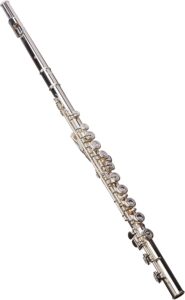
All five models use covered keys, so beginners can concentrate on finger placement without sealing open key holes. Yamaha is the strongest overall choice here for its well-documented student design; the others offer different combinations of construction, accessories and keywork.
Top 5 Best Flute Brands for Beginners
| Image | Model | Price |
|---|---|---|
 | Glory GFL-01-NIA | Check Price |
| Yamaha YFL-222 (Editor's Choice) | Check Price |
 | Hisonic Signature Series 2810N | Check Price |
 | Lazarro 120-NK | Check Price |
 | Mendini MFE-N | Check Price |
Glory GFL-01-NIA
Glory’s GFL-01-NIA is a straightforward starting point: a C flute with 16 covered keys and a cupronickel body. Covered keys remove the need to seal small finger holes, leaving a new player free to work on posture, breath and a consistent embouchure.
Leather pads sit beneath the keys to seal the tone holes. Together with the covered-key layout, they give the Glory a conventional student-flute construction. The included hard-shell case, cleaning rod and cloth make the package practical for carrying the flute and drying it after practice.
The appeal is simplicity rather than advanced keywork. This is a conventional closed-hole instrument for working on the basics, without the extra finger-placement demands of open-hole keys. A teacher’s assessment and a clear route to local servicing are worth arranging before it becomes the student’s daily instrument.
Pros
- 16 covered keys on a C flute.
- Cupronickel body and leather pads.
- Hard-shell case, cleaning rod and cloth.
Cons
- Closed keys will not suit someone specifically seeking an open-hole flute.
- No stand is included in the listed accessory set.
Yamaha YFL-222 (Editor’s Choice)
The YFL-222 earns the overall recommendation because its student-friendly design has substance behind it. Yamaha’s CY headjoint uses a double-flare taper and an undercut embouchure hole, intended to help developing players find a responsive sound. The covered keys and offset G arrangement keep the layout approachable without making the instrument feel like a short-term novelty.
Its headjoint, body, footjoint and keys use silver-plated nickel silver. The C footjoint reaches low C, while alignment marks help position the footjoint during assembly. Yamaha also builds serviceability into the keywork, with accessible adjustment screws and screw-resistance inserts designed to hold adjustments. These are useful everyday details for an instrument that will travel between lessons and practice.
The limitation is clear: the YFL-222 does not have a split E mechanism or a B footjoint. Players who specifically need those features should choose a different configuration. For ordinary beginner study, however, the combination of the CY headjoint, covered keys and thoughtful mechanical design makes this the most convincing all-round student flute in the group.
Pros
- CY headjoint designed for a responsive student playing experience.
- Covered keys, offset G and a C footjoint.
- Accessible adjustment design and footjoint alignment marks.
Cons
- No split E mechanism.
- C footjoint does not extend down to low B.
Hisonic Signature Series 2810N
The Hisonic 2810N pairs a nickel-plated finish with 16 closed-hole keys in the key of C. It is a conventional student layout: there are no open finger holes to seal, so early practice can focus on making a clear sound and moving cleanly between notes.
PRESTINI pads and power-forged keys are the construction details that distinguish this model’s specification. The pads seal the tone holes, while the keywork transfers finger movement to those seals. For a learner, the practical priority is light, consistent key operation that does not get in the way of smooth changes between notes.
A hard case and cleaning rod provide the essentials for transport and routine drying. The 2810N makes sense for a learner who wants a familiar covered-key arrangement with named pads. A teacher or repair technician can assess the individual instrument’s response and sealing; neither the pad brand nor the finish replaces that practical assessment.
Pros
- 16-key closed-hole C layout.
- PRESTINI pads and power-forged keys.
- Hard case and cleaning rod.
Cons
- No stand is included in the listed accessory set.
- Does not offer the open-hole layout some advancing players prefer.
Lazarro 120-NK
The Lazarro 120-NK keeps the proposition simple: a silver-colored, closed-hole C flute supplied with a case and care kit. Its covered keys are a practical feature for a new player, because finger placement does not have to form a seal over open holes.
The restrained finish suits a conventional school-band setup, and the case makes the instrument easier to keep together between lessons. The useful question is how comfortably the player can reach the keys and produce a stable sound. A long accessory list is less important than those basics when choosing a first flute.
Compared with the Yamaha and Mendini, there is less detailed model-specific construction information to distinguish this Lazarro. Its attraction is the uncomplicated student format, rather than a particular advanced mechanism. Choose it when that layout suits the player and a teacher or local technician can help establish that the instrument is ready for regular study.
Pros
- Closed-hole C-flute format.
- Conventional silver-colored appearance.
- Case and care kit included.
Cons
- Less detailed published construction information than several alternatives here.
- No open-hole keys for players specifically seeking that layout.
Mendini MFE-N
Mendini’s MFE-N stands out for combining covered keys with an offset G and a split E mechanism. The offset G changes the reach of the left-hand key group, while the split E mechanism assists the production of high E. That gives this model a meaningful keywork distinction beyond its nickel-plated appearance.
The embouchure hole is undercut and beveled, and the keywork uses double-bladder pads and rubber bumpers. The included foldable stand and pocketbook are useful additions: the stand provides a place to put the flute during a break, and the book brings basic reference material to early practice. A case, cleaning rod and cloth cover the everyday transport and drying essentials.
This is the most feature-led alternative here for someone who wants split E without moving to open-hole keys. The extra mechanism is useful for that particular upper-register note, but it does not change the need to develop breath control and a stable embouchure. Pick it for the covered-key, offset-G and split-E combination, with the stand and reference book as useful extras.
Pros
- Covered keys, offset G and split E mechanism.
- Undercut, beveled embouchure hole.
- Foldable stand, pocketbook and routine care accessories.
Cons
- Covered keys will not suit someone specifically seeking an open-hole flute.
- Extra accessories are less important if a stand and care kit are already available.
Buyer’s Guide to Purchasing the Best Beginner Flute
A comfortable instrument and reliable access to maintenance matter more than a bundle of accessories. Ask the teacher about the preferred student configuration, and include lessons and routine servicing in the budget.
Offset G-Key vs. Inline Key
An offset G moves the G keys slightly out of the main line of keywork; an inline layout keeps them in line. The offset arrangement can make the reach more comfortable for some hands, but comfort is individual. Neither arrangement guarantees better tone.
Tuning Rod and Cleaning Cloth
A cleaning rod and suitable cloth help remove moisture after playing. On an appropriate marked rod, the reference mark also helps a technician check the headjoint cork position. Ordinary tuning is adjusted by moving the headjoint in or out; beginners should not move the internal cork themselves.
Wipe the bare metal joints clean and dry before assembly. Do not apply cork grease to a metal flute joint. If a joint becomes stiff, ask a technician rather than forcing it or attempting a repair.
Open-Hole vs. Closed-Hole Flutes
Closed-hole, or covered-key, flutes have solid key cups. Open-hole flutes have holes in some key cups that the fingers must seal; removable plugs can close those holes while a player develops the necessary placement. Plugs belong to the open-hole design, not to ordinary closed-hole keys. Covered keys are a sensible starting point for many learners.
C or B Footjoint
A C footjoint gives a standard flute a lowest note of low C. A B footjoint adds the keywork needed for low B and changes the instrument’s length and weight. It is a configuration choice, rather than a feature every beginner needs. The YFL-222 reviewed here has a C footjoint.
Multi-Colored Instruments
Color does not establish a flute’s musical quality. Check the school’s appearance requirements if the instrument is for band, then concentrate on keywork, comfortable reach, condition and servicing. A conventional silver-colored finish keeps the appearance simple, but finish alone is not a reason to accept or reject an instrument.
Flute Brands in Terms of Repairing
Before buying, ask a local woodwind technician whether they can service the exact model and obtain the necessary parts. Workshop policies and parts availability vary between brands and models. Avoid turning adjustment screws, filing parts or forcing a tight joint as a substitute for professional attention.
The Best Beginner Flute: Our Verdict
The Yamaha YFL-222 is the overall choice for its CY headjoint, approachable covered-key layout and thoughtful mechanical details. Mendini is worth a closer look when split E is a priority, while Glory, Hisonic and Lazarro offer other straightforward closed-hole starting points. Match the instrument to the student’s hands, teacher’s requirements and available servicing, rather than choosing by accessories alone.