Looking for the best tuners for a Les Paul? These ten choices cover vintage-style replacements, conventional sealed machines and several locking designs, with different advantages for adjustment feel, appearance and string changes.

All use a three-per-side arrangement, but their mounting systems differ. Identify the existing hole diameter, bushing type and rear screw positions before choosing. A screw-in bushing and a vintage press-fit bushing are not interchangeable just because both tuners have keystone buttons.
Locking tuners clamp the string at the post and can simplify restringing. They do not lock the nut or cure every tuning problem, so worn strings, nut friction and the guitar’s setup still deserve attention.
Best Tuners for Les Paul – Comparison Table
Gibson PMMH-010 (Editor’s Choice)
The PMMH-010 is the overall choice here for a Gibson-style restoration that calls for vintage pearloid buttons and the corresponding mounting system. Its appeal is the familiar look: a nickel finish, enclosed housings and traditional buttons keep the headstock visually close to the guitar’s original character.
These are conventional tuning machines rather than a locking design. Screw-in bushings secure them from the front, which distinguishes this version from older push-fit-bushing hardware. The three-left/three-right set is appropriate to a typical Les Paul headstock layout, provided the existing holes and rear screw positions correspond.
Choose the Gibson set when a suitable factory-style replacement matters more than adding a new string-clamping mechanism. It is a coherent way to refresh worn hardware without changing the visual direction of the instrument. Players who mainly want quicker string changes will find more purpose-built features in the locking Grover and GOTOH options below.
Pros
- Traditional pearloid buttons and nickel finish.
- Gibson-branded three-per-side replacement set.
- Enclosed housings and screw-in bushings.
Cons
- Conventional winding rather than a locking mechanism.
- Screw-in-bushing format does not suit every vintage installation.
Grover 502N Roto-Grip Locking Rotomatics
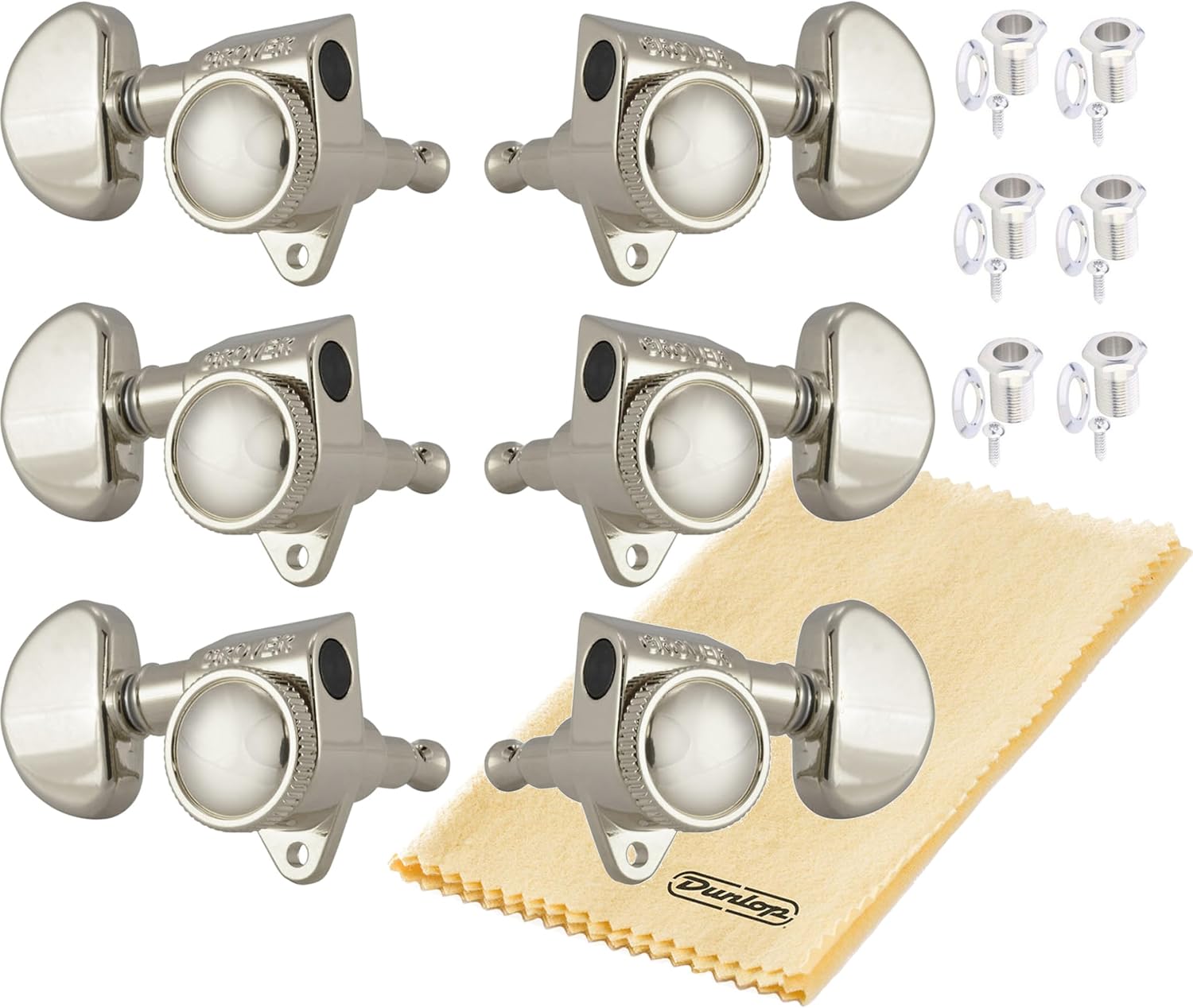
The 502N is a strong choice when the goal is the familiar Rotomatic format with a straightforward rear-thumbwheel lock. The clamp holds the string at the post, reducing the winding needed during a string change and making the process easier to repeat consistently.
Grover combines sealed, lubricated gearing with an 18:1 ratio and nickel-finished kidney buttons. The higher ratio provides smaller post movements for a given turn of the button. The manufacturer specifies a maximum string gauge of .074, giving heavier-set players more room than the .054 limit of the internal-cam 106 series.
The practical compromise is its full-size modern format. The roughly 10 mm mounting-hole requirement and Rotomatic screw position need to suit the guitar, and the larger housings look different from slim vintage-style machines. Where that mounting already exists, the Roto-Grip is a useful way to add an accessible locking control without abandoning a familiar tuner layout.
Pros
- Accessible rear-thumbwheel locking mechanism.
- 18:1 gearing with sealed, lubricated gears.
- Maker specifies string gauges up to .074.
Cons
- Full-size housing changes a vintage-style appearance.
- Requires the correct modern hole and screw arrangement.
Grover 135N Deluxe Vintage
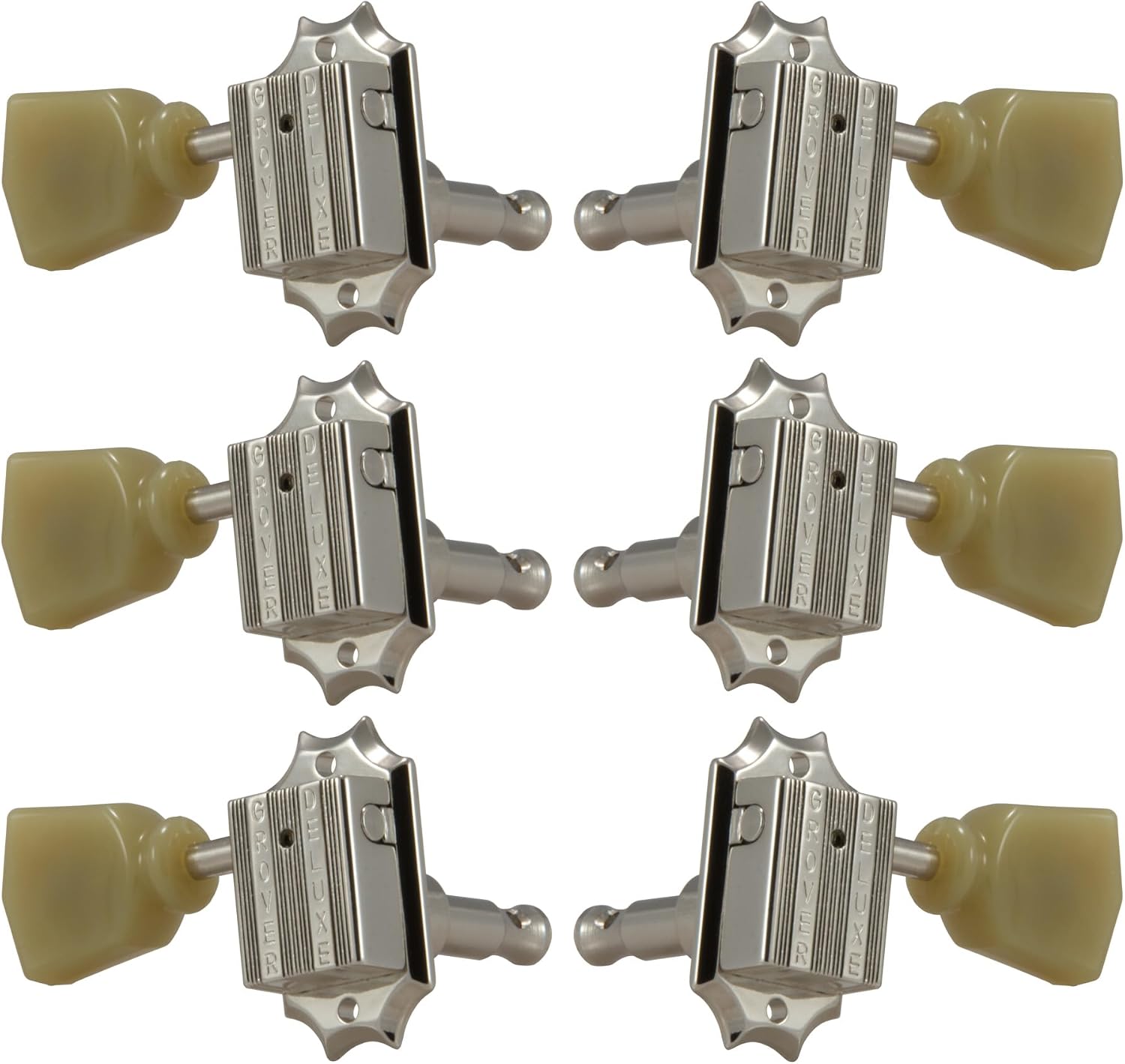
The 135N brings a vintage keystone-button appearance to a set of individual machines. It is appealing for a Les Paul owner who likes the traditional look but wants the enclosed, lubricated gearing of a current replacement design.
The nickel-finished three-per-side set uses a two-piece die-cast housing and a 14:1 ratio. Grover’s bearing arrangement supports the string post and maintains the relationship between the worm and gear. Compared with an 18:1 design, the post turns further for the same button movement, so the adjustment feels less geared down.
The important distinction is underneath that vintage appearance: Grover specifies a 25/64-inch post hole, approximately 10 mm. It is not automatically a replacement for small-hole push-fit hardware. A conversion from a single-screw Rotomatic can also require a new upper fixing hole. Choose the 135N for its combination of traditional styling and a defined modern mounting format.
Pros
- Vintage-style keystone buttons in a nickel finish.
- Individual machines with sealed, lubricated gearing.
- Die-cast housing and 14:1 adjustment ratio.
Cons
- Vintage appearance does not mean small-hole mounting.
- Some conversions require an additional rear screw hole.
Grover 102-18N Rotomatics

The 102-18N is the straightforward conventional Rotomatic choice. It suits a player who wants a fine, controlled adjustment without changing to a locking-post routine. Its kidney buttons and enclosed housings have a clearly modern look alongside the vintage-style options here.
The 18:1 gearing provides a more gradual post movement than Grover’s original 14:1 Rotomatic design. Sealed-in lubrication protects the working gears, and the button’s tension screw lets the player adjust turning resistance. The nickel-finished set supplies three machines for each side of the headstock.
Its strength is simplicity: restring it using a normal, tidy winding pattern, then use the higher ratio for small pitch corrections. There is no separate string clamp to operate, although string changes require more winding than a locking set. The full-size Rotomatic mounting must already suit the guitar or be part of a properly planned conversion.
Pros
- 18:1 ratio for gradual pitch adjustment.
- Enclosed, lubricated gears and adjustable button resistance.
- Simple conventional string-post operation.
Cons
- No locking clamp for faster restringing.
- Larger modern housings differ from vintage-style hardware.
Wilkinson K1403 E-Z Post 3+3

The K1403 combines sealed housings and tulip-shaped buttons with Wilkinson’s distinctive two-hole E-Z Post. It is useful for someone who wants a different string-threading approach while keeping the rear of the tuner free from a separate locking thumbwheel.
The chrome set has a 15:1 ratio, equal-height posts and a three-left/three-right arrangement. The E-Z Post uses its two string holes and the appropriate winding method rather than a mechanical rear clamp. That distinction matters when comparing it with the Grover Roto-Grip or GOTOH Magnum Lock-Trad.
This version is specified for modern 10 mm holes with a 45-degree fixing tab. Its appeal is the combination of a familiar tulip shape and a relatively simple post design, but the winding method still needs care. Choose it for that particular construction rather than expecting E-Z Post to operate like a thumbscrew-locking machine.
Pros
- Two-hole E-Z Post offers an alternative winding method.
- Sealed housings with chrome tulip buttons.
- 15:1 gearing and a three-per-side arrangement.
Cons
- Not a rear-thumbwheel or internal-cam locking design.
- Requires the specified 10 mm hole and fixing-tab layout.
Grover 106C Locking Rotomatics
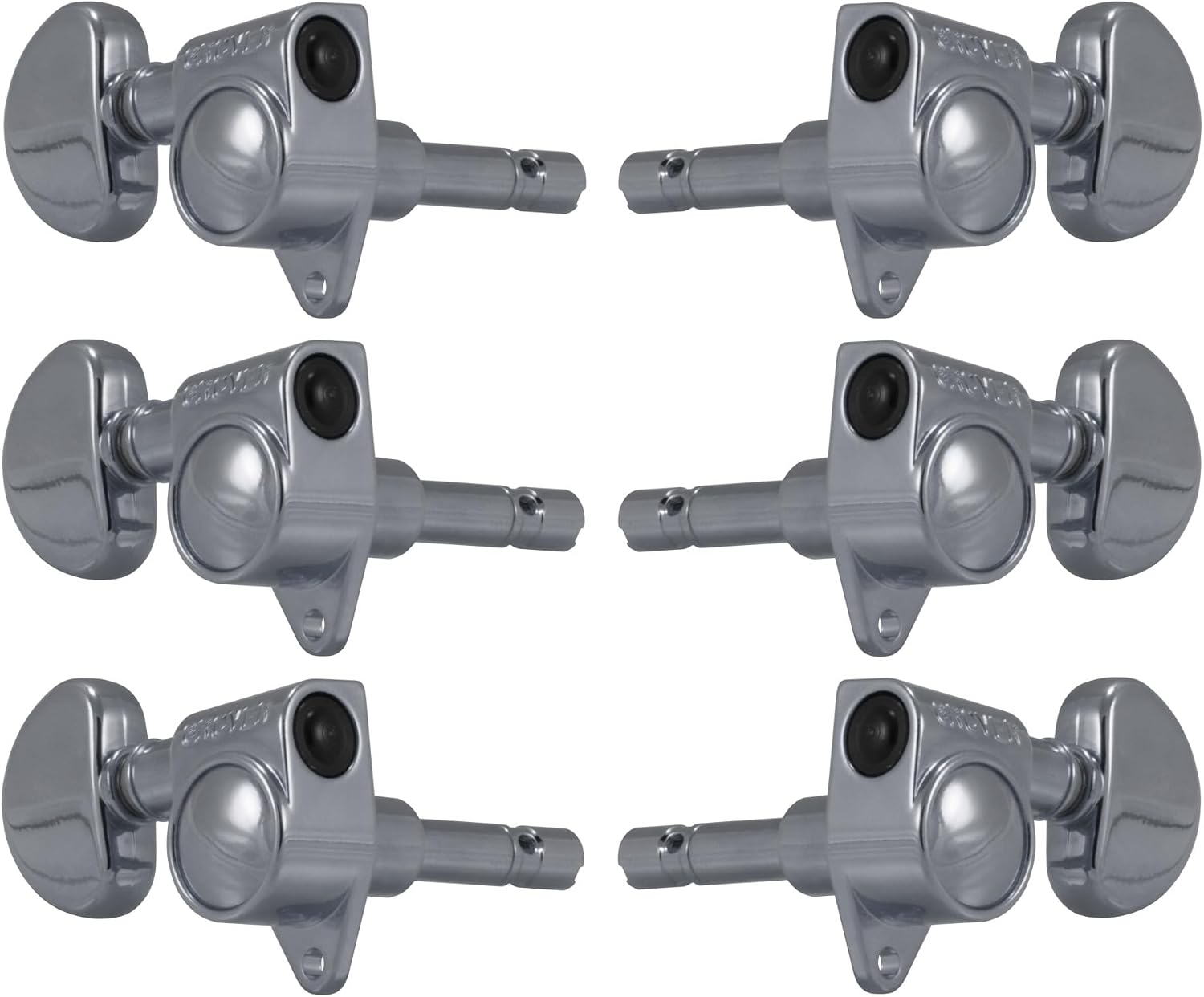
The 106C is the locking Rotomatic for players who prefer an automatic internal cam to a rear thumbwheel. Pull the string through by hand and begin tuning: the cam first grips the string, after which the post turns to bring it to pitch. It makes the locking step part of the normal tuning action.
The chrome three-per-side set uses an 18:1 ratio and enclosed, lubricated gearing. It keeps the familiar Rotomatic body shape, while the different post mechanism distinguishes it from both the non-locking 102-18N and the manually clamped 502N.
The clearest limitation for a heavy-strung Les Paul is Grover’s specified .054 maximum string gauge. Check that before choosing it for a thick low string or a heavily detuned setup. For a suitable set of strings and the correct mounting, the internal cam offers quick changes without an extra rear control to tighten.
Pros
- Internal cam engages as tuning begins.
- 18:1 gearing in an enclosed Rotomatic body.
- Locking action without a rear thumbwheel.
Cons
- Maker specifies a .054 maximum string gauge.
- Uses the larger Rotomatic mounting format.
GOTOH SD90 MG-T SL
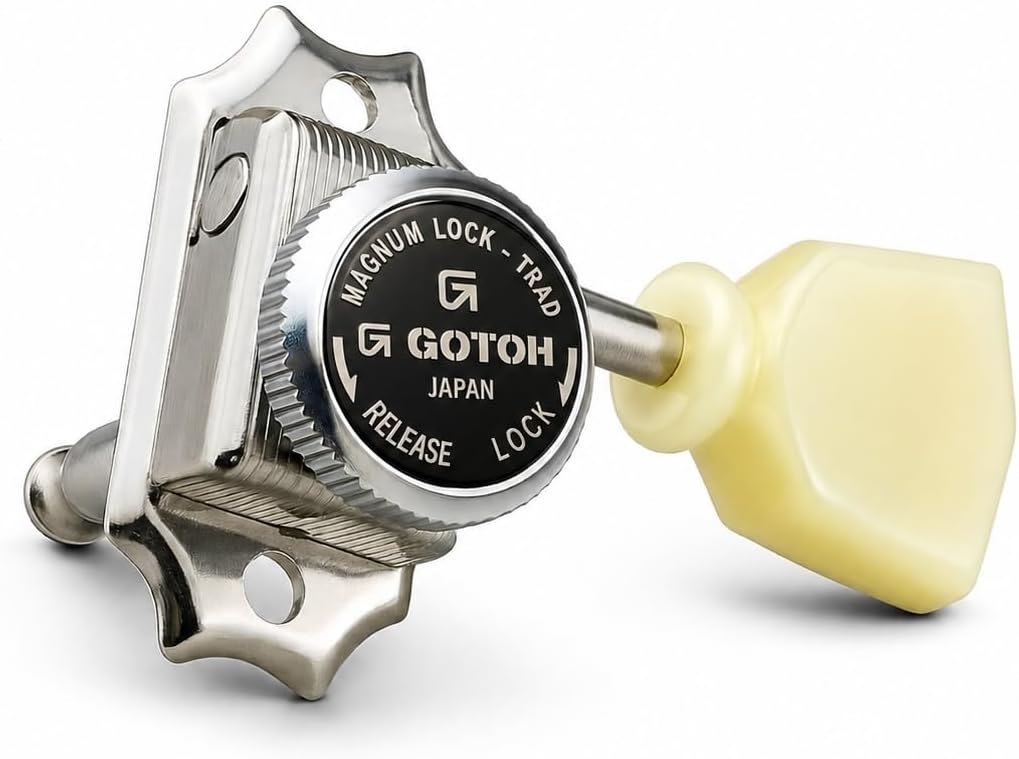
The SD90 MG-T combines a compact vintage-style body and keystone buttons with a rear-thumbwheel lock. It is an appealing direction for a Les Paul that needs locking convenience without the larger, rounded appearance of a full-size Rotomatic.
The nickel set uses GOTOH’s Magnum Lock-Trad posts and a 15:1 gear ratio. The selected three-per-side version has 21.5 mm posts and vintage-style press-fit bushings. It also uses GOTOH’s Rock-Solid post-support design, intended to reduce looseness at the string post.
This is the small-bushing approach rather than a front-threaded-nut design. That gives it a clear role on an appropriate vintage-format headstock, but means that an existing modern hole may need the correct conversion bushing. For the right mounting, it is a purposeful way to combine a traditional appearance with direct thumbwheel operation.
Pros
- Vintage-style body with rear-thumbwheel locking.
- 15:1 gearing and Rock-Solid post support.
- Three-per-side nickel set with keystone buttons.
Cons
- Press-fit bushings do not directly replace threaded-nut hardware.
- The 21.5 mm post version must suit the headstock.
GOTOH Magnum Lock-Trad 3+3 Chrome

This chrome Magnum Lock-Trad set offers a more modern enclosed shape with keystone buttons. Its practical attraction is the rear thumbwheel: the string can be secured at the post without relying on several carefully stacked turns around it.
The set contains three left and three right machines with an 18:1 ratio. GOTOH’s Rock-Solid post support aims to reduce unwanted movement, while the enclosed mechanism and threaded-bushing format suit a different installation from the vintage-style SD90 above.
Choose it when the existing guitar has the appropriate modern mounting and the chrome finish works with the rest of the hardware. Its fine ratio and accessible clamp make a useful combination for regular restringing and small pitch adjustments. The larger enclosed housing is less period-correct than a slim vintage-style machine, so appearance remains part of the decision.
Pros
- Rear-thumbwheel Magnum Lock-Trad mechanism.
- 18:1 gearing and Rock-Solid post support.
- Chrome finish with keystone buttons.
Cons
- Modern enclosed housings change the vintage appearance.
- Threaded bushings require the corresponding mounting format.
KAISH K1388 Vintage-Style Locking Tuners

The K1388 offers vintage-style tulip buttons and a rear locking thumbwheel in a small-hole format. Its main appeal is adding a string clamp while retaining a relatively traditional headstock appearance, rather than moving to a larger modern housing.
The nickel-finished set has three machines for each side, a 14:1 ratio and supplied bushings and screws. It is specified for smaller 8.1 mm tuner holes. The visible rear thumbwheel provides the manual locking control; string fitting should follow that mechanism’s instructions.
The small-hole requirement gives this set a specific role. A guitar with modern 10 mm holes needs correctly sized conversion bushings rather than a loose installation. Choose it when the mounting and desired appearance line up; the locking feature can simplify string changes, but careful nut and setup work still determine how the complete guitar behaves.
Pros
- Vintage-style tulip buttons with a manual rear lock.
- Three-per-side layout and 14:1 gearing.
- Specified small-hole format with bushings and screws.
Cons
- Modern 10 mm holes require suitable conversion bushings.
- Not the finer 18:1 adjustment of some alternatives.
GOTOH Magnum Lock-Trad 3+3 Gold

The gold Magnum Lock-Trad set brings the same enclosed locking approach as the chrome version to a guitar with gold bridge and tailpiece hardware. It is a coherent visual choice when a bright chrome replacement would stand out for the wrong reason.
Its useful features remain the rear thumbwheel clamp, 18:1 gearing and Rock-Solid post support. The supplied three-left/three-right arrangement suits the usual Les Paul layout, with keystone buttons preserving a familiar outline despite the more modern enclosed bodies.
The decision between this and the chrome set is primarily appearance, not an extra tuning function. Choose the finish that matches the instrument after checking the threaded bushings and screw layout. For a gold-hardware guitar that needs the corresponding modern mounting, it offers a practical locking upgrade without introducing a visibly mismatched set of buttons.
Pros
- Gold finish coordinates with matching guitar hardware.
- Magnum Lock-Trad rear-thumbwheel locking.
- 18:1 gearing in a three-per-side set.
Cons
- Finish adds no adjustment feature beyond the chrome version.
- Modern enclosed housing is not a vintage push-fit replacement.
Frequently Asked Questions About Tuners for Gibson Les Paul
Who Makes Gibson Les Paul Tuners?
Hardware varies by model, year and specification. Identify the machines actually fitted to the guitar rather than assuming one supplier or mounting pattern covers every Les Paul. Gibson-branded, Grover and GOTOH replacements offer different designs, with appearance and mechanical fit both worth considering.
When Do Stock Les Paul Tuners Need Replacing?
Damaged gears, excessive play or a rough turning action can justify a new set. Persistent tuning trouble can also come from strings settling, nut friction or the setup, especially when the pitch jumps during tuning. Installing locking machines does not remove those causes. Use appropriate strings for the guitar and a tidy winding method as part of the setup.
Are Grover Tuners Good for a Les Paul?
A suitable Grover model is a useful option. The 102-18N is conventional, the 106C uses an automatic internal cam, and the 502N uses a rear thumbscrew. Their mounting may be related, but the mechanisms and maximum string gauges differ. The 135N adds a vintage-style body with its own two-screw pattern.
What Should Be Measured Before Replacement?
Make a short record of the existing installation before comparing replacements. A clear photograph of the front and back of the headstock is a useful companion to the measurements.
- Front fixing: record the existing hole diameter and whether each post uses a press-fit bushing or a threaded retaining nut. The vintage appearance of a button does not identify the bushing type.
- Rear fixing: note the number and position of the mounting screws, or any locating pins. Compare their positions on the manufacturer’s drawing rather than judging from a front-facing product photo.
- Post and headstock: record the headstock thickness, bushing length and the height of the string hole above the face. The string hole must remain usable after the machine and bushing are fitted.
- Playing preference: decide whether you want ordinary winding or a locking mechanism for quicker string changes. That choice comes after the physical mounting, not before it.
Use the model descriptions above to narrow the mechanism: the Grover 102-18N uses conventional winding, the 502N uses a rear thumbscrew, and the 106C uses an internal cam. The GOTOH SD90 MG-T offers a vintage-format alternative with a rear locking control. They should not be treated as the same installation simply because each comes in a three-per-side arrangement.
The GOTOH SD90 MG-T product information and drawings illustrate why the exact post option matters. Match the drawing to the version being purchased. If a change would require drilling or enlarging holes, have the installation planned before ordering; a reversible replacement is a different job from a hardware conversion.
The same principle applies to replacement tuners for a Squier Strat, although the headstock arrangement differs. Our broader locking-tuner guide compares other applications.
Les Paul Replacement Tuners: Our Verdict
The Gibson PMMH-010 is the overall vintage-style restoration choice here for a corresponding screw-in-bushing installation. Grover’s 102-18N keeps conventional operation, while the 502N and 106C provide two clearly different locking systems. The 135N offers a vintage-button alternative with modern sealed gearing.
For a compact vintage-format locking set, the GOTOH SD90 MG-T is worth comparing with the KAISH K1388. The chrome and gold Magnum Lock-Trad sets serve a more modern mounting, while Wilkinson’s K1403 provides the two-hole E-Z Post approach. Choose the mechanism and adjustment feel that suit the player, with the physical mounting checked first.