Looking for the best replacement tuners for Squier Strat? Start with the hardware already on the headstock: tuner-hole diameter, rear fixing points and post height vary between Squier models. These four sets offer different mounting arrangements and stringing systems rather than one universal drop-in upgrade.
If you are also changing the sound of the same guitar, see our separate guide to pickup upgrades for a Squier Strat; tuner fitment does not establish pickup or pickguard fitment.
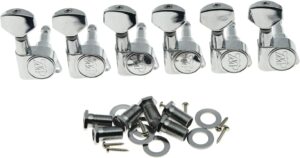
A good set of machine heads should turn predictably and hold the string securely. Locking models also make string changes quicker, but they cannot correct a binding nut, an unstable vibrato or poorly stretched strings. The Wilkinson E-Z Post set is the overall choice here for a guitar with matching 10mm holes and 45-degree screw fixings.
The 4 Best Tuners for Squier Strat
Wilkinson E-Z Post Tuners (Editor’s Choice)
The Wilkinson E-Z Post set combines a 19:1 gear ratio with sealed housings and compact, flat-sided buttons. Nineteen button turns move the string post through one revolution, giving useful control over small pitch adjustments. The chrome set reviewed here uses six in-line tuners for a conventional right-handed Strat-style headstock.
The distinctive feature is the two-hole E-Z post. It lets the string be secured through the post arrangement rather than clamped by a rear thumbwheel. That gives a different restringing routine from a conventional single-hole tuner without adding a separate screw-operated locking mechanism. The set includes bushings, washers and rear mounting screws.
It is the overall pick for a Squier with the matching modern mounting layout: 10mm headstock holes and a 45-degree fixing tab. All six posts are the same height, so retain the string tree where the guitar needs it. This is not the right no-modification choice for a smaller vintage-style bore, a two-pin layout or a differently positioned rear screw. Its appeal is fine adjustment and the E-Z stringing system, not a promise to cure every tuning problem.
Pros
- 19:1 ratio for fine pitch adjustment.
- Two-hole E-Z post stringing system.
- Sealed chrome housings with mounting hardware.
Cons
- Requires matching 10mm holes and 45-degree screw positions.
- Equal-height posts do not replace the function of a string tree.
Fender American Standard Tuners

Fender’s 0990820100 American Standard set uses staggered posts: two tall posts for the low E and A strings, and four shorter posts for the remaining strings. The shorter posts increase the string’s downward angle toward the nut. It is a clean, conventional option for players who want genuine Fender sealed tuners rather than a rear-thumbwheel locking design.
The 14:1 gearing gives a familiar tuning feel, while dual guide pins keep each housing aligned on a compatible headstock. Threaded bushings and washers secure the posts from the front. There is no separate rear mounting screw in this design, so the pin layout is a central part of the fit rather than an incidental detail.
The set makes sense on a Squier already equipped for the same Fender-style pin spacing, or as part of a properly planned headstock conversion. A Squier with two pins does not necessarily use the same spacing as an American Standard. Measure both pin positions and bore diameter before choosing it. The stagger is useful, but it is not a reason to remove a string tree without checking the resulting string angle.
Pros
- Genuine Fender six-in-line sealed set.
- Two tall and four short posts.
- 14:1 gears with bushings and washers included.
Cons
- Fender dual-pin spacing is not universal across Squier models.
- Conventional posts do not provide a thumbwheel string lock.
KAISH K2000-CR Locking Tuners
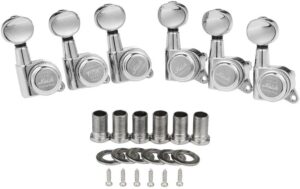
The KAISH K2000-CR set adds rear-thumbwheel locking to a six-in-line chrome design. Its mini oval buttons keep the appearance restrained, while the 18:1 gearing gives finer adjustment per button turn than a 14:1 mechanism. The string is held by the locking arrangement inside the post, reducing the number of wraps needed during a change.
This version uses a 45-degree rear screw tab and is intended for modern 10mm tuner holes. That makes it a candidate for a matching screw-mounted Squier layout, distinct from Fender-style dual-pin sets. The package includes the mounting hardware, and the rear thumbwheel provides direct access to the string clamp.
The practical gain is faster, less fiddly restringing, especially when changing a complete set before a rehearsal. It is not a floating-vibrato locking nut: the strings still move over the nut and through the rest of the guitar’s setup. A 90-degree fixing tab or smaller vintage-style bore is a different fit, and the added rear hardware needs sufficient clearance around adjacent tuners.
Pros
- Rear-thumbwheel locking for quicker string changes.
- 18:1 gearing and compact oval buttons.
- 10mm, 45-degree screw-mounted layout.
Cons
- Not a match for 90-degree screw tabs or smaller vintage bores.
- Locking posts cannot correct nut or vibrato friction.
Grover 205C6 Mini Rotomatic Tuners

The Grover 205C6 Mini Rotomatic set pairs small housings and mini buttons with sealed, lubricated gears. The compact format leaves useful finger room between the tuning keys. This is the chrome, six-in-line version, with a 14:1 ratio and conventional non-locking posts.
Grover specifies a 25/64-inch post hole, approximately 10mm, and includes bushings, washers and mounting screws. Its published post dimensions also help when checking the string path and headstock thickness. The result is an established sealed-tuner layout for a measured installation, rather than a generic promise that every Strat-shaped guitar uses the same holes.
Choose it for the small-button feel and conventional Rotomatic mechanism when the headstock dimensions and fixing positions suit. It does not offer the KAISH’s thumbwheel clamp or the Fender’s staggered-post arrangement. Grover itself does not identify the 205 series as a universal drop-in replacement, so a different rear fixing pattern may call for a luthier-installed conversion rather than a simple swap.
Pros
- Compact Mini Rotomatic housings and buttons.
- Sealed, lubricated 14:1 mechanism.
- Published dimensions and included mounting hardware.
Cons
- Non-locking posts use conventional string winding.
- Rear fixing pattern may require a planned conversion.
Do Locking Tuners Affect Tone?
Locking tuners are primarily a string-retention and restringing convenience. They are not a dependable way to make a guitar brighter, louder or more resonant. Different tuner weights can change how the instrument balances, but a particular tonal improvement should not be assumed.
Do Locking Tuners Help a Guitar Stay in Tune?
A locking post clamps the string so fewer wraps are needed. This can reduce movement in poorly wound strings and make changes more repeatable. Conventional tuners can also hold tuning well when the strings are installed correctly and the mechanism is in good condition.
The nut, string trees, bridge, vibrato setup and string stretching all remain relevant. If the pitch changes suddenly after bending or using the vibrato, investigate friction and setup rather than assuming the tuner gears are slipping.
Are Locking Tuners Worth It?
They are worth considering when quicker string changes are a priority or the current tuners are worn. They are less compelling when the existing machines work well and the tuning problem lies elsewhere. A rear locking wheel also adds hardware and weight, and installation may require more work than the word “upgrade” suggests.
Before buying, measure the headstock bore, thickness, post spacing and rear fixing pattern. Smaller vintage-style holes and modern threaded-bushing holes are different systems. Squier model names and production years alone are not enough to establish a no-drill fit. If enlargement or new pilot holes are required, have the work assessed by a competent guitar technician.
The broader locking-tuner comparison covers other designs. A Les Paul tuner set, by contrast, normally uses a three-per-side layout and is not interchangeable with a Strat’s six-in-line arrangement.
So, Which Tuner Set Should You Pair With a Squier Strat?
The Wilkinson E-Z Post set is the overall choice for a matching 10mm, 45-degree screw-mounted headstock. The KAISH K2000-CR adds thumbwheel locking in that broad mounting format. Fender’s American Standard set offers staggered posts for the correct dual-pin layout, while the Grover 205C6 provides a compact conventional mechanism.
Choose the mounting fit first, then decide which stringing system and button feel you prefer. A secure installation and a well-set-up nut and bridge matter more than expecting new tuners alone to solve every tuning issue.