Looking for the best cheap car amps under $200? These five four-channel amplifiers offer different ways to upgrade a car sound system, from compact speaker boosters to larger units with more crossover adjustment. Compare the power your speakers need, the available mounting space and the connections on your head unit before choosing.
For a separate higher-power car-audio comparison, see 2000 Watt Amps; check continuous ratings and the actual load rather than relying on a peak-watt label.

The Planet Audio AC1200.4 remains the overall budget-oriented pick for its input options and bridgeable layout. The compact Rockford and Kenwood suit tighter installations, while the Alpine adds adjustable filtering in a compact chassis. Prices vary, so treat the under-$200 category as a budget target rather than a guarantee for every model.
Top 5 Best Cheap Car Amps Under $200
| Image | Model | Size | Price |
|---|---|---|---|
| Planet Audio AC1200.4 (Editor's Choice) | 11 × 10 × 2.4 in | Check Price |
 | Alpine MRV-F300 | 7.87 × 7.87 × 2.17 in | Check Price |
 | Rockford Fosgate PBR300X4 | 6.75 × 4.25 × 1.53 in | Check Price |
 | Kenwood KAC-M1804 | 5.51 × 3.54 × 1.34 in | Check Price |
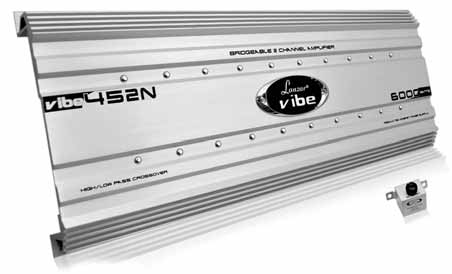 | Lanzar VIBE452N | 20.47 × 10.25 × 2.36 in | Check Details |
Planet Audio AC1200.4 (Editor’s Choice)
The AC1200.4 is a practical starting point for a budget system that needs more flexibility than a basic speaker booster. Its four-channel Class A/B design can run separate speakers or use approved bridged configurations. High- and low-level inputs make it easier to plan around either speaker-level signals or RCA outputs.
The crossover controls cover the essentials: an 80 Hz high-pass setting, an adjustable low-pass filter and variable bass boost. The fixed high-pass frequency is less flexible than a fully adjustable filter, but it provides a straightforward option for reducing deep bass sent to smaller speakers. Bass boost is best used sparingly because it consumes amplifier and speaker headroom.
The 1200-watt headline is a maximum figure, not the four-channel RMS output. Planet Audio specifies up to 113 watts RMS per channel at 4 ohms; use its load-specific ratings when matching speakers rather than treating the largest number as continuous power.
The AC1200.4 keeps the overall recommendation for its useful controls and connection options. Its 11-by-10-inch footprint needs more room than the smallest amps here, and four channels still require a plan: they do not independently power four speakers plus a subwoofer.
Pros
- Four channels with approved bridging options
- Speaker-level and RCA inputs
- High-pass, variable low-pass and bass-boost controls
Cons
- Fixed rather than adjustable high-pass frequency
- Larger footprint than the compact speaker boosters
Rockford Fosgate PBR300X4
The PBR300X4 is built around a clear practical advantage: useful four-speaker power in a very small enclosure. Rockford rates it at 75 watts RMS per channel into 4 ohms, measured at 14.4 volts. Its Boosted Rail Technology and compact format make it interesting when a conventional amplifier would consume too much space.
The input harness accepts RCA or speaker-level signals, while a two-/four-channel input switch allows a stereo source to feed all four outputs. The crossover offers fixed 80 Hz high-pass, low-pass and all-pass settings. These filters remove unwanted frequency ranges; they are not tone-boost switches.
The important restriction is the speaker load: this original PBR300X4 is for 4-ohm stereo operation only. It is not bridgeable and should not be confused with other similarly named Rockford models. That makes it a focused choice for four suitable speakers rather than a flexible subwoofer amplifier.
An aluminum heatsink and protection circuitry help manage normal operating demands, but the small chassis still needs ventilation. Choose the Rockford for space efficiency and its specified four-channel output, accepting the fixed crossover frequency and restricted load options.
Pros
- Very compact four-channel format
- 75 watts RMS per channel at 4 ohms
- RCA and speaker-level input options
Cons
- 4-ohm stereo operation only; not bridgeable
- Fixed 80 Hz crossover frequency
Lanzar VIBE452N
The VIBE452N is the larger, more adjustable amplifier in this group. Its four-channel layout includes separate input-level controls for the channel pairs and high-pass, low-pass or full-range operation. It is a more natural fit for a planned trunk installation than a discreet space-saving upgrade.
The adjustable crossover ranges are useful: the low-pass control covers 40–350 Hz, while the high-pass control reaches from 40 Hz to 3 kHz. Those settings offer more scope to shape each speaker pair’s working range than a fixed-frequency crossover. Bass boost adds another adjustment, though careful gain and crossover setup matter more than turning every control up.
Approved stereo and bridged configurations provide different ways to assign the channels. The RCA line inputs also mean the head unit or an appropriate integration device must supply a compatible signal. A large advertised wattage number is not a substitute for matching the system around continuous output and the permitted speaker load.
The Lanzar’s appeal is control and layout flexibility, with size as the main compromise. At roughly 20.5 inches long, it needs considerably more mounting room than the compact Kenwood or Rockford. Leave room for the terminals and airflow rather than judging fit from the bare chassis alone.
Pros
- Adjustable high- and low-pass crossover frequencies
- Separate level controls for the channel pairs
- Stereo and approved bridged configurations
Cons
- Long chassis needs substantial mounting space
- RCA inputs require a compatible source or integration device
Kenwood KAC-M1804
The KAC-M1804 keeps a speaker upgrade compact and straightforward. Its Class D design provides 45 watts RMS per channel into 4 ohms, with a small enclosure that is easier to accommodate than a full-size four-channel amp. It makes most sense for a simple four-speaker system rather than a subwoofer-centered installation.
Kenwood supports both RCA and speaker-level input signals through the input connections, so a head unit without preamp outputs is not automatically excluded. Signal-sensing turn-on is another useful feature for an appropriate speaker-level installation. Confirm the required harness wiring for the vehicle rather than assuming every factory system connects in the same way.
The conformal-coated circuit board adds environmental protection, but it does not make the amplifier waterproof. Kenwood specifically advises avoiding water splashes, excessive humidity, dust and heat. A sensible mounting location still matters, including in boats or other more exposed applications.
The trade-off for the small, uncomplicated design is limited system-tuning flexibility. It is non-bridgeable and intended for 4-ohm loads, with fewer onboard adjustments than the Alpine or Lanzar. Choose it when compact four-speaker amplification matters more than extensive crossover control.
Pros
- Compact Class D four-channel design
- 45 watts RMS per channel at 4 ohms
- Speaker-level input support and signal-sensing turn-on
Cons
- Non-bridgeable and intended for 4-ohm loads
- Limited onboard tuning; coating is not waterproofing
Alpine MRV-F300
The MRV-F300 is an appealing middle ground between a tiny speaker booster and a large traditional amplifier. Its Class D design is rated at 50 watts RMS per channel into 4 ohms or 75 watts into 2 ohms, at 14.4 volts. The chassis is about 7.9 inches square, making its size easier to plan around than many full-length amps.
Adjustable high- and low-pass filtering from 50–400 Hz gives useful control over what reaches the speakers. It supports four-, three- and two-channel arrangements with the appropriate wiring and loads. That flexibility is valuable if the system may evolve beyond four independently driven speakers.
RCA and speaker-level inputs support different head-unit arrangements. On channels 3/4, the bass EQ is a selectable boost rather than a continuously adjustable tone control, so it is a fairly coarse way to change the low end. The crossover settings and careful input-level adjustment remain the more precise tools.
Thermal and current protection are useful safeguards, but they do not remove the need for airflow and correct installation. The Alpine is a well-rounded choice for someone who wants a compact chassis with more tuning freedom than the smallest amps here. Its bass-boost switch and lack of a separate dedicated subwoofer channel are the main practical limits.
Pros
- Compact Class D chassis
- 50 watts RMS per channel at 4 ohms; 75 watts at 2 ohms
- Adjustable crossovers and multiple channel configurations
Cons
- Bass boost is a coarse on/off adjustment on channels 3/4
- A dedicated subwoofer channel requires a different system layout
How to Shop for the Best Car Amps Under $200
A budget amplifier should fit the speakers, source and vehicle as a system. The highest wattage printed on the case is rarely the most useful starting point. Begin with the channels and speaker loads you need, then compare continuous ratings under the same conditions.
Size: Will It Fit?
The table dimensions are the amplifier bodies in inches, listed as length × width × height. Check the available space, mounting brackets, cable exits and ventilation clearance. A compact case still needs a secure mounting position with airflow; fitting beneath a seat does not guarantee a suitable installation.
How Many Channels?
- A mono amplifier is commonly used for a subwoofer, leaving the main speakers to the head unit or another amplifier.
- A two-channel amplifier can drive a stereo speaker pair, or sometimes one subwoofer when correctly bridged. It does not normally provide two independent stereo speaker channels plus a separate subwoofer channel.
- A four-channel amplifier can power front and rear speaker pairs. Some models also allow one pair of channels to be bridged for a subwoofer while the other pair drives stereo speakers. Four speakers plus an independently amplified subwoofer generally calls for additional amplification or a suitable five-channel amp.
Bridging is available only where the manufacturer permits it, and the minimum load may differ from stereo operation. The PBR300X4 and KAC-M1804 here are not bridgeable.
Wattage and Power
Compare RMS or continuous output at the intended impedance and supply voltage. Maximum or peak figures describe a different condition and should not be substituted for continuous ratings. Check the speakers’ power-handling guidance as well as their impedance; factory speakers may not suit every aftermarket amp.
Gain matches the input signal to the amplifier. It is not an extra power control. Too much gain, excessive bass boost or driving the amplifier into clipping can create distortion and increase the risk of speaker damage. A lower-powered amp is not automatically harmful, and there is no universal rule requiring an amp to exceed every speaker’s rating by a fixed percentage.
Head Unit Compatibility
RCA preamp outputs are convenient for an amplifier with line-level inputs. If the radio only offers speaker-level signals, choose an amp that accepts them or use an appropriate integration interface. Factory systems can involve additional processing, so the presence of a high-level input alone does not guarantee a direct connection in every vehicle.
Plan the power cable, fuse, ground connection and mounting as part of the upgrade. Follow the amplifier’s installation instructions and use an experienced installer where the vehicle’s wiring or factory audio system makes the job less straightforward.
Verdict: Best Budget Car Amp Under $200
The Planet Audio AC1200.4 remains the overall budget-oriented choice for its combination of inputs, controls and bridgeable channels. For a tight mounting space, consider the Rockford’s specified four-speaker output or the compact Kenwood. The Alpine offers useful filtering and system flexibility, while the larger Lanzar provides more crossover adjustment when space allows.
Compare current pricing with the complete installation cost, including wiring and any integration hardware. A correctly matched amp that fits the system is more useful than a larger maximum-power claim.