The best headphone amp for Sennheiser HD 598 depends on the source you use and the problem you want to solve. A USB DAC/amp can replace a noisy computer output and add convenient volume control; an analog amplifier serves a different role. These five options cover both approaches.
If you are still choosing between the HD 558 and HD 598 themselves, see our separate HD 558 versus HD 598 comparison.
The HD 598 does not automatically need an expensive amplifier. If your current output already provides clean sound at a comfortable level, another device may bring little benefit. Start with the connections and controls you need.

The 5 Best Amps for HD 598
| Image | Model | Price |
|---|---|---|
| FiiO K3 (Editor's Choice) | Check Price |
 | Apogee Groove | Check Price |
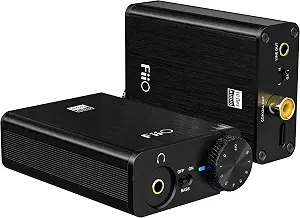 | FiiO E10K-TC | Check Price |
 | FiiO A3 | Check Price |
 | Schiit Fulla USB DAC/Amp | Check Price |
FiiO K3 (Editor’s Choice)
The K3 is the most versatile desktop option in this group. It combines a USB DAC and headphone amplifier with a physical volume knob, gain selection and bass boost. Its USB-C connection carries both power and audio from a compatible computer, keeping the setup compact without a separate desktop power supply.
The 3.5 mm headphone output is the relevant connection for a stock HD 598 cable with the appropriate stereo adapter. The K3 also has a separate 2.5 mm balanced output, line output and digital outputs, which are useful if your system grows. Those connections serve different jobs: an ordinary adapter does not turn the HD 598’s stock cable into a balanced connection. The broad set of outputs is the main reason to choose it over the simpler E10K.
Pros
- USB-powered DAC and headphone amplifier
- Volume knob with gain and bass controls
- Headphone, line and digital output options
Cons
- Needs a compatible USB audio source
- Extra balanced socket does not benefit a stock HD 598 cable
Apogee Groove
The Groove keeps desktop listening simple: USB audio goes in, and headphones connect to a single 3.5 mm output. Hardware buttons control volume, while its small enclosure takes up much less room than a conventional desktop component. It suits someone who values a compact computer-listening setup over a panel full of switches and sockets.
Apogee combines its Constant Current Drive design with a Quad Sum DAC architecture. Those are features of the circuit, not a promise that every headphone will sound better. The practical trade-off is connectivity: there is no analog input or collection of dedicated line and digital outputs to manage. Check Apogee’s software requirements for your operating system before setting it up, particularly on Windows.
Pros
- Compact USB-powered design
- Physical volume controls
- Single headphone connection keeps operation straightforward
Cons
- Fewer output options than the K3
- Operating-system setup may require a driver
FiiO E10K-TC
The E10K-TC is a straightforward USB DAC and amplifier for a computer desk. A front-panel volume knob and 3.5 mm headphone socket keep daily operation simple, while gain and bass switches offer useful adjustment without a software control panel. For an HD 598 owner who mainly needs a convenient wired output, that simplicity is its strength.
This is the USB-C version. FiiO specifies USB audio support up to 32-bit/384 kHz, alongside a rear 3.5 mm line output and coaxial digital output. The coaxial output has a different maximum format from USB playback, so those figures should not be treated as interchangeable. High-resolution support is an input capability rather than proof of an audible improvement; the useful question is whether the device solves noise, connection or volume problems in your existing setup.
Pros
- USB-C connection supplies audio and power
- Gain and bass switches
- Separate headphone, line and coaxial outputs
Cons
- No analog audio input
- No balanced headphone output
FiiO A3
The A3 fills a different role from the USB DACs above: it is a battery-powered analog headphone amplifier. A 3.5 mm audio connection carries the source signal into it, while gain and bass switches let you adjust the amplification and low-end emphasis. It is most useful when your source already has a suitable analog output but needs a more convenient or capable headphone stage.
FiiO specifies a headphone range of 16–150 ohms, which includes the original 50-ohm HD 598. The rechargeable design makes the A3 usable away from a computer, but adds battery management to the routine. Its USB charging connection is not a USB audio input, and an amplifier cannot remove noise or distortion that is already present in the signal feeding it.
Pros
- Battery operation supports portable use
- Analog input works with suitable existing sources
- Gain and bass switches
Cons
- Requires charging
- No USB DAC function; needs an analog audio source
Schiit Fulla USB DAC/Amp
The original Fulla is a small USB DAC and headphone amplifier built around direct, simple operation. Its physical volume control gives computer listening a more convenient adjustment point than repeatedly opening an on-screen mixer. It is an appealing design when you want a compact wired listening setup with very little desk clutter.
This review concerns the original Fulla USB model, not a later Fulla gaming DAC with different connections. That distinction matters because features from newer generations cannot be assumed here. Choose it for the straightforward USB-to-headphone role; the K3 is the more flexible option if you need extra outputs, while the battery-powered A3 is better suited to an analog portable source.
Pros
- Compact USB DAC and headphone amplifier
- Physical volume control
- Simple wired listening setup
Cons
- Older design with fewer connection options
- USB operation depends on a suitable source
Do I Need an Amp for HD 598?
Use the headphones with your existing source first. If the output reaches a comfortable level without audible hiss or distortion, a separate amplifier is optional. A DAC/amp is useful when you need a better connection, a quieter output or convenient hardware volume control. Impedance alone does not tell you the complete power requirement.
USB DAC/Amp or Analog Amplifier?
A USB DAC/amp accepts digital audio and converts it into a headphone signal. The A3 instead amplifies an analog input. Choose the former for a compatible computer USB connection and the latter when you already have a suitable analog source. A cable adapter cannot give a device an audio function its input does not support.
Headphone Connections
The original HD 598 cable uses a stereo connection. Use a suitable 6.35 mm-to-3.5 mm adapter where required. Do not connect that cable to a balanced headphone socket through a passive wiring adapter; use the single-ended output intended for standard stereo headphones.
Which Amplifier Should You Choose?
The FiiO K3 is the overall choice for its flexible connections and useful desktop controls. The E10K-TC is a simpler alternative for USB listening, while the Groove and original Fulla keep the setup compact. Choose the A3 when battery-powered analog amplification is the job you need done. The most useful upgrade solves a specific limitation in your current system rather than promising a transformation every listener will hear.