Looking for the best 6×8 speakers for your car? Replacing worn factory speakers can be a worthwhile way to bring voices, guitars and percussion back into focus. The right upgrade should suit the opening in the vehicle, the power available and the kind of sound you want to build around.
For a vehicle that uses a 4×6 mounting format instead, see 4×6 Speakers With Good Bass; a 6×8 speaker is not a fitment substitute.

These five options range from straightforward two-way replacements to more elaborate three- and four-way designs. The Rockford Fosgate Punch P1683 remains the overall pick for its combination of useful power handling, integrated filtering and adjustable mounting points. The reviews below explain where each alternative makes sense—and where a separate subwoofer would help more than another pair of full-range speakers.
Top 5 Best 6×8 Speakers
| Image | Model | Price |
|---|---|---|
| Rockford Fosgate Punch P1683 (Editor's Choice) | Check Price |
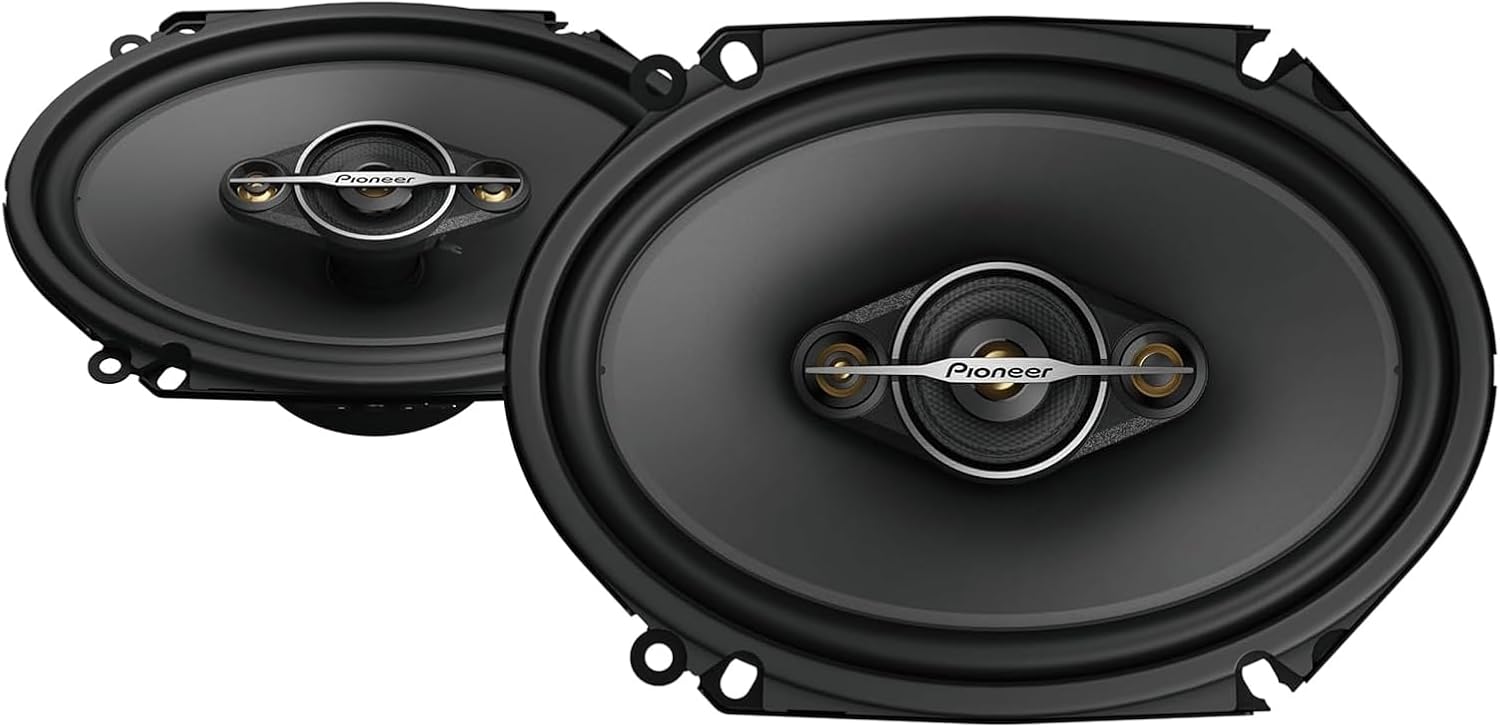 | Pioneer TS-A6881F | Check Price |
 | Rockford Fosgate Prime R168X2 | Check Price |
 | Kicker DS68 | Check Price |
 | Pyle PL683BL | Check Price |
Rockford Fosgate Punch P1683 (Editor’s Choice)
The Punch P1683 is the overall choice for a system that needs a capable factory-speaker replacement with room for modest amplification. Each 4-ohm speaker handles 65 watts RMS, giving it a useful step up in continuous-power capacity from the lower-rated DS68. Its three-way arrangement puts the higher-frequency drivers above the oval woofer, keeping the system within one mounting position.
The mineral-filled polypropylene cone and butyl-rubber surround form a practical foundation for the woofer. Rockford’s VAST surround design makes more of the available frame area, while the integrated crossover keeps the high-frequency filtering inside the assembly. There is no separate crossover box to mount in the door.
FlexFit mounting slots allow some movement when lining up the frame with the original fixing points. That is a useful detail in a replacement speaker: a little adjustment can make the difference between a straightforward fit and an awkward screw position. It still needs the right cutout and enough clearance behind the factory trim.
The appeal is a well-equipped full-range speaker rather than a promise of subwoofer bass. Its 130-watt maximum rating is not a continuous target, and heavy bass boost can use up the available headroom quickly. With suitable filtering and sensible gain settings, it is a sound starting point for a balanced everyday system.
Pros
- 65W RMS handling per speaker at 4 ohms
- FlexFit slots help align mounting points
- Integrated crossover avoids a separate filter box
Cons
- Does not replace a dedicated subwoofer
- Frame and depth still need a vehicle-specific fit check
Pioneer TS-A6881F
The TS-A6881F suits someone who wants a more elaborate full-range design without moving to a separate component-speaker installation. Its four-way layout combines the oval woofer with a 42mm midrange driver and small PET high-frequency drivers. Everything stays together on the speaker frame, which avoids finding another mounting position for a separate tweeter.
The woofer uses a carbon- and mica-reinforced IMPP cone. Reinforcement is intended to help the cone maintain its shape as it moves, while the additional drivers cover the middle and upper frequencies. The practical attraction is broad coverage from one assembly, rather than an assumption that four drivers must beat every two-way design.
Pioneer specifies 80 watts RMS per speaker at 4 ohms, with a 350-watt maximum figure. The continuous rating is the useful starting point when considering an amplifier. A 2.5-inch mounting depth is another important number: the magnet and basket must clear the structure behind the opening, not just match the size of the grille.
This is an appealing alternative when a compact amplified system is planned and the mounting space is suitable. The trade-off is that the stacked driver assembly also needs space beneath the factory grille. Keep deep-bass expectations realistic and let a subwoofer handle the lowest notes if that is central to the system.
Pros
- Four-way layout keeps the drivers in one mounting position
- Carbon/mica-reinforced IMPP woofer
- 80W RMS handling per speaker
Cons
- 2.5-inch depth needs adequate rear clearance
- More drivers do not guarantee a better result in every installation
Rockford Fosgate Prime R168X2
The R168X2 makes the case for keeping a factory-speaker refresh simple. It is a two-way 6×8-inch design, with a polypropylene woofer and a flush-mounted silk-dome tweeter. The layout is less elaborate than the P1683 or Pioneer, but the integrated high-pass crossover keeps the high-frequency filtering within the assembly.
Its 55-watt RMS rating per speaker at 4 ohms gives it useful scope for a modest amplifier system. That is the figure to work from, rather than its 110-watt peak rating. The silk dome is an interesting choice for listeners who prefer this type of tweeter construction, although the final tonal balance will also depend on placement, trim and equalization.
The physical design is worth checking before committing to it. Rockford gives a mounting depth of about 2.54 inches, so it is not automatically the shallowest or easiest option because it has fewer drivers. Measure clearance around window hardware and behind the mounting surface, as well as the opening itself.
Choose the Prime for a straightforward full-range replacement with sensible continuous-power capacity and no separate tweeter or crossover box to accommodate. It is less compelling if the main aim is much deeper bass: that calls for a different part of the system, rather than asking the R168X2 to do a subwoofer’s job.
Pros
- Simple two-way layout with a silk-dome tweeter
- Integrated high-pass crossover
- 55W RMS handling per speaker
Cons
- Approximately 2.54-inch depth can limit fit
- Limited low-bass output compared with a separate subwoofer
Kicker DS68
The original DS68 is an uncomplicated choice for a lower-powered factory-speaker replacement. Its polypropylene woofer and half-inch PEI balanced-dome tweeter share a conventional two-way frame. That gives it a clear purpose: a compact full-range speaker for everyday listening, rather than the centerpiece of a high-power installation.
Kicker’s 2011 DS manual specifies a 6–35-watt RMS operating range per speaker at 4 ohms. The 70-watt peak rating is separate; multiplying figures across several speakers does not increase what one speaker can handle. The manual also gives 90dB sensitivity at one watt and one meter, a useful reference when planning a modest system.
The tweeter protrudes only about 2mm above the frame, which can help beneath a close-fitting original grille. Rear clearance still matters: the same manual gives a 60mm bottom-mount depth. Grilles are not included with the DS68, so retaining the factory protection is part of a sensible installation.
The main limitation is its lower continuous-power capacity beside the Rockford and Pioneer options. It makes more sense for a restrained refresh than for someone planning to keep increasing amplifier output. This review concerns the original DS68, whose specifications differ from later Kicker DSC models.
Pros
- Straightforward two-way design for a lower-powered system
- Low tweeter protrusion helps with grille clearance
- 90dB sensitivity specified at 1W/1m
Cons
- 35W RMS capacity is lower than the other named Rockford and Pioneer options
- No grilles included
Pyle PL683BL
The PL683BL is the visually distinctive option in this group, with a blue polypropylene woofer cone and a three-way driver arrangement. A 1-inch film-dome midrange and a 3/4-inch piezo tweeter sit above the woofer, keeping the full-range assembly together in the standard oval mounting format.
The butyl-rubber surround is a useful construction detail, and the 4-ohm impedance is familiar territory for a compatible car-audio system. Pyle also includes grilles, wire and mounting hardware, which can help when the speaker will not sit behind an existing factory cover. The grille still needs enough space to clear the surrounding trim.
At 2.35 inches deep, it is not an especially shallow replacement. Its bright cone is also part of the appeal only if the installation leaves it visible; behind an opaque factory grille, fit and system matching matter far more than color. The three-way format is a design choice, not evidence that it outperforms the other speakers here.
This is worth considering for a simple replacement where the dimensions and included accessories are useful. The manufacturer’s large advertised power figures should not be the deciding factor: they are not a controlled comparison with the per-speaker RMS ratings above. For an amplified build, prioritize a clearly matched operating specification and sensible crossover settings over the headline wattage.
Pros
- Three-way assembly with a distinctive blue cone
- Butyl-rubber surround
- Includes grilles, wire and mounting hardware
Cons
- 2.35-inch depth needs adequate clearance
- Headline power figures are not a reliable basis for ranking these speakers
What to Look for When Buying a 6×8 Speaker
Sensitivity Rating
Sensitivity describes sound output for a stated input and measurement distance. It is not a power-handling limit or an indication of the ideal volume setting. Compare figures measured on the same basis: a 2.83V measurement is not automatically equivalent to one watt, particularly with a 4-ohm speaker.
Sound Quality
Driver materials, crossover design, placement and installation all contribute to the result. A silk dome, PEI dome or reinforced cone describes part of the design; it does not guarantee a particular listening experience. A secure mounting surface and a good seal around the frame can matter as much as an impressive list of materials.
Use continuous or RMS power handling when planning amplification, and keep impedance, gain and crossover settings in view. Avoid audible distortion and excessive bass boost. Neither a large peak-power number nor a high sensitivity rating makes a speaker immune to damage.
Frequency Response
A wide published frequency range does not tell you how evenly the speaker plays across it. The vehicle and mounting position also change the response. Full-range 6×8 speakers can cover much of everyday music, but a dedicated subwoofer remains the more effective route to strong output in the lowest bass notes.
Installation
Check the cutout, screw pattern, mounting depth and clearance beneath the grille. Window mechanisms and factory brackets can make two apparently identical openings very different jobs. Confirm any adapter and wiring-harness requirements before removing the trim; a 6×8 label alone is not a universal-fit promise.
Need Even More Bass?
Build the system around the result you want. If deep bass matters most, adding a properly installed subwoofer can be more useful than replacing one full-range speaker with another. Appropriate filtering can then let the main speakers concentrate on the rest of the music.
If the vehicle has larger openings, the 6×9 speaker guide covers another factory-replacement format. A different frame size is useful only when it suits the vehicle.
The Best 6×8 Speakers: Our Verdict
The Rockford Fosgate Punch P1683 remains the overall pick for its combination of 65W RMS handling, integrated filtering and adjustable mounting points. The Pioneer TS-A6881F offers a four-way alternative with more continuous-power capacity, while the R168X2 is a simpler two-way option.
The original Kicker DS68 is better suited to a lower-powered refresh, and the Pyle PL683BL adds grilles and a distinctive appearance. Choose around the actual mounting space and system rather than a promise that one pair of speakers will transform every car.