Looking for the best 4×6 speakers for your car or truck? A well-chosen replacement can refresh tired factory speakers without asking you to rebuild the whole audio system. These three designs take different approaches to the same compact mounting space.
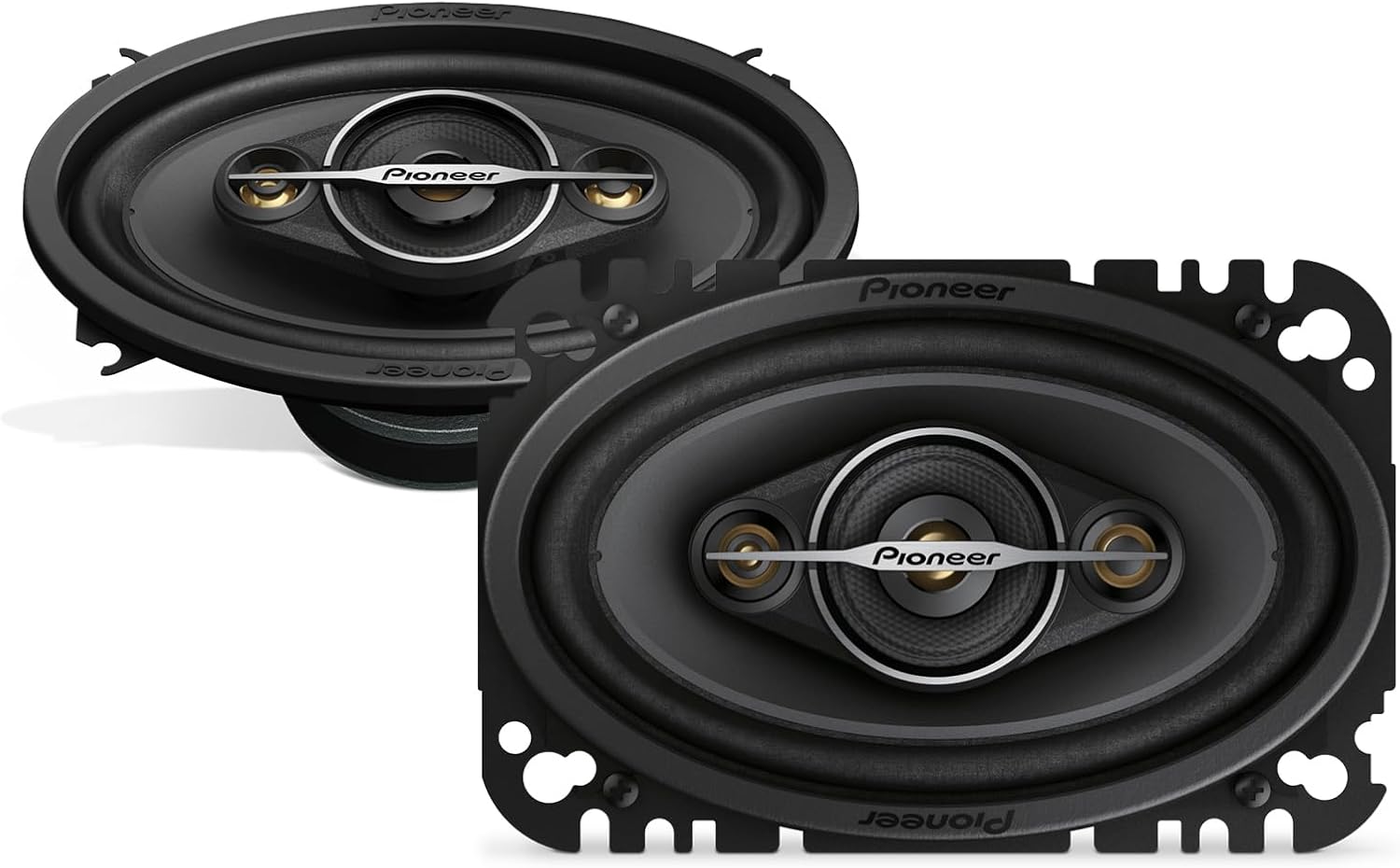
The Pioneer is the overall pick for a shallow, straightforward factory-speaker upgrade; the Rockford emphasizes mounting flexibility, while the Polk uses a separate round woofer and tweeter on a plate. The Watts column below shows continuous power handling per speaker, not peak power. None is a substitute for a subwoofer if deep bass is the priority.
Best 4×6 Speakers Comparison Chart
| Image | Model | Watts | DB | Price |
|---|---|---|---|---|
| Pioneer TS-A4671F (Editor's Choice) | 30W | 88 | Check Price |
 | Rockford Fosgate Punch P1462 | 35W | 87.5 | Check Price |
 | Polk Audio DB461P | 50W | 91 | Check Price |
Pioneer TS-A4671F (Editor’s Choice)
The TS-A4671F is the most rounded starting point here for replacing worn factory speakers in a shallow 4×6-inch location. Its 1-5/8-inch mounting depth is a useful advantage where space behind a dashboard or trim panel is tight. The familiar oval format also keeps the installation concept simple, although the cutout, screw positions and rear clearance still need to suit the vehicle.
Pioneer uses a carbon- and mica-reinforced IMPP woofer, with a 42mm midrange driver and small PET high-frequency drivers arranged above it. The four-way layout divides the work among those drivers rather than asking the woofer to cover the entire range. That is a thoughtful design for a compact full-range replacement; the number of drivers alone does not establish that it sounds better than a good two-way speaker.
Continuous power handling is 30 watts per speaker at 4 ohms. That makes it a more natural fit for a modest everyday system than for an installation built around very high output. The large peak-power figure is not a continuous operating target, and the small cone still limits how much low bass it can move.
Its appeal is the combination of a shallow basket, a reinforced cone and a complete full-range layout in a small footprint. Choose it for a practical factory-speaker refresh, then use sensible equalization rather than heavy bass boost to get the best from that size. For a strong kick below the speakers’ comfortable range, a separate subwoofer remains the more effective upgrade.
Pros
- Shallow 1-5/8-inch mounting depth
- Reinforced IMPP woofer with dedicated midrange and high-frequency drivers
- Conventional 4-ohm design for a modest car-audio system
Cons
- Limited deep-bass output from a small cone
- 30W continuous rating is not intended for a high-power system
Rockford Fosgate Punch P1462
The Punch P1462 earns its place through the details that make a factory replacement less awkward. Its FlexFit basket provides some adjustment at the mounting points, and the supplied multi-OEM adapter plate offers additional mounting options. That flexibility is useful when the original speaker uses an inconvenient hole pattern, even though it cannot guarantee a direct fit in every car or truck.
The two-way arrangement combines a mineral-filled polypropylene cone with a 3/4-inch PEI dome tweeter. Rockford’s VAST surround design aims to leave more usable cone area within the frame, while the integrated crossover keeps the filtering within the speaker assembly. The result is a compact design with fewer separate components to find space for.
Rockford rates the P1462 at 35 watts RMS and 70 watts maximum per speaker, with 87.5dB sensitivity measured at one watt and one meter. Those are useful system-planning figures, rather than a reason to call it the loudest speaker in the group. Its small woofer is better treated as part of a balanced full-range system than as the source of substantial low bass.
The mounting hardware and adapter plate are welcome practical touches, but grilles are not included with this model. It is particularly worth considering when keeping the factory grille and working around the original mounting arrangement matters more than adding a decorative speaker cover. Allow time to check clearance and wiring before taking the trim apart.
Pros
- Adjustable mounting points and multi-OEM adapter plate
- Integrated crossover keeps the installation compact
- Clearly specified 35W RMS handling at 4 ohms
Cons
- Grilles are not included
- Mounting flexibility does not eliminate vehicle-specific fitting work
Polk Audio DB461P
The DB461P takes a different route to filling a 4×6-inch opening: a 4-inch round woofer and a separate 3/4-inch soft-dome tweeter sit side by side on a plate. That gives the tweeter its own position beside the woofer instead of placing it over the center of an oval cone. The plate layout is the defining reason to consider this Polk, rather than simply comparing the numbers on its box.
A polymer/mica cone and butyl-rubber surround provide the woofer’s working structure, while the silk/polymer dome handles the treble. These are purposeful materials for a speaker that may face heat, sunlight and humidity. Marine certification adds appeal for exposed vehicles or suitable marine installations, but it does not make the speaker safe to submerge or remove the need for protected wiring.
Polk specifies 50 watts continuous power handling per speaker at 4 ohms and a sensitivity rating of 91dB. The higher continuous rating gives more amplifier-matching scope than the other two on this list; it does not, by itself, promise better sound or deeper bass. The round 4-inch woofer remains a small driver, so bass-heavy music still benefits from a separate low-frequency speaker.
The trade-off is physical fit. A plate assembly needs clearance for the woofer, tweeter and mounting surface, and the 4×6 label is not proof that it will sit neatly behind every original grille. For a compatible location, the separate-driver layout and weather-resistant construction make it a distinctive alternative to an ordinary oval coaxial.
Pros
- Separate 4-inch woofer and 3/4-inch soft-dome tweeter on a 4×6 plate
- Butyl surround and marine-certified construction
- 50W continuous handling per speaker
Cons
- Plate layout requires careful clearance checks
- Marine certification does not mean waterproof or submersible
How to Pick the Best 4×6 Speakers for Bass
The best-sounding 4×6 speakers for one installation may be a poor match for another. Start with the mounting space and the equipment already in the car, then decide what improvement matters most.
Know What You’re Trying to Achieve
Replacing a damaged or tired factory speaker can make voices and instruments easier to follow. A small 4×6-inch driver still has limited cone area and excursion, though. If the goal is deep, room-filling bass, a properly installed subwoofer is a more direct solution than pushing these speakers with excessive bass boost.
An amplifier can provide more clean output when correctly matched and adjusted; it does not turn a small woofer into a subwoofer. A suitable high-pass filter can reduce the low-frequency load on the main speakers when a subwoofer handles the bottom end.
Pay Attention to Frequency and Power Ratings
A published frequency range does not show how evenly a speaker plays across that range, particularly once it is installed behind a grille or in a door. Do not choose a small speaker solely because its specification starts at a lower frequency.
Use continuous or RMS power handling when planning an amplifier system. Peak ratings describe a different limit and are not a sensible everyday power target. Impedance, gain adjustment, crossover settings and audible clipping all matter; a matching wattage number alone does not guarantee protection.
The DB column reports manufacturer sensitivity figures in decibels. Pioneer specifies 88dB at one watt and one meter, and Rockford specifies 87.5dB on that basis. Polk publishes 91dB in its manual without the same measurement reference there, so these numbers should not be treated as a controlled loudness comparison.
Shape and Material
Measure the cutout, mounting pattern, depth and clearance beneath the factory grille. Check for window mechanisms, dashboard structure and wiring behind the speaker. Adapters and harnesses can simplify a job, but neither an oval frame nor a flexible mounting slot makes a speaker universal.
The Polk’s plate-mounted round woofer needs a different clearance check from an oval coaxial. Reinforced cones, rubber surrounds and weather-resistant construction each serve a purpose, but no single material guarantees better sound or immunity to damage. A secure mounting surface and a good seal around the speaker are worth getting right.
The Best 4×6 Speakers with Good Bass: Our Verdict
The Pioneer TS-A4671F is the overall choice for a compact factory-speaker upgrade, thanks to its shallow mounting depth and well-rounded full-range design. The Rockford P1462 is especially interesting when mounting flexibility matters, while the Polk DB461P offers a separate-driver plate layout and marine-certified construction.
Choose the design that fits the actual opening and the system you plan to use. For everyday listening, a tidy installation and sensible settings will do more good than chasing the biggest peak-power number.