Looking for the best battery powered DJ mixer for a compact setup? These three portable mixers can combine audio sources away from a wall outlet. The main differences are stereo routing, microphone support and whether you need USB recording.
These are small audio mixers rather than turntable battle mixers: none has a crossfader or built-in phono preamp. They suit simple playback, announcements and portable submixing. For a scratch player, a dedicated DJ mixer is the more appropriate tool.
The 3 Best Battery Powered DJ Mixers (Comparison)
| Image | Model | Price |
|---|---|---|
| Pyle PAD20MXU.5 Audio Mixer (Editor's Choice) | Check Price |
 | Pyle PAD15MXU Audio Mixer | Check Price |
 | Nady MM-141 Mini Mixer | Check Price |
Pyle PAD20MXU.5 Audio Mixer (Editor’s Choice)
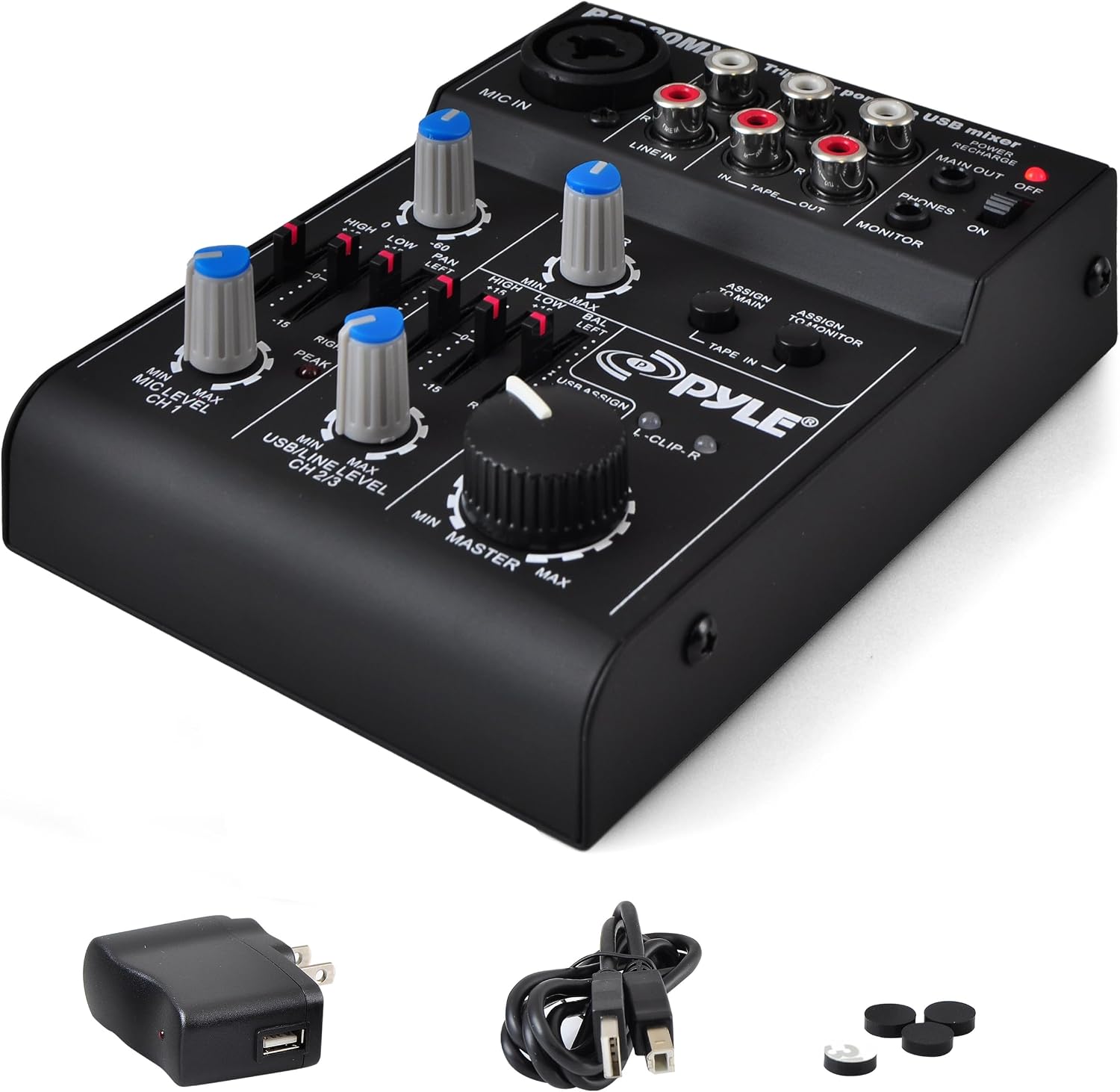
The PAD20MXU.5 is the most versatile all-round option here for a microphone alongside stereo playback. Its compact layout puts the main adjustments within easy reach, and the rechargeable battery makes it practical for a small portable rig. USB audio also gives it a useful role at a desk after the event is over.
The connections include an XLR/quarter-inch microphone input, stereo RCA inputs and separate 3.5mm main and monitor outputs. Two-band EQ and pan or balance controls provide basic shaping, while clip indicators help show when levels are being pushed too far. The advertised five channels include stereo sides; this is not five separate microphone inputs.
The limitations are straightforward: small connectors and closely spaced controls are less convenient than a full-size mixer, and there is no crossfader for deck transitions. Its 18V phantom supply also needs to suit the particular microphone. Choose it for flexible compact mixing and recording, rather than elaborate DJ performance controls.
Pros
- Rechargeable battery and USB audio interface.
- Microphone input plus stereo RCA connectivity.
- EQ, monitoring and clip indicators in a compact unit.
Cons
- No crossfader or phono inputs.
- 18V phantom power does not meet every condenser microphone’s requirements.
Pyle PAD15MXU Audio Mixer
The PAD15MXU is a compact solution for a voice and a stereo source. That makes more sense for announcements, a small presentation or simple playback than a complicated multi-deck performance. Its built-in rechargeable battery keeps the setup portable without requiring a separate battery pack.
A mono microphone/line channel sits alongside a stereo RCA channel, with USB playback and recording adding flexibility. Headphone monitoring is useful for checking the signal, and the microphone channel has basic EQ and an echo control. The three-channel description counts the stereo left and right sides separately.
Its strength is a small, uncomplicated setup, not extensive expansion. The microphone supply is 18V rather than standard 48V, and it is always present at the XLR input when powered. Use a suitable microphone and balanced connection. Choose it when the input count is enough and an accessible voice-plus-playback mixer is more useful than a larger console.
Pros
- Rechargeable battery with USB audio input and output.
- Headphone monitoring and stereo RCA connections.
- Microphone EQ and echo control.
Cons
- Limited number of independently controlled sources.
- Always-present 18V phantom power needs microphone compatibility.
Nady MM-141 Mini Mixer
The MM-141 is the simplest option: four line-level sources, four level knobs and a master control. Its appeal is the lack of fuss. When several mono outputs need to feed one destination, the small steel enclosure can take the place of a much larger mixer.
Four unbalanced quarter-inch inputs feed a single unbalanced quarter-inch output. It runs from a 9V battery or an optional PAD-1 adapter, making it useful for a compact submix where mains power is inconvenient. The controls are easy to understand because each source has its own level adjustment.
The compromise is substantial for a DJ setup: the mix is mono, with no USB recording, EQ, echo or headphone cue section. It is a line mixer rather than a substitute for a microphone preamp, and stereo sources need appropriate routing. Choose it for straightforward mono submixing, not stereo music presentation or turntable work.
Pros
- Four individual level controls and a master knob.
- 9V battery or optional adapter operation.
- Compact steel housing.
Cons
- Mono output; no stereo mix or headphone cue section.
- No microphone preamp, USB interface, EQ or effects.
What Is a Benefit of Having an Unpowered DJ Mixer?
“Unpowered” usually means a mixer has no built-in speaker power amplifier. It still needs electrical power to operate, whether that comes from a battery, USB or an adapter. All three mixers here send an audio signal to other equipment; they do not directly drive passive PA speakers.
Portability
Battery operation removes one power connection, but the rest of the system still needs planning. A laptop, player and powered speaker each have their own power requirements. Test the complete setup before relying on it away from an outlet, and start with a fully charged battery.
Inputs and Monitoring
Count the sources you need to control independently rather than relying on the channel total. One stereo input occupies two audio channels but may share a single level knob. For DJs, headphone cueing, crossfader layout and phono support can matter more than a larger channel number. A USB socket also does not necessarily mean a mixer can play files from a thumb drive.
Sound and Power
Battery power does not guarantee cleaner sound or fewer effects. Set input levels to avoid clipping, use the correct cables and keep enough headroom for louder passages. An 18V phantom supply is not equivalent to 48V: check the microphone’s permitted operating range, and avoid unsuitable unbalanced XLR connections.
Conclusion: The Best Battery Operated DJ Mixer Is…
The PAD20MXU.5 is the overall choice for its combination of microphone support, stereo routing and USB audio. PAD15MXU suits a simpler voice-plus-playback setup; MM-141 is for basic mono line submixing. Match the controls and connections to the job, and choose a dedicated performance mixer if crossfader work or turntable inputs are essential.