Choosing the best strings for Gibson SG guitars starts with feel: easy bends, firmer rhythm playing or a smoother, mellower response. The seven six-string electric guitar sets below offer useful differences in gauge, winding and material, from familiar nickel-wound .009s to jazz-oriented flatwounds.

The SG Standard’s 24.75-inch scale gives the same strings less tension than a longer 25.5-inch scale at the same pitch. Super Slinky remains the overall pick here for a light touch and expressive bends. Prefer more resistance under the pick? The .010–.046 choices are the natural alternatives.
Best Strings for SG (Comparison Table)
Ernie Ball Super Slinky 3-Pack (Editor’s Choice)
Super Slinky earns the overall pick for players who want an SG to feel easy and responsive under the fingers. Its .009–.042 gauges encourage bends and wide vibrato without the extra resistance of a .010 set. That is particularly appealing for a light fretting hand and expressive lead playing.
The wound strings use nickel-plated steel around a tin-plated hex-shaped steel core, paired with tin-plated plain strings. The six gauges are .009, .011, .016, .024, .032 and .042. This three-pack contains individually wrapped sets, so spare strings are ready without opening every set at once.
The light feel is also the trade-off. A firm fretting hand can pull notes sharp, and the .042 sixth is less supportive for heavy picking or substantially lowered tunings. Choose Super Slinky for its approachable standard-tuning feel rather than assuming thinner strings suit every SG player.
Pros
- Light .009–.042 gauges favor bends and vibrato.
- Familiar nickel-wound construction.
- Three individually wrapped sets.
Cons
- Can feel too soft for forceful fretting or picking.
- Not the first choice for substantially lowered tunings.
D’Addario EXL120-3D Guitar Strings

The EXL120-3D is another straightforward route to a light-feeling SG. Its .009–.042 range matches Super Slinky’s gauges, making this a close alternative for players who already like light strings but prefer D’Addario’s familiar XL design.
Nickel-plated steel wrap wire over a high-carbon steel hex core gives the wound strings a bright, versatile electric guitar response. The set runs .009, .011, .016, .024, .032 and .042, and the 3D version supplies three complete sets. It is an uncoated roundwound set, with the usual textured feel on the wound strings.
The important distinction is familiarity rather than a dramatic new tension category. Switching between two .009–.042 brands is a subtler change than moving to .010s or flatwounds. Choose EXL120 when you want flexible upper strings and conventional roundwound character; move up a gauge if the SG feels too yielding under your hand.
Pros
- Flexible .009–.042 six-string gauge combination.
- Nickel-plated steel roundwounds over a hex core.
- Three complete sets in the 3D version.
Cons
- Light bottom strings can feel soft under a heavy pick.
- Uncoated roundwounds need normal cleaning and replacement.
DR DBG-10 Hi-Voltage Guitar Strings

The DBG-10 brings the SG back toward a familiar .010–.046 feel. Its Dimebag Darrell signature connection is part of the design’s identity, but the useful feature for an SG player is a conventional six-string gauge range that works for both rhythm parts and leads.
DR combines nickel-plated steel winding with a hex core and treats the wrap wire with a liquid polymer to help protect against corrosion. That treatment distinguishes Hi-Voltage from a basic untreated nickel-wound set. The .010 first string and .046 sixth offer more substance than the .009–.042 options without entering heavy-gauge territory.
The signature name does not restrict the set to metal, and it will not reproduce an artist’s recorded tone on its own. Expect a normal gauge change if moving from .009s: bends take more effort, while the strings give the picking hand more resistance. Choose it when familiar gauges and a protective treatment matter more than the endorsement.
Pros
- Conventional .010–.046 range for rhythm and lead.
- Liquid-polymer treatment helps protect the wrap wire.
- Nickel-plated steel winding over a hex core.
Cons
- Firmer feel than the .009–.042 sets.
- Treatment does not eliminate string wear or maintenance.
Ernie Ball Regular Slinky Cobalt 3-Pack

Regular Slinky Cobalt offers a material change without an unusual gauge jump. Its .010, .013, .017, .026, .036 and .046 combination is familiar territory for an SG, while the cobalt winding gives it a different relationship with magnetic pickups from conventional nickel-plated steel strings.
Ernie Ball designs the cobalt alloy for a stronger magnetic response and increased output. That makes the set worth considering when you want to explore a more assertive response from the guitar without replacing its pickups. The selected three-pack provides three complete Regular Slinky sets.
More output is a preference, not an automatic improvement. If the result pushes an already driven amp harder than you want, adjust gain and level rather than assuming the extra signal is always useful. Choose Cobalt for the alloy experiment within a familiar .010–.046 feel; choose ordinary nickel-wound strings if you prefer to keep that variable unchanged.
Pros
- Distinctive cobalt-alloy winding for magnetic pickup response.
- Familiar .010–.046 gauges.
- Three complete sets.
Cons
- Increased output may not suit every amp setting.
- Does not provide the light feel of a .009 set.
Dunlop 3PDEN1046 Guitar Strings

The 3PDEN1046 is the uncomplicated .010–.046 option: three sets of Dunlop’s standard nickel-wound electric guitar strings. Its appeal is a familiar gauge balance, with enough substance for rhythm work while keeping the upper strings within ordinary lead-playing territory.
The six gauges are .010, .013, .017, .026, .036 and .046. This makes it an easy comparison with the cobalt and Rotosound sets because gauge differences are largely taken out of the decision. Dunlop seals its strings in protective packaging, which is useful when the spare sets spend time in a case.
This is not the Heavy Core range, and there is no reason to treat an ordinary .046 sixth as a dedicated low-tuning solution. For a standard-tuned SG, however, the simplicity is the point. Choose it when you want conventional roundwounds in a practical three-pack rather than a specialized alloy or flatwound feel.
Pros
- Conventional .010–.046 six-string gauges.
- Three-set format keeps spares available.
- Protective packaging for unused strings.
Cons
- Standard roundwound texture rather than flatwound smoothness.
- Not a dedicated heavy-gauge low-tuning set.
D’Addario ECG24 Chromes Guitar Strings
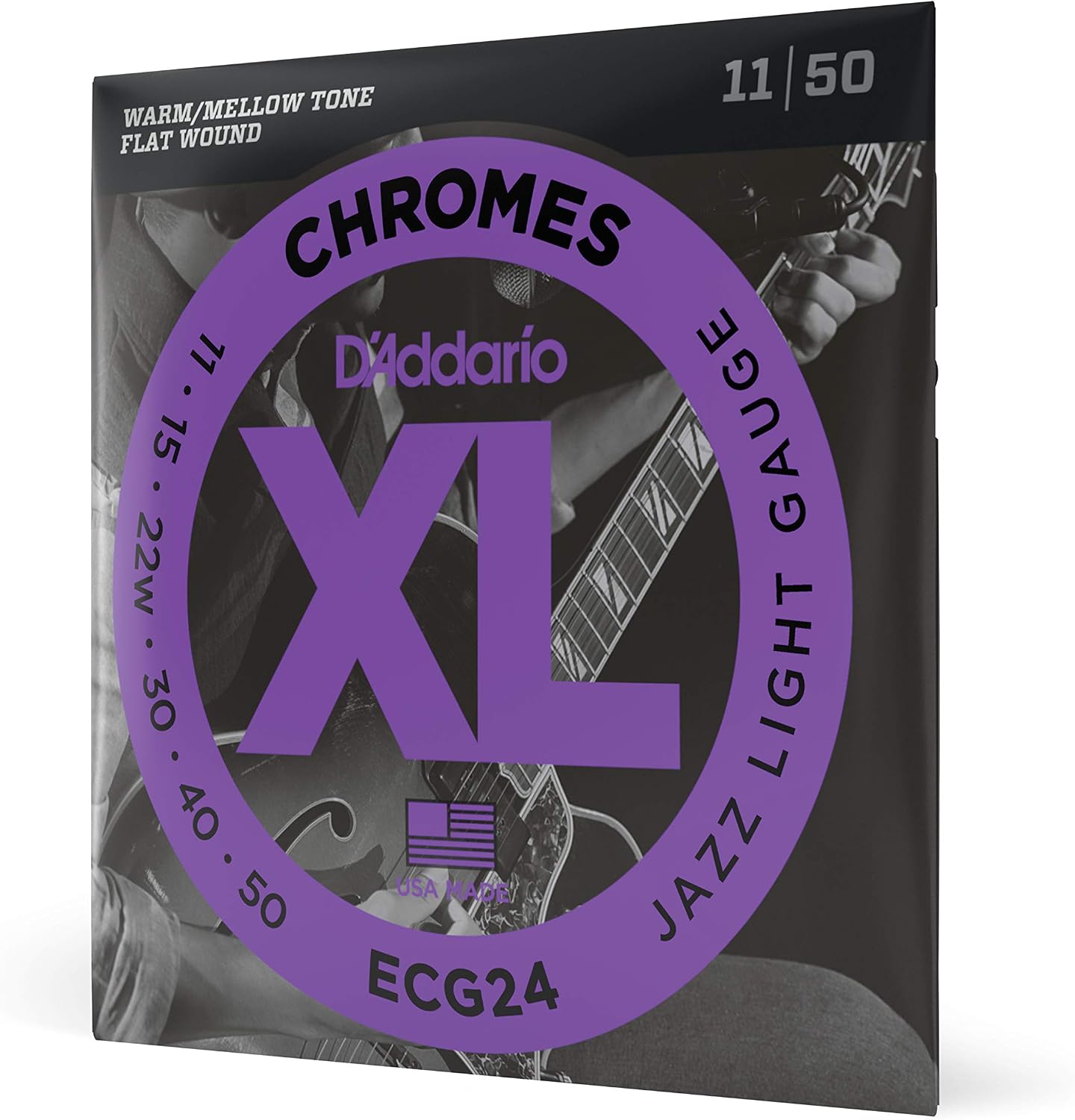
ECG24 Chromes is the most substantial tonal and tactile departure in this group. Its flatwound construction gives the wound strings a polished surface and a mellower response than ordinary roundwounds. On an SG, that is an appealing direction for rounded chord work and a less wiry attack.
This six-string .011–.050 set uses stainless-steel ribbon winding over a high-carbon steel core. The gauges are .011, .015, .022 wound, .030, .040 and .050. The wound third is a meaningful difference from the plain thirds in the lighter sets, especially for players who mix chords with expressive bends.
The smoother surface can reduce finger noise, but the heavier gauges and wound third make this a different playing experience, not a like-for-like replacement for .009s. It may need a setup adjustment, and players who want bright roundwound bite or easy wide bends may prefer another set. Choose Chromes to explore the SG’s warmer side deliberately.
Pros
- Polished flatwound surface feels smooth under the fingers.
- Mellower response offers a distinct tonal option.
- Six-string .011–.050 set with a wound third.
Cons
- Wound third changes bending feel.
- Heavier gauges may need a setup adjustment.
Rotosound R10 Roto Yellows Guitar Strings
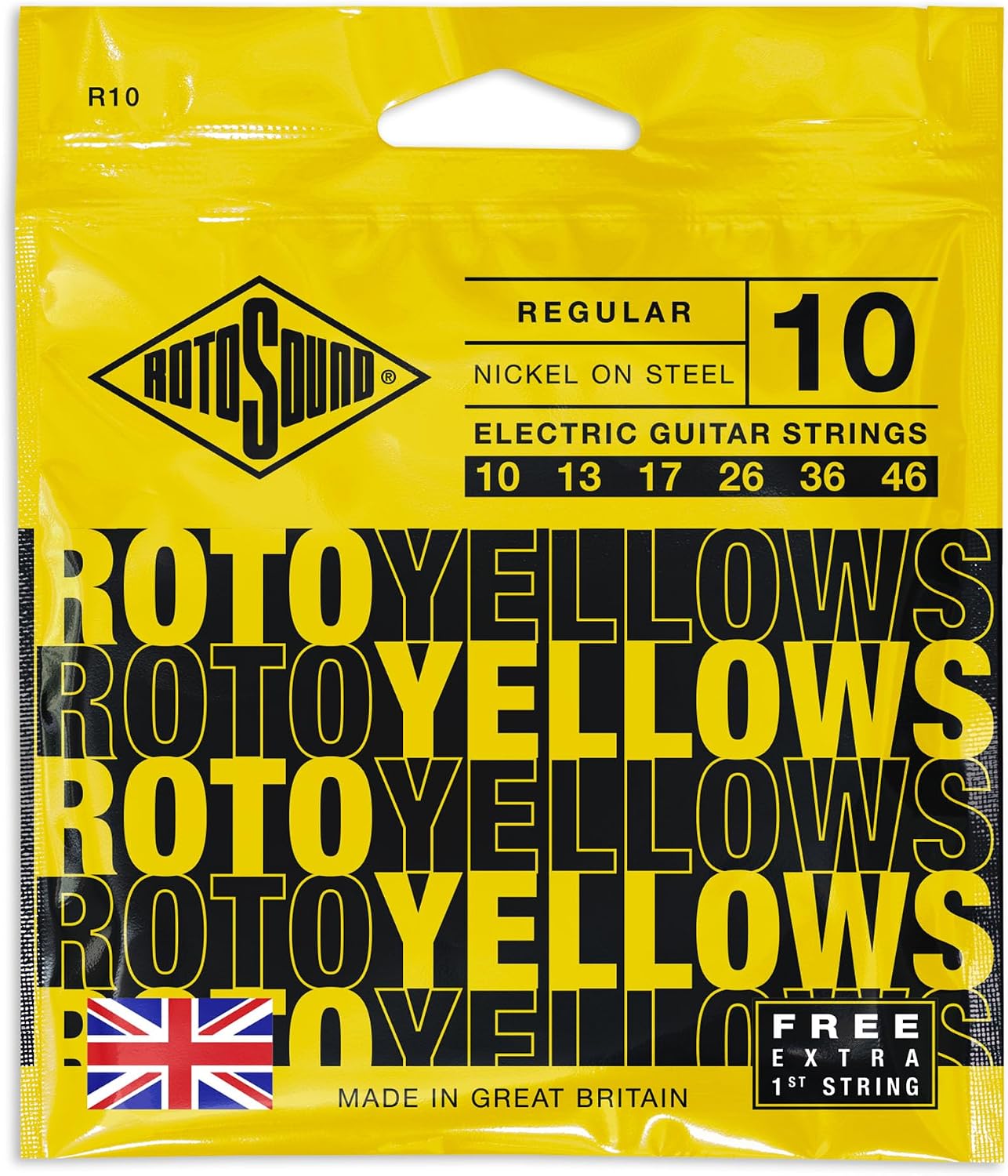
Roto Yellows is a familiar-feeling alternative for an SG player who likes .010–.046 gauges. Its roundwound design keeps the sound and touch in conventional electric guitar territory, making it a much smaller adjustment than moving to the Chromes flatwounds.
The R10 set uses nickel-plated winding over a steel core, with .010, .013, .017, .026, .036 and .046 gauges. Rotosound also includes an extra first string. That small practical detail is useful if the thinnest string breaks while the rest of the set still has usable life.
The spare does not change the six-string gauge combination or guarantee a longer service life. The main choice is whether this construction and familiar .010 feel suit your SG. Choose R10 for a straightforward roundwound set with a handy spare, while the lighter Super Slinky and EXL120 sets remain better directions for an especially soft touch.
Pros
- Familiar .010–.046 roundwound gauge combination.
- Nickel-plated winding over a steel core.
- Includes an extra first string.
Cons
- Firmer feel than the .009 sets.
- Roundwound texture is less smooth than Chromes.
FAQs About Strings Used on Gibson SG Guitars
What Kind of Strings Does Gibson Put on Its Guitars?
Gibson factory strings depend on the instrument and model year. Check the specification for the particular guitar rather than assuming one set is fitted to every Gibson. Electric guitar strings also differ from acoustic and bass strings, even when the brand names are similar.
What Strings Are on a Gibson SG?
The SG Standard specification lists .010, .013, .017, .026, .036 and .046 strings. That is a useful reference point for a conventional setup, not a requirement to keep using the same gauges. A previous owner may also have changed the set or adjusted the guitar.
What Gauge Strings Come on a Gibson SG Guitar?
The current SG Standard’s .010–.046 set balances lead and rhythm playing. Move to .009–.042 for a lighter touch, or choose heavier gauges for more resistance when the tuning and playing style call for it. The 24.75-inch figure refers to scale length, not the physical length of the neck.
At the same pitch, the same string has less tension on a 24.75-inch scale than on a 25.5-inch-scale Stratocaster. That does not make .010s on an SG precisely equivalent to .011s on every longer-scale guitar. Construction, setup and the way you play affect the result.
Do You Need to Adjust the Guitar When Changing Strings?
A small gauge change may need only modest adjustment, but check neck relief, action, nut-slot behavior and intonation after restringing. Heavier strings should not be forced into slots that bind. A truss rod adjusts neck relief; it is not a universal fix for nut fit or intonation. Consult a guitar technician if the required work is unfamiliar.
Replace strings when corrosion, wear, loss of clarity or tuning problems make them unhelpful. Pickups are not routine consumables and do not need frequent replacement just because strings do. Wiping the strings after playing and keeping unused sets sealed are simple ways to care for them.
So, the Best Gibson SG Guitar Strings Are…
Super Slinky stays the overall pick for a light touch and easy bends, with EXL120 a close alternative in the same gauge range. For a firmer standard-tuning feel, compare the .010–.046 DR, Cobalt, Dunlop and Rotosound sets. Chromes offers the biggest change in texture and character. Choose the response you want from the SG, then match its setup to the strings.