Looking for the best banjo strings for bluegrass? A fresh set can bring back a clear attack and make rolls feel more consistent, but gauge matters as much as the name on the packet. These seven five-string sets cover lighter, more flexible feels and firmer combinations for a stronger picking hand.
Most steel five-string sets combine four plain strings with one wound fourth string. That makes the complete gauge pattern important: two sets with similar headline sizes can feel quite different. The Ernie Ball Earthwood Bluegrass set remains the overall starting choice here for its crisp bronze-wound character and light gauges; the other options offer useful changes in resistance and fourth-string material.
Best Bluegrass Banjo Strings (Comparison Table)
Ernie Ball Earthwood 5-String Banjo Bluegrass Set (Editor’s Choice)

The Earthwood Bluegrass set is a bright, lively starting point for a five-string banjo. Its relatively light gauges suit a player who wants the notes to speak without a particularly stiff feel under the fretting hand. That makes it a useful first comparison when the current set feels heavy or the instrument could use a crisper edge.
The P02063 set uses gauges .009, .011, .013, .020w and .009. The wound string has an 80/20 bronze wrap over a hex-shaped steel core; the plain strings are tin-plated steel. Loop ends suit an appropriate banjo tailpiece, and the bronze winding gives this set a different fourth-string character from the nickel-wound choices below.
The lighter feel is not ideal for every picking hand. A forceful attack may work better with a firmer set, and uncoated strings will still change with use and exposure. Choose Earthwood for crisp articulation and an easy-moving feel, rather than expecting the bluegrass label to guarantee the right tension on every banjo.
Pros
- Light .009-.020 gauge pattern for a flexible feel.
- 80/20 bronze-wound fourth string adds a crisp tonal option.
- Loop ends for a suitable five-string banjo tailpiece.
Cons
- May feel too light for a forceful picking hand.
- Uncoated construction still needs normal care and replacement.
Martin V700 Vega Banjo Strings

The V700 is the light, familiar-feeling option for players who want a straightforward nickel/steel set. Martin emphasizes a smooth, consistent response, which suits clean rolls and an even fretting touch. It is a sensible direction when comfortable handling matters more than adding resistance.
The gauge sequence is .009, .010, .013, .020 and .009. Compared with the Earthwood set, the lighter second string is a useful difference to notice rather than judging both packets simply as light gauge. The nickel/steel construction also provides an alternative to the bronze-wound options without changing to a heavier overall range.
That light second string can feel less substantial under a strong hand, and a more aggressive player may prefer the firmer middle strings of the EJ61. These are steel strings for a suitable banjo, not replacements for an instrument designed specifically around nylon. Choose V700 for a light feel and a conventional nickel/steel response.
Pros
- Light gauges with a particularly light .010 second string.
- Smooth, consistent nickel/steel construction.
- Useful for players who prefer a relaxed fretting feel.
Cons
- Light second string may feel insubstantial to a strong picking hand.
- Not a reason to exceed an instrument’s recommended string type.
GHS PF145 Stainless Steel Banjo Strings

The PF145 offers a firmer-feeling middle ground without moving every string into a heavy range. Its .010, .012, .013, .022w and .010 pattern gives the outer strings more substance than the lightest sets here while keeping the third string relatively modest. That balance is useful when a light set feels loose but a thicker third string feels cumbersome.
The stainless-steel wound fourth string provides another material choice alongside nickel and bronze. GHS uses its Lock Twist construction on the plain strings, with shaped loop ends and an extended 42-inch winding length in this series. Those are practical construction features, not a promise that the banjo will never need retuning.
The .022 fourth string and .010 outer strings are a step up from a .009-.020 light set, so the change may require a setup check. The stainless winding also has its own feel rather than duplicating the bronze response of Earthwood. Choose PF145 for this particular medium-light gauge balance and a steel-wound fourth.
Pros
- Medium-light pattern with .010 outer strings.
- Stainless-steel wound fourth string.
- Lock Twist plain strings and extended winding length.
Cons
- Firmer than a .009-.020 light set.
- Different fourth-string feel from a bronze-wound set.
D’Addario EJ61 Medium Banjo Strings
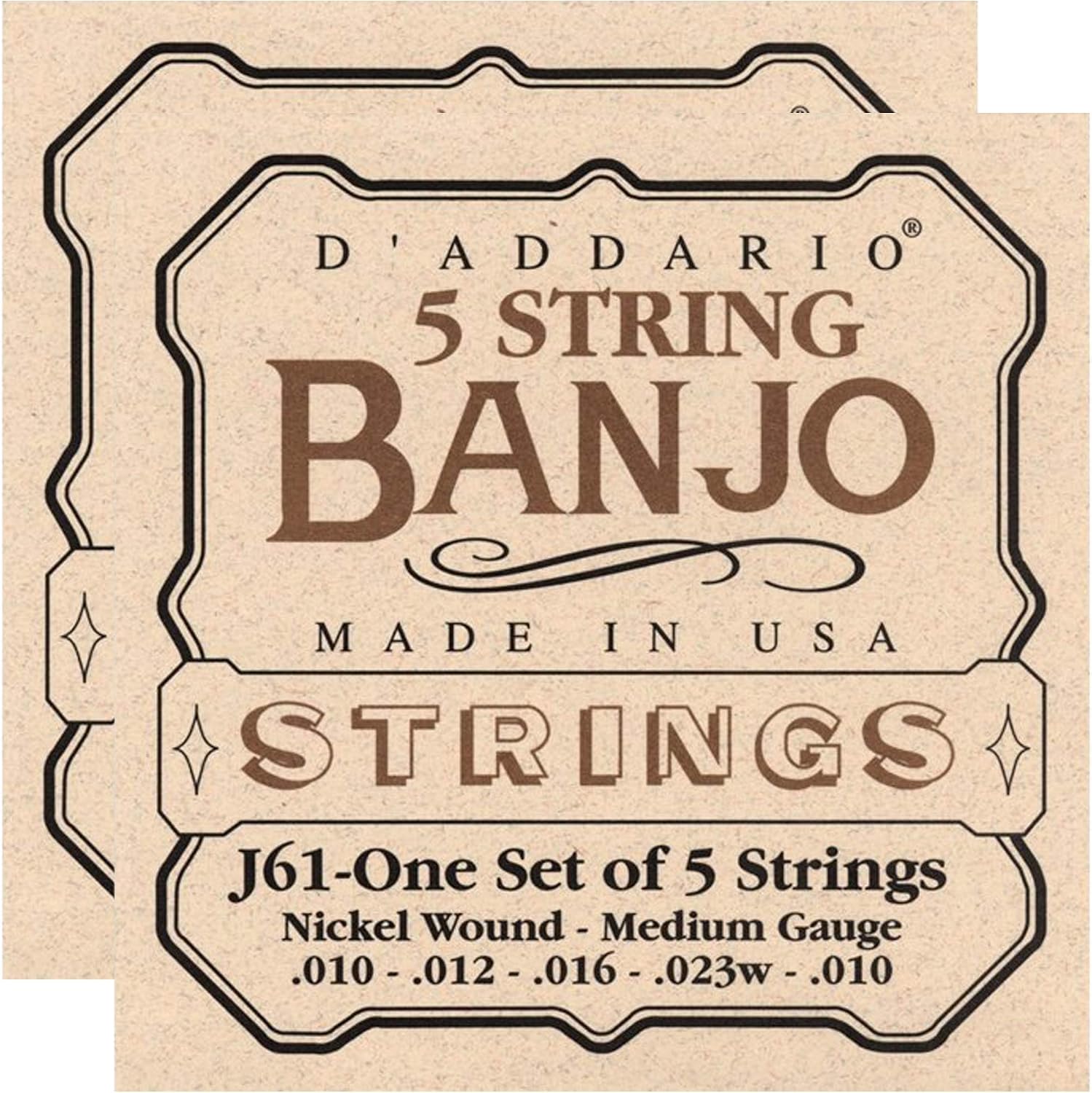
The EJ61 is the option for a player who wants more resistance through the middle of the set. A .016 third string and .023 wound fourth give it a more substantial feel than the lighter combinations here. That can be useful when a strong picking hand makes thinner strings feel too easy to push around.
The full pattern is .010, .012, .016, .023w and .010. Four plain high-carbon, tin-plated steel strings are joined by a nickel-plated steel wound fourth. Loop ends keep it in the conventional five-string banjo format, and the linked package contains two sets of the same medium-gauge strings.
The thicker third is the main trade-off: it asks more from the fretting hand than the .013 third in PF145 or EJ60+. A player seeking easier bends or a gentler feel may prefer one of those lighter patterns. Choose EJ61 for a firmer center and a familiar nickel-wound response, with the setup matched to that additional resistance.
Pros
- Substantial .016 third and .023 wound fourth.
- Nickel-plated steel winding with plain steel trebles.
- Conventional loop-end five-string format.
Cons
- Thicker third string can feel demanding beside lighter sets.
- A gauge change may require setup adjustments.
D’Addario EJ57 Custom Medium Banjo Strings

The EJ57 takes a different route to a medium feel. Its .011 first and fifth strings add resistance at the edges of the set, while the .013 third stays slimmer than the EJ61’s .016. That is a meaningful difference for players who want a stronger feel under the outside strings without making the middle string equally heavy.
The complete gauges are .011, .012, .013, .022w and .011. The set combines high-carbon, tin-plated plain steel with a nickel-plated steel wound fourth, using loop ends for a suitable tailpiece. It is a custom combination, not simply the EJ61 pattern with every string made thicker.
The heavier outer strings can feel less yielding for bends and fretting than a light set. They also do not automatically make the whole instrument louder or better balanced; the banjo and picking technique still matter. Choose EJ57 when this outside-string resistance is the missing ingredient in the current setup.
Pros
- Firmer .011 first and fifth strings.
- Slimmer third string than the EJ61 medium set.
- Nickel-wound fourth with conventional loop ends.
Cons
- Heavier outer strings may feel stiff beside a light set.
- Custom pattern suits a specific preference rather than every player.
D’Addario EJ60+ Light Plus Banjo Strings

The EJ60+ is the small-step option when a .009 light set feels just a little too yielding. Its .0095 first and fifth strings add a modest amount of resistance without moving all the way to .010 outer strings. That makes it a useful adjustment rather than a dramatic change in playing feel.
The remaining strings are .011, .013 and a .020 wound fourth. D’Addario uses high-carbon, tin-plated plain steel and a nickel-plated steel winding, with loop ends. The half-gauge outer strings are the main reason to choose it over a conventional light set.
The subtle change may not be enough for someone who wants a noticeably firm medium set. It also retains the lighter .020 fourth, so it will not feel like the heavier-bottom EJ61. Choose EJ60+ for a measured change in tension while staying close to a familiar light-gauge nickel-wound setup.
Pros
- Half-gauge .0095 outer strings bridge two common light feels.
- Light .020 nickel-wound fourth.
- Useful for a subtle adjustment rather than a full gauge jump.
Cons
- May still feel too light for a forceful attack.
- Less fourth-string resistance than the EJ61.
D’Addario EJ69 Phosphor Bronze Banjo Strings
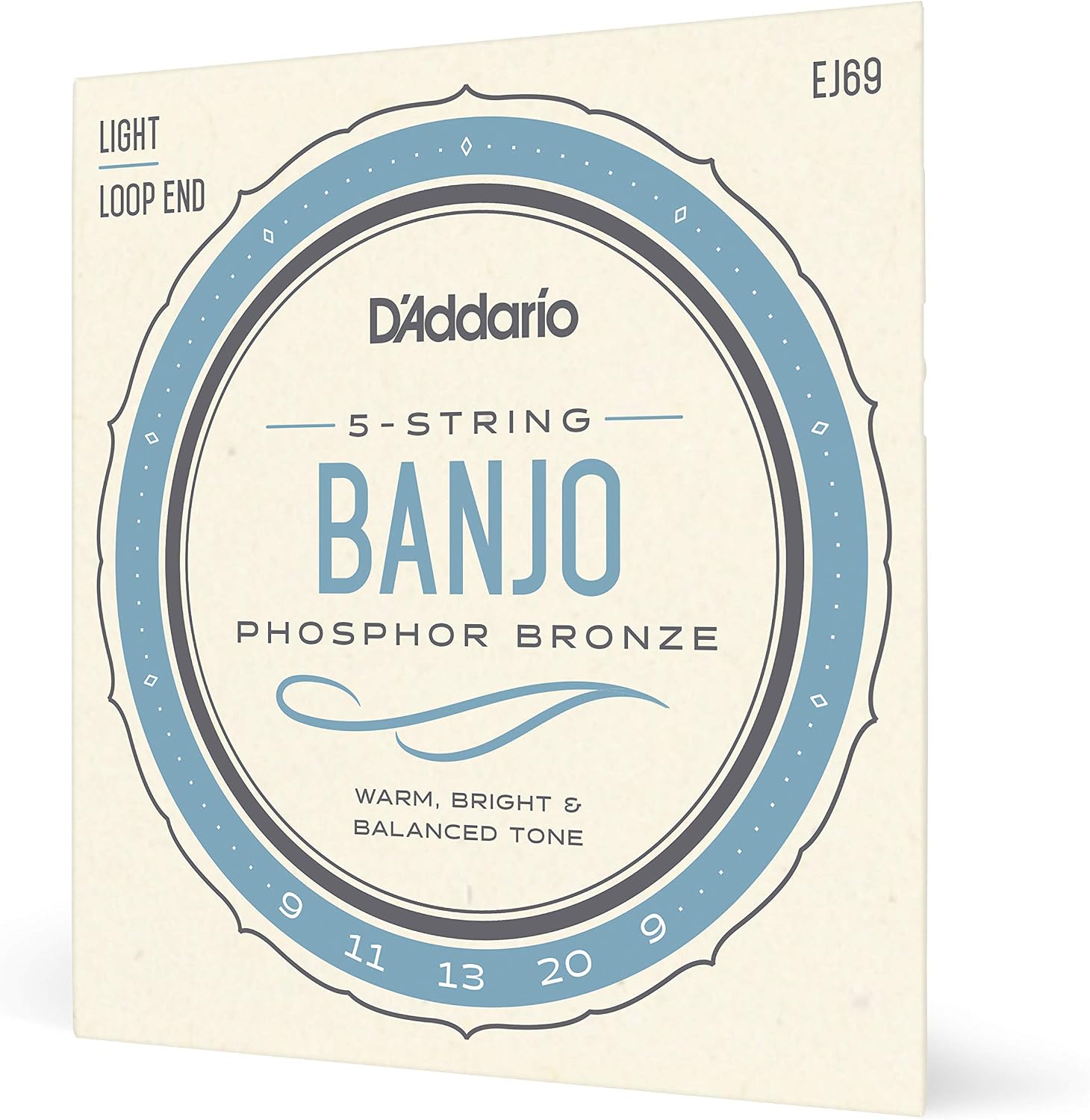
The EJ69 brings a phosphor-bronze voice to a familiar light-gauge set. Its wound fourth adds warmth and body to the low register while the plain trebles retain a light feel. That makes it an appealing direction for players who like the handling of light strings but want the fourth string to have a little more acoustic richness.
The gauges are .009, .011, .013, .020w and .009, with high-carbon, tin-plated plain steel and loop ends. The manufacturer describes the phosphor-bronze response as warm, bright and balanced. Since only the fourth string is wound, that material change should be understood as one part of the set’s character rather than a transformation of every string.
The .009 outer strings remain light and may not suit a particularly heavy touch. The winding is uncoated, so it still needs ordinary care and will age with playing. Choose EJ69 for a light feel with a phosphor-bronze fourth, especially when the current nickel-wound low string is the part you want to compare.
Pros
- Phosphor-bronze wound fourth offers a different tonal balance.
- Light .009-.020 gauge pattern.
- Loop ends with clearly specified individual gauges.
Cons
- Light outer strings may not suit a heavy touch.
- Uncoated winding changes with use and exposure.
How to Choose the Right Banjo Strings
Start with the type of banjo, the maker’s string recommendations and the tuning you use. A five-string bluegrass set is not the same as a tenor or six-string guitar-banjo set. Check the tailpiece attachment and scale length before treating a packet as a direct replacement.
Construction and Winding Material
These sets use plain steel strings with one wound fourth string. Nickel-plated steel, stainless steel, 80/20 bronze and phosphor bronze offer different wound-string choices, but the plain strings still make up most of the set. Do not assume that a change in winding material affects all five strings equally.
Compare Every Gauge
Gauge names are not a universal standard. The EJ61 has a .016 third string, while the custom-medium EJ57 has a .013 third and heavier outer strings. Those differences matter more than seeing medium on both packets. At the same tuning and scale length, thicker versions of otherwise comparable strings generally increase resistance; pick the feel that supports a clean attack.
Tuning and Setup
A different tuning changes string tension, so use the instrument maker’s guidance rather than assuming every alternate tuning requires a new set or can safely use the existing one. A substantial gauge change may also affect neck relief, action and intonation. Vintage or lightly built instruments deserve particular care before fitting heavier steel strings.
Care and Replacement
Wipe strings after playing and replace them when the feel, clarity or intonation becomes unsatisfactory. Packaging helps protect unused strings; it does not guarantee years of life once they are fitted. Tuning stability also depends on installation, the tuners and the setup, not just the string brand.
So, Which Banjo Strings Are Best for Bluegrass?
Ernie Ball Earthwood Bluegrass remains the overall starting pick for a crisp, light-feeling set. Martin V700 offers another light nickel/steel route, PF145 balances .010 outer strings with a modest third, and the D’Addario options provide useful differences in gauge and winding. Choose the complete pattern that feels right on the banjo rather than assuming all bluegrass players need medium strings.