Looking for the best strings for B tuning? The best strings for Drop B tuning give the low notes enough support without making the rest of the guitar feel unnecessarily stiff. These eight six-string electric guitar sets cover lighter-feeling options, heavier rhythm choices and a purpose-built signature set.
Ernie Ball Mammoth Slinky is the overall pick for a substantial low end and a wound third string. Prefer a plain third or a lighter touch? The Dunlop Jim Root set takes a different approach. Gauge is a starting point, not a guarantee: scale length, picking strength and setup all affect how a set feels in Drop B.
The 8 Best String Sets for Drop B Tuning
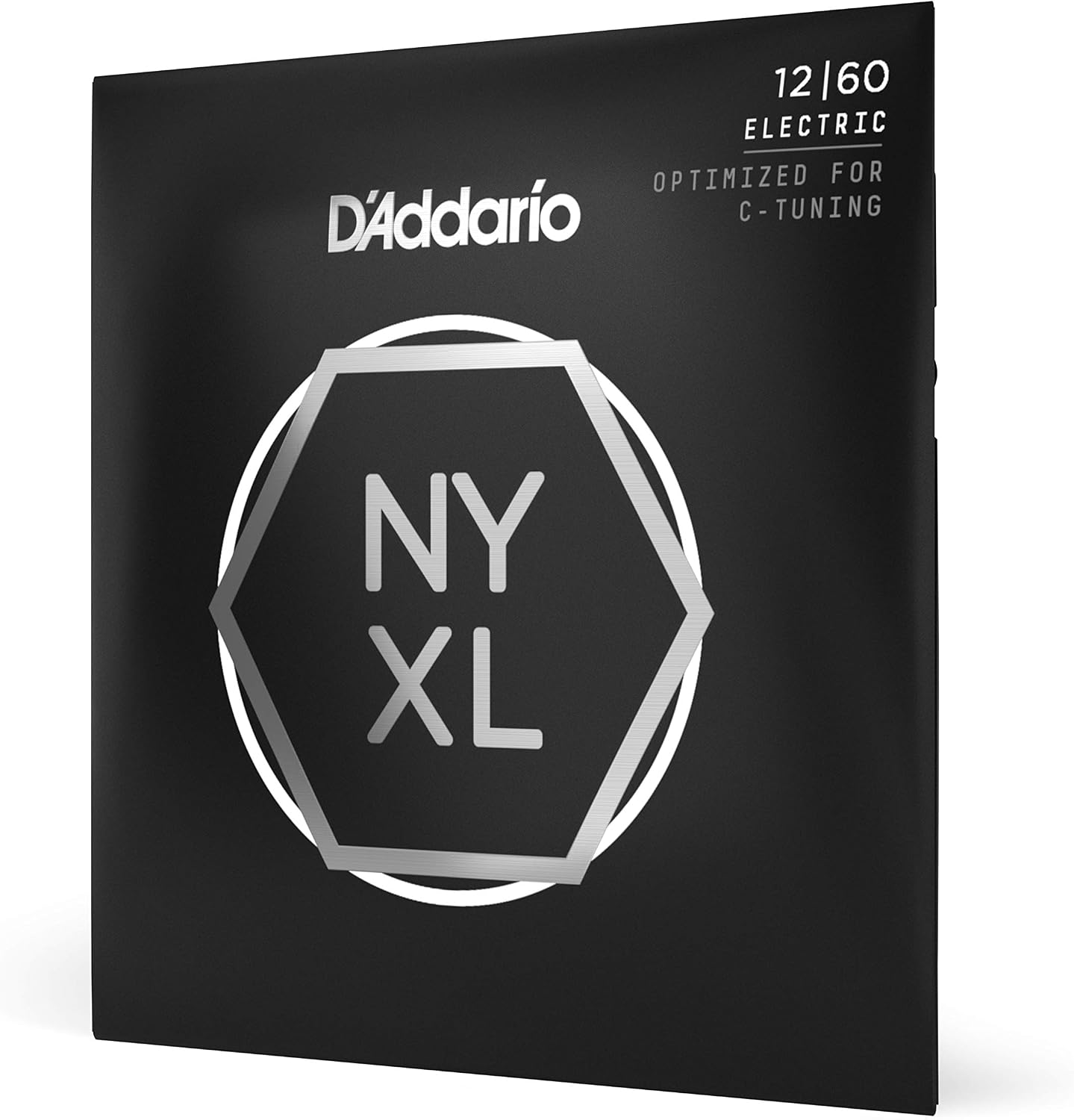
D’Addario NYXL1260 Electric Guitar Strings
The NYXL1260 pairs a .012 first string with a .060 sixth, giving this set a useful place between the lighter .054-bottom options and the heaviest DR set here. The larger bottom string is a sensible starting point for players who want more resistance under low-register riffs without moving straight to a .065.
D’Addario combines its NY Steel core with nickel-plated steel winding and Fusion Twist construction. This is an uncoated electric guitar set, designed around strength and tuning stability rather than a slick protective coating. It suits players who prefer the familiar feel of an uncoated string and want a substantial six-string set.
The factory describes this gauge combination for C and Drop C, so its feel in the lower Drop B tuning will depend on the guitar. On a shorter scale or under a heavy picking hand, the Mammoth or DDT-13 may provide the resistance you prefer. Choose the NYXL1260 for a middle-ground heavy gauge, not as a promise that every guitar will need no setup.
Pros
- .012–.060 gauges offer a substantial bottom end.
- Uncoated nickel-plated steel construction.
- NY Steel core and Fusion Twist construction.
Cons
- The .012 first string may feel heavy for frequent bends.
- Drop B tension still depends on scale length and playing style.
Dunlop DHCN1254 Heavy Core Guitar Strings

The DHCN1254 is a less extreme option than its Heavy Core name might suggest. Its .012–.054 range keeps the bottom string slimmer than the .060–.065 choices here, while the .012 first string gives the upper register a substantial feel. That combination can suit players who dislike an oversized low string.
Dunlop uses a core-to-wrap ratio developed for lowered tunings. The six gauges are .012, .016, .020 plain, .032, .042 and .054. The plain third offers a different bending and vibrato feel from the Mammoth’s wound third, making the choice about the whole set rather than the sixth-string number alone.
The limitation is the .054 low B: some players will find it too yielding, especially on a shorter-scale guitar or with an aggressive pick attack. This set makes more sense for a controlled picking hand and a preference for lighter low-string resistance than for someone chasing the firmest possible chug.
Pros
- Core-to-wrap ratio developed for lowered tunings.
- Plain .020 third string.
- Slimmer low string than the heaviest sets here.
Cons
- .054 low B may feel loose on shorter scales.
- Upper strings are heavier than in an .011 set.
Ernie Ball Mammoth Slinky (Editor’s Choice)
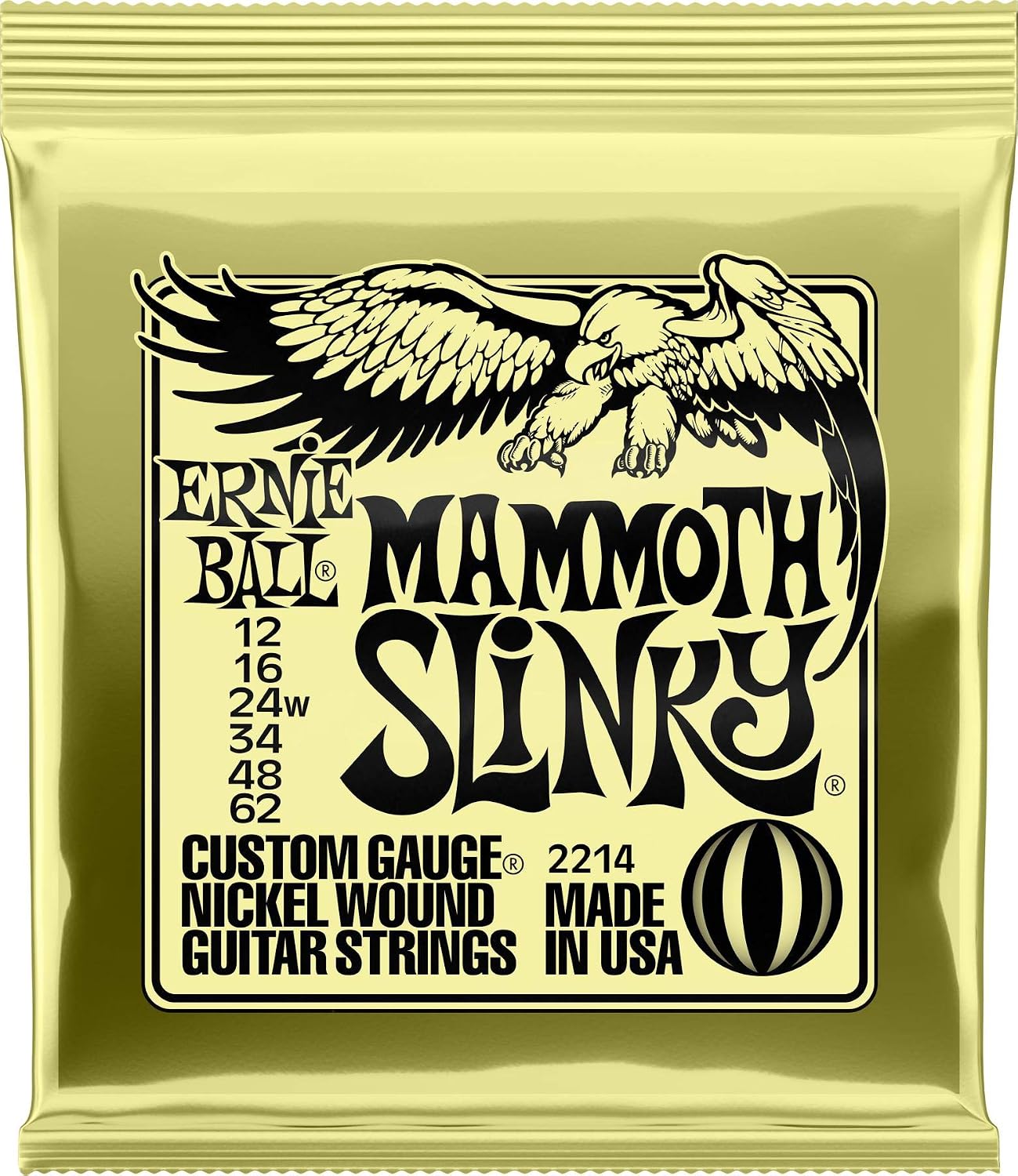
Mammoth Slinky is the overall pick because its gauge balance addresses the demands of low tuning directly. Ernie Ball specifies this six-string set for tunings including Drop B, and the .062 bottom string supplies more material under the pick than the .054 and .056 options in this roundup.
The distinctive feature is the wound .024 third string. The complete set runs .012, .016, .024w, .034, .048 and .062, with nickel-plated steel wound strings. That wound third is worth considering for chord-focused playing when a thick plain third feels awkward; it also makes this a distinct choice from Not Even Slinky.
There is a trade-off. The wound third changes bending feel, and the heavier gauges may require nut-slot and setup work when moving from a light set. For a dedicated Drop B rhythm guitar, however, the combination is well judged: a substantial bottom end, sensible intermediate gauges and no need to assemble a custom set.
Pros
- Manufacturer explicitly includes Drop B among its applications.
- Substantial .062 sixth string.
- Wound .024 third provides a useful alternative to thick plain strings.
Cons
- Wound third feels different for bends and vibrato.
- Heavier gauges may require nut-slot and setup adjustments.
Dunlop Jim Root JRN1156DB Guitar Strings
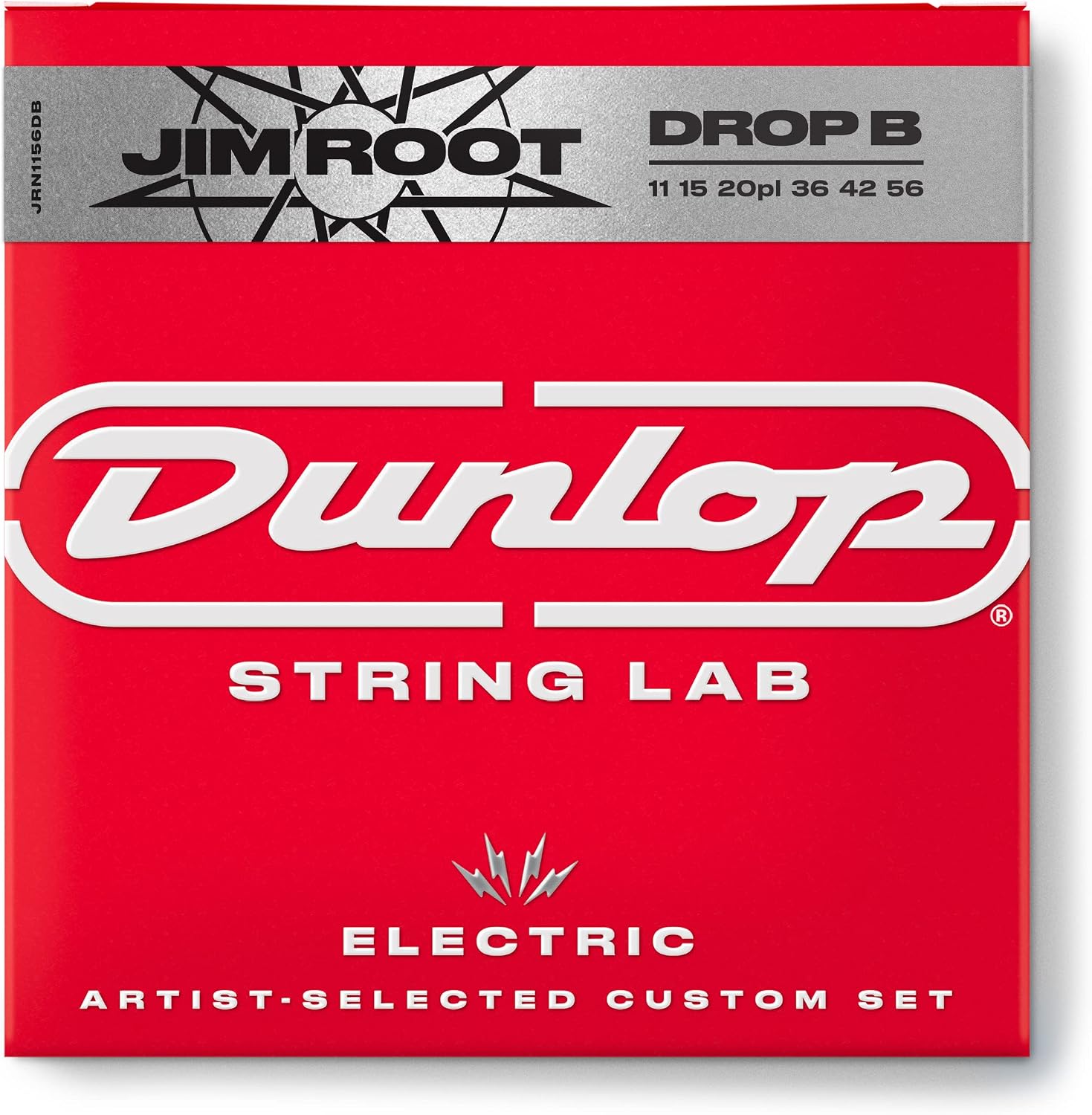
The Jim Root JRN1156DB is the focused choice for players who want a set specifically arranged for Drop B without moving to .012 or .013 upper strings. Its .011 first string keeps the top end comparatively manageable, while the .056 bottom gives the low register more substance than an ordinary light set.
The six nickel-wound gauges are .011, .015, .020 plain, .036, .042 and .056. The jump from a plain .020 third to a wound .036 fourth is particularly useful to consider: it offers a different balance from a uniform heavy set, with a relatively approachable top end and more support through the middle strings.
Jim Root selected the gauges and core sizes with Dunlop for his downtuned playing. That is useful design context, not a guarantee of his recorded tone. Compared with Mammoth, this set favors a lighter upper-register feel and a plain third; players who strike the low B hard may still prefer a .060 or .062 bottom.
Pros
- Purpose-built six-string Drop B gauge combination.
- Lighter .011 first string than most sets here.
- Plain .020 third with substantial .036 fourth.
Cons
- .056 low B may be too yielding for a very heavy picking hand.
- Signature construction does not remove the need for a suitable setup.
Ernie Ball Not Even Slinky Guitar Strings

Not Even Slinky is a heavy electric guitar set with an unusual point of emphasis: its plain .024 third string. The full .012, .016, .024p, .032, .044 and .056 combination gives the upper and middle strings a substantial feel without using the Mammoth’s wound third or .062 bottom.
Nickel-plated steel winding over a hex-shaped steel core gives the wound strings a familiar electric guitar construction, while the plain strings use tin-plated steel. The practical appeal is the gauge combination: players who prefer a thick plain third can get it in a standard six-string pack rather than building a set from singles.
That same third string is the main reason to pause before choosing it. Its bending feel differs markedly from the .020 plain thirds in the Dunlop sets, and the .056 sixth is not the heaviest low-B option here. Choose Not Even Slinky when its thick plain middle strings suit your rhythm playing, rather than assuming every heavy set feels alike.
Pros
- Distinctive heavy plain .024 third string.
- Familiar nickel-wound electric guitar construction.
- Substantial upper strings without a .060-plus bottom.
Cons
- Thick plain third can feel stiff for bends.
- Lighter bottom than Mammoth and the heavy DR options.
DR DDT-13 Electric Guitar Strings

The DDT-13 is the heavyweight choice here, spanning .013–.065. It is worth considering when the lighter sets leave the low B too soft for your picking style. Its larger gauges make particular sense for a guitar dedicated to low-tuned rhythm work rather than frequent switching back to standard tuning.
DR’s DDT range uses a hex core with Accurate Core Technology and nickel-plated steel winding. Those construction choices are intended for lowered tunings, but the immediate practical distinction of this version is its gauge range: both the .013 first string and .065 sixth are heavier than the corresponding strings in the other sets here.
The cost is in feel and setup, not just string size. Bends take more effort, and a guitar previously set up for light strings may need professional adjustment. Choose it when substantial resistance is the goal; a heavier set cannot correct poor fretwork or an unsuitable setup on its own.
Pros
- Heaviest .013–.065 range in this roundup.
- Designed as part of DR’s lowered-tuning range.
- Useful for players who find lighter low strings too soft.
Cons
- Demanding upper-string feel for bends.
- Large gauges can require nut-slot and setup work.
Ernie Ball Beefy Slinky Guitar Strings

Beefy Slinky offers a different kind of balance from the .012 sets: a comparatively light .011 first string, a thick plain .022 third and a .054 bottom. It suits players who want some give in the upper register without moving all the way down to a conventional light-gauge set.
The complete six-string combination is .011, .015, .022 plain, .030, .042 and .054. Nickel-plated steel wound strings and tin-plated plain strings give it familiar Slinky construction. The thick plain third is the detail to notice, because an .011 first string alone does not tell the whole story about bending feel.
For Drop B, the .054 sixth makes this a lighter-feeling alternative, not the default answer for hard picking on every scale length. If the low string bends noticeably sharp under your attack, one of the .060–.065 sets is a better direction. Choose Beefy Slinky for its particular balance of upper-string flexibility and a substantial plain third.
Pros
- Comparatively manageable .011 first string.
- Thick plain .022 third offers a distinctive feel.
- Familiar nickel-wound six-string construction.
Cons
- .054 bottom may feel soft at low B.
- Plain third is heavier than the first-string gauge suggests.
DR DDT-12 Electric Guitar Strings

The DDT-12 is the more moderate of the two DR sets here. Its .012–.060 range offers a substantial low string without the .013 first and .065 bottom of DDT-13. That makes it a sensible option when the goal is a dedicated low-tuning set rather than the heaviest feel available.
It shares the DDT family’s hex-core construction, Accurate Core Technology and nickel-plated steel winding. The appeal is straightforward: a purpose-oriented lowered-tuning range with a gauge combination that sits between the lighter Dunlop and Beefy sets and the heavier Mammoth and DDT-13 bottoms.
It still feels heavier than an everyday .009 or .010 set, especially when bending the upper strings. Settle the strings, tune carefully and adjust the guitar for the chosen gauge rather than expecting the set to fix intonation automatically. Choose DDT-12 when a .060 bottom sounds like the right compromise and .013 upper strings feel excessive.
Pros
- .012–.060 range sits between lighter and very heavy options.
- DDT hex-core design for lowered tunings.
- Less extreme gauge range than DDT-13.
Cons
- .012 upper strings may be demanding for frequent bends.
- Intonation and action still need a suitable setup.
FAQ About the Best Guitar Strings for Drop B
Who Uses Drop B Tuning?
Drop B tuning is useful for low-register riffs and the familiar one-finger power-chord shapes associated with drop tunings. It appears in djent and other heavy music, but the tuning does not dictate a genre. String choice should support the way you play, from tight rhythm parts to bends and melodic lines.
How Do You Check a Song’s Tuning?
A band may use several tunings across different songs and instruments. For a particular riff, check the tuning of that recording rather than assuming that the artist always uses Drop B. A reference pitch, reliable transcription or official lesson is more useful than a general list of names.
Can You Tune a 7-String Guitar to Drop B?
Seven-string instruments can use many tuning arrangements, but the sets in this comparison are for six-string electric guitars. A seven-string set needs a suitable seventh string and a clear tuning plan. Do not treat a six-string Drop B set and a seven-string B-standard set as interchangeable.
Can You Tune a Guitar to Drop B?
On a six-string guitar, Drop B is B–F#–B–E–G#–C#, from lowest to highest. The lowest string drops from E to B, while the other five drop a minor third from standard tuning. Lowering only the sixth string does not produce the usual Drop B tuning.
Use a chromatic tuner and retune all six strings in several passes. Moving from a light set to heavier strings can affect the nut slots, neck relief, action and intonation. A floating tremolo also needs its spring balance adjusted. If the strings bind or the setup moves beyond comfortable adjustment, have a guitar technician handle it.
What Gauge Works Best for Drop B?
There is no single correct gauge for every guitar. A longer scale gives the same string more tension at the same pitch; a shorter scale or a stronger picking hand may call for a heavier bottom string. The .060–.062 options are useful starting points for a substantial low end, while the .054–.056 choices suit players who prefer more give. The .065 DR set is the heaviest-gauge direction here.
Pay attention to the middle strings as well. Mammoth has a wound third, while the Dunlop sets use a plain .020 third. A wound and a plain string of similar diameter do not feel identical, particularly for bends. Choose the whole combination, not just the first and sixth gauge numbers.
So, the Best Strings to Use for Drop B Tuning Are…
Mammoth Slinky is the overall choice for a dedicated low-tuned rhythm guitar, with its .062 bottom and wound third. The Jim Root set is the more focused alternative for an .011 top and plain third. NYXL1260 and DDT-12 offer .060-bottom options, while DDT-13 goes heavier still. Start with the feel you want, then give the guitar a proper setup so the strings can do their job.