Looking for the best speakers for Bluesound Powernode 2i? This compact streaming amplifier needs a pair of passive speakers that suits the room, listening distance and preferred volume. These four bookshelf options offer different strengths without turning the system into a stack of separate components.
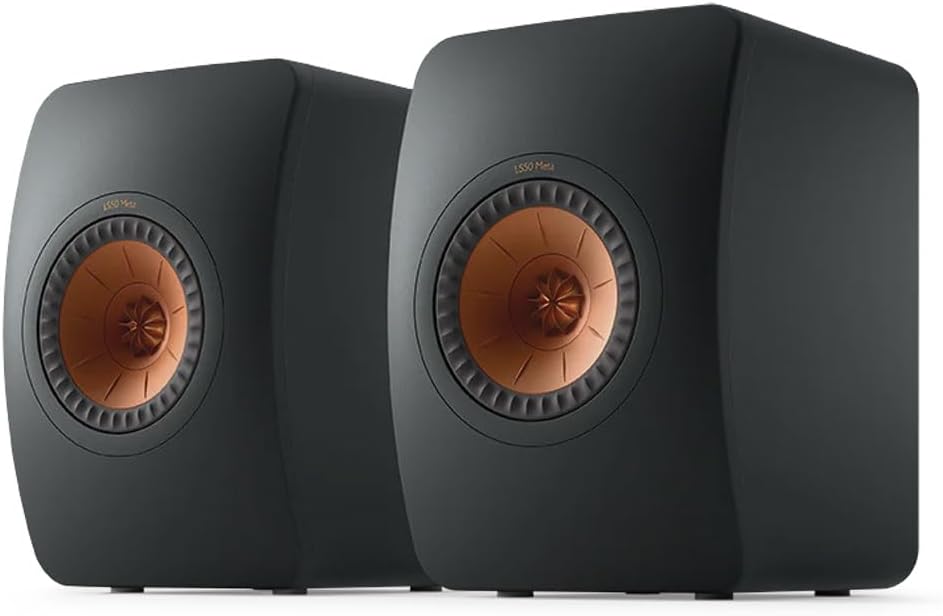
The Powernode 2i is rated at 60 watts per channel into 8 ohms. That is useful stereo power, but not a promise that it will drive every demanding speaker at any level. The KEF LS50 Meta is the overall choice here for focused small-room listening; the ELAC, Klipsch and Q Acoustics alternatives bring different driver layouts, cabinet sizes and placement priorities.
For a different amplifier setup around a passive LS50, see our guide to amplifiers for the passive KEF LS50; distinguish the passive speaker from an active LS50 Wireless system.
Best Speakers for Powernode 2i
| Image | Model | Price |
|---|---|---|
| KEF LS50 Meta (Editor's Choice) | Check Price |
 | ELAC Debut Reference DBR62 | Check Price |
 | Klipsch RP-600M | Check Price |
 | Q Acoustics Concept 20 | Check Price |
KEF LS50 Meta (Editor’s Choice)
The LS50 Meta is the focused-listening choice: its Uni-Q array places a 25mm tweeter at the acoustic center of the 130mm mid/bass driver. That concentric layout is designed to keep the two drivers working as a coherent source, a useful strength when vocals and instrumental placement matter more than maximum output. Metamaterial Absorption Technology behind the tweeter helps absorb unwanted rearward sound.
This is a passive two-way speaker with an 8-ohm nominal impedance, a 3.5-ohm minimum and an 85dB sensitivity rating. KEF recommends 40–100 watts of amplification, placing the Powernode 2i’s 60-watt rating within that range. Proper stands, some space behind the rear ports and a moderate listening distance give the combination a sensible starting point.
The trade-off is headroom: low sensitivity and a small mid/bass driver make it less suited to very loud playback across a large room. Deep-bass listeners may also want a powered subwoofer. It earns the overall pick for its compact coaxial design and carefully controlled driver arrangement, with realistic expectations about scale rather than a claim that the amplifier can make it do everything.
Pros
- Uni-Q concentric driver arrangement for coherent sound dispersion.
- Metamaterial absorption behind the tweeter.
- Compact passive design within KEF’s recommended amplifier-power range.
Cons
- Low sensitivity limits very loud, long-distance listening.
- Deep bass may call for a powered subwoofer.
ELAC Debut Reference DBR62
The DBR62 is the more substantial conventional bookshelf design here, pairing a 6.5-inch aramid-fiber woofer with a 1-inch cloth-dome tweeter. Its cast woofer chassis and internal perimeter bracing address unwanted movement in the driver support and cabinet, while the tweeter waveguide helps shape high-frequency dispersion. The wood-look cabinet and contrasting baffle also give it a distinctive appearance.
A front-facing, dual-flared slot port is a practical feature when a rear port would be awkward, although it does not remove the need to experiment with wall distance. ELAC specifies a 6-ohm nominal impedance, 86dB sensitivity and a maximum input rating of 120 watts. That last figure is a handling limit, not a requirement for a 120-watt amplifier.
The larger cabinet takes more shelf or stand space than the KEF or Concept 20, and its modest sensitivity still rewards sensible volume expectations with the Powernode 2i. Choose it for a sturdier, larger-driver bookshelf format and flexible front-port placement—not because a front vent makes room acoustics irrelevant.
Pros
- 6.5-inch aramid-fiber woofer and cloth-dome tweeter.
- Front slot port with flared geometry.
- Cast woofer chassis and perimeter cabinet bracing.
Cons
- Larger cabinet needs more shelf or stand space.
- Modest sensitivity limits headroom at high listening levels.
Klipsch RP-600M
The original RP-600M is the energetic, horn-loaded option in this group. A 1-inch titanium LTS tweeter sits in a hybrid Tractrix horn above a 6.5-inch Cerametallic woofer. The horn controls high-frequency dispersion, while the vented tweeter assembly is designed to reduce unwanted pressure behind the diaphragm. It is a purposeful design for listeners who like a direct, lively presentation.
Klipsch specifies 96dB sensitivity at 2.83V/1m, an 8-ohms-compatible load and 100 watts continuous power handling. Those manufacturer ratings suggest less demand for a given level than the lower-sensitivity monitors here, though different brands’ sensitivity numbers are not a controlled listening comparison. The Powernode’s output does not need to match the speaker’s power-handling figure exactly.
The rear Tractrix port needs breathing room, and toe-in can make a worthwhile difference to the balance at the listening seat. Dual binding posts support bi-wiring, but a normal single-wire connection with the links fitted is sufficient. This is the original RP-600M, not the later II version; it suits a dynamic two-channel system without making a subwoofer mandatory in every small room.
Pros
- Horn-loaded titanium tweeter and 6.5-inch woofer.
- High manufacturer-rated sensitivity.
- Dual binding posts with removable links.
Cons
- Rear port and horn balance reward careful placement.
- Manufacturer sensitivity figures are not directly comparable across every brand.
Q Acoustics Concept 20
The Concept 20 is the compact, understated option, with a 125mm bass driver and 25mm tweeter in a gloss-finished cabinet. Its Gelcore construction uses a damped cabinet-within-a-cabinet approach to reduce enclosure resonance. That is the interesting feature here: attention goes into keeping the cabinet from adding its own contribution to the music, rather than filling the speaker with extra electronics.
Q Acoustics specifies a 6-ohm nominal impedance, a 4-ohm minimum and a recommended amplifier range of 25–75 watts. The Powernode 2i fits that rated power range. The dedicated Concept stands are optional; stable supports at a sensible listening height remain worthwhile whichever stands are used.
For a system built around a 4-ohm speaker load, see our separate guide to amplifiers for 4-ohm speakers; check the actual impedance and amplifier specification for that setup.
The small cabinet and driver bring limited deep-bass reach, and the rear port still needs room to work. A gloss finish also shows handling marks more readily than a textured surface. Choose the Concept 20 when a compact, restrained-looking stereo setup matters, with a powered subwoofer available later if the lowest notes need more weight.
Pros
- Damped Gelcore cabinet construction.
- Compact format with a 125mm driver and 25mm tweeter.
- Recommended power range suits the Powernode 2i’s rating.
Cons
- Limited deep-bass scale from a small enclosure.
- Rear-port placement and gloss-finish care need attention.
Are Expensive Speakers for Powernode 2i Worth It?
A higher price can buy better engineering, finish or bass capability, but it does not guarantee a better match for the room. The Bluesound Powernode 2i already provides streaming, conversion, volume control and stereo amplification. The speakers should complement those functions, not duplicate them with another amplified streaming system.
Use Passive Speakers
Connect one passive speaker to each pair of speaker terminals, observing polarity and keeping loose wire strands apart. Do not connect an amplifier’s speaker outputs to the line inputs of powered speakers. A powered subwoofer uses the Powernode’s dedicated subwoofer output instead.
Match Output to the Room
The amplifier is rated at 60 watts per channel into 8 ohms. Speaker sensitivity, impedance, listening distance and the desired peak level all affect the result. A compact low-sensitivity monitor can be satisfying at moderate levels nearby yet run out of headroom sooner across a large room.
Likewise, a 100- or 120-watt speaker rating describes power handling, not the minimum power required to make sound. Start at a modest level and avoid audible distortion. Adding extra speaker pairs in parallel changes the load and should not be treated as a free multiroom upgrade.
Spend on the Features That Matter
The LS50 Meta concentrates on coaxial driver integration, the DBR62 on a larger conventional driver layout and cabinet bracing, the RP-600M on a horn-loaded design, and the Concept 20 on a compact damped enclosure. None of those features makes every recording or room sound the same. Listening preferences and placement can matter more than moving up a price bracket.
Placement Before More Equipment
Use stable supports, similar speaker heights and a balanced distance to the listening seat. Experiment with toe-in and wall distance before adding equipment. Front ports can make installation more convenient, but they do not eliminate boundary effects; rear ports should not be blocked against a wall.
The Powernode 2i can feed a suitable powered subwoofer when more low-frequency extension is wanted. Set level and crossover carefully so that it supports the main speakers instead of dominating them.
Keep the Powernode Generation Straight
These recommendations concern the Powernode 2i, not a newer Powernode with a different output rating. Its USB-A input is for supported storage devices, while the service USB port is not a computer-audio input. Use the connections and BluOS functions documented for the particular unit rather than assuming every generation has identical hardware.
Best Speakers to Pair With Bluesound Powernode 2i
The KEF LS50 Meta is the overall choice for focused small-room listening at sensible levels. The ELAC DBR62 offers a larger-driver, front-ported alternative; the Klipsch RP-600M suits a lively horn-loaded system; and the Concept 20 keeps the setup compact. Choose the speaker that fits the room and listening habits, with enough clean headroom for the intended use.
If the RP-600M mentioned here is the speaker you are building around, see our separate guide to receiver choices for the Klipsch RP-600M.