Looking for the best amplifier for 6 ohm speakers? Start with an amplifier that supports the speakers’ load, then consider listening level, room size and the connections you need. A nominal 6-ohm rating is a useful starting point, but the speaker’s impedance changes with frequency.

These four choices range from straightforward stereo integrated amplifiers to a high-output rack power amp. The Yamaha A-S301 is the overall choice here for its practical controls and mix of analog and digital inputs. Use one suitable speaker per channel unless the amplifier’s instructions specifically permit a more complex arrangement.
The 4 Best Amps for 6 Ohm Speakers
| Image | Model | Price |
|---|---|---|
 | Yamaha A-S301BL (Editor's Choice) | Check Price |
 | Denon PMA-600NE | Check Price |
 | Cambridge Audio CXA61 | Check Price |
 | Crown XLS 2502 | Check Price |
Yamaha A-S301BL (Editor’s Choice)
The A-S301 is the most complete conventional stereo starting point in this group. Bass, treble, balance and variable loudness controls give useful ways to adjust listening without an app or menu. Pure Direct bypasses the tone-related controls when a simpler signal path is preferred. Its familiar front panel makes it easy to live with across several sources.
Yamaha rates it at 60 watts per channel into 8 ohms across 20Hz to 20kHz at 0.019% THD, and 70 watts into 6 ohms at 0.038% THD. Optical and coaxial inputs handle suitable stereo PCM sources, while the MM phono input supports a compatible turntable. A headphone connection and subwoofer output add flexibility for a small home system.
The rear USB-shaped DC OUT supplies accessory power; it is not a USB audio input. There is no built-in wireless streaming, and the A/B terminals are not an invitation to run two pairs of 6-ohm speakers together. Choose the A-S301 for a straightforward one-pair stereo setup, setting the impedance selector as the manual specifies with the power disconnected.
Pros
- Useful tone, balance, variable loudness and Pure Direct controls.
- Optical, coaxial and MM phono inputs.
- Headphone and subwoofer connections.
Cons
- No built-in Bluetooth, network streaming or USB audio.
- Simultaneous A+B speakers have stricter load requirements.
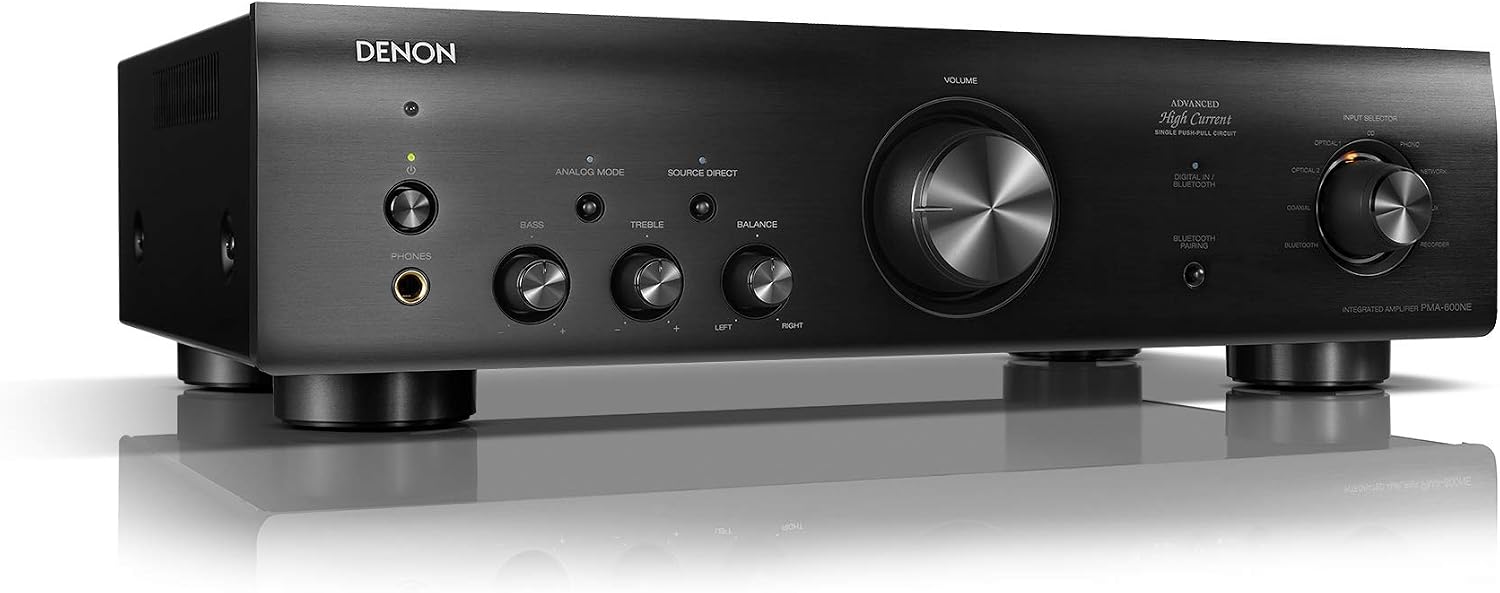
Denon PMA-600NE
The PMA-600NE is the convenient choice when phone playback belongs alongside a turntable or TV. Bluetooth is built in, and the physical input selector, volume and tone controls keep everyday use straightforward. It is a stereo integrated amplifier, so source selection and speaker amplification are handled in one box.
Denon specifies speakers from 4 to 16 ohms. Rated output is 45 watts per channel into 8 ohms over 20Hz to 20kHz at 0.07% THD; the 70-watt figure is measured into 4 ohms at 1kHz and 0.7% THD. Two optical inputs, one coaxial input and an MM phono stage cover a useful range of sources. Analog Mode disables the digital circuitry when using an analog source.
Bluetooth adds convenience, but there is no built-in network-streaming platform, HDMI input or USB audio connection. It also has one pair of speaker terminals rather than A/B selection. Choose the Denon for a manageable two-speaker system with several everyday sources, rather than expecting an AV receiver or a high-output power amp.
Pros
- Built-in Bluetooth plus optical and coaxial inputs.
- MM phono stage and analog-source mode.
- Specified 4–16-ohm speaker range.
Cons
- No HDMI, USB audio or built-in network streaming.
- One speaker pair; less output than the dedicated Crown power amp.
Cambridge Audio CXA61
The CXA61 suits a system built around digital sources without abandoning analog connections. Its Class AB amplifier is rated at 60 watts per channel into 8 ohms and 90 watts into 4 ohms, giving it a useful place between the simple integrated amplifiers and the much more powerful Crown. A clean front-panel layout keeps source selection uncomplicated.
USB audio, optical and coaxial inputs make it flexible for a computer or other digital source, while Bluetooth supports convenient wireless playback. RCA inputs and the front 3.5mm input serve line-level analog equipment. A headphone output, stereo pre-out and subwoofer output make it easier to expand the system without immediately changing the amplifier.
There is no built-in phono stage, so a turntable needs a suitable external stage or its own line output. A/B speaker switching also has limits: Cambridge does not recommend running two pairs of 6-ohm speakers simultaneously. Choose the CXA61 for one suitable pair and a mix of computer, digital and analog sources, rather than for an all-in-one streaming or home-theater system.
Pros
- USB audio, optical, coaxial and Bluetooth connectivity.
- 60W/8-ohm and 90W/4-ohm per-channel ratings.
- Headphone, preamp and subwoofer outputs.
Cons
- Turntables need a separate phono stage or line output.
- Two pairs of 6-ohm speakers should not run together.
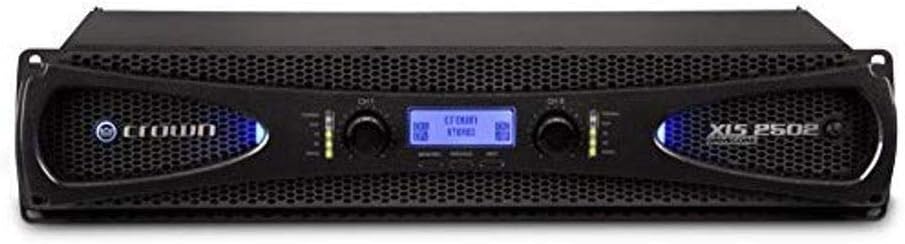
Crown XLS 2502
The XLS 2502 is the specialist choice for a system that already has a suitable preamp and genuinely needs substantial output. It is a two-channel Class D rack power amplifier, not a domestic integrated amp with source switching, a phono stage and a listening remote. Its attraction is power and control in a relatively light chassis.
Crown specifies 440 watts per channel into 8 ohms and 775 watts into 4 ohms, measured at 1kHz and 0.5% THD. Per-channel filtering, Peakx limiting and selectable input sensitivity help integrate it into a larger system. RCA, balanced XLR and 1/4-inch inputs accept suitable line-level signals, while forced-air cooling deals with the demands of a power amplifier.
Those ratings can greatly exceed what a typical small home speaker can tolerate. Use stereo operation with appropriately set levels and protection; bridging is not a sensible default for ordinary bookshelf speakers. The rack format and cooling fan also deserve consideration in a quiet room. Choose the Crown for a deliberately engineered high-output system, not simply because its wattage number is largest.
Pros
- High-output two-channel amplifier in a relatively light rack chassis.
- Per-channel filtering and Peakx limiting.
- RCA, XLR and 1/4-inch line-level inputs.
Cons
- Needs appropriate preamplification and careful level management.
- Output, rack format and forced-air cooling can be excessive for a small room.
FAQs About 6 Ohm Amplifiers
How Does Speaker Impedance Work?
Impedance is the load a speaker presents to an amplifier, and it varies with frequency. The nominal rating is not the minimum impedance at every point. A 6-ohm speaker can dip below that figure, so check both the amplifier’s supported load and any minimum-impedance information supplied with the speakers. The 4-ohm amplifier guide covers lower-load setups; there is no universal rule that all amplifiers operate best between 6 and 12 ohms.
Does More Power Make the System Safer?
Extra clean headroom can be useful, but too much power can damage a speaker. An amplifier driven into heavy clipping can also cause trouble. Neither a large nor a small wattage rating is automatically safe. Compare the speaker manufacturer’s recommended amplifier range, sensitivity and intended listening level, then avoid audible distortion and excessive volume.
Can Two Speakers Share One Channel?
Some amplifiers support multiple speakers in a specified arrangement; others do not. Two nominal 6-ohm speakers connected in parallel create a nominal 3-ohm load, before considering their impedance dips. A/B terminals often connect the two pairs in parallel when both are selected. Follow the amplifier’s instructions rather than assuming a selector switch makes any combination acceptable.
Are the Power Ratings Directly Comparable?
Check impedance, test bandwidth, distortion and the number of channels driven. A single-frequency rating at higher distortion is not the same measurement as a full-band rating at lower distortion. Do not estimate a precise 6-ohm output by averaging the 4- and 8-ohm numbers. Room size and speaker sensitivity also influence how much output is useful.
So, Which Is the Best Amp for 6 Ohm Speakers?
The Yamaha A-S301 remains the overall recommendation for a practical stereo system with useful controls and varied inputs. The Denon adds convenient Bluetooth and analog-source flexibility, while the CXA61 suits computer audio and a wider digital setup. The Crown is for a system that specifically needs its power-amp format and output. Match the amplifier to the actual speaker load and listening task rather than choosing by wattage alone.