Looking for the best portable PA systems for live music, presentations or small events? Start with the number of microphones and instruments that need their own controls, then consider speaker placement and the distance everything must be carried. A system that works beautifully for one singer may be awkward for a group.

These portable PA systems range from a battery-powered speech speaker to stereo suitcase systems and compact columns. The Behringer PPA500BT remains the overall pick for its balance of transport, mixing and effects. The other choices suit different priorities, including extra microphone inputs, simple recording and quick solo setup.
Best Portable PA Systems – Comparison Table
| Image | Model | Features | Price |
|---|---|---|---|
| Behringer Europort PPA500BT (Editor's Choice) | 6-channel mixer; Bluetooth; effects | Check Price |
 | Behringer Europort EPS500MP3 | 8-channel mixer; USB MP3; reverb | Check Price |
 | Yamaha STAGEPAS 600i | 10-channel mixer; SPX reverb; 10-inch speakers | Check Price |
 | Fender Passport Venue | 10-channel mixer; USB record/playback | Check Details |
 | Behringer Europort MPA40BT-PRO (Best for Speaking Events) | Battery-powered; Bluetooth; trolley handle | Check Price |
 | Harbinger HA300 Compact PA System | Column and 12-inch sub; 300W total | Check Details |
 | Bose L1 Compact | Column system; integrated bass; 2 channels | Check Price |
 | Fender Passport Event | 7-channel mixer; Bluetooth; reverb | Check Details |
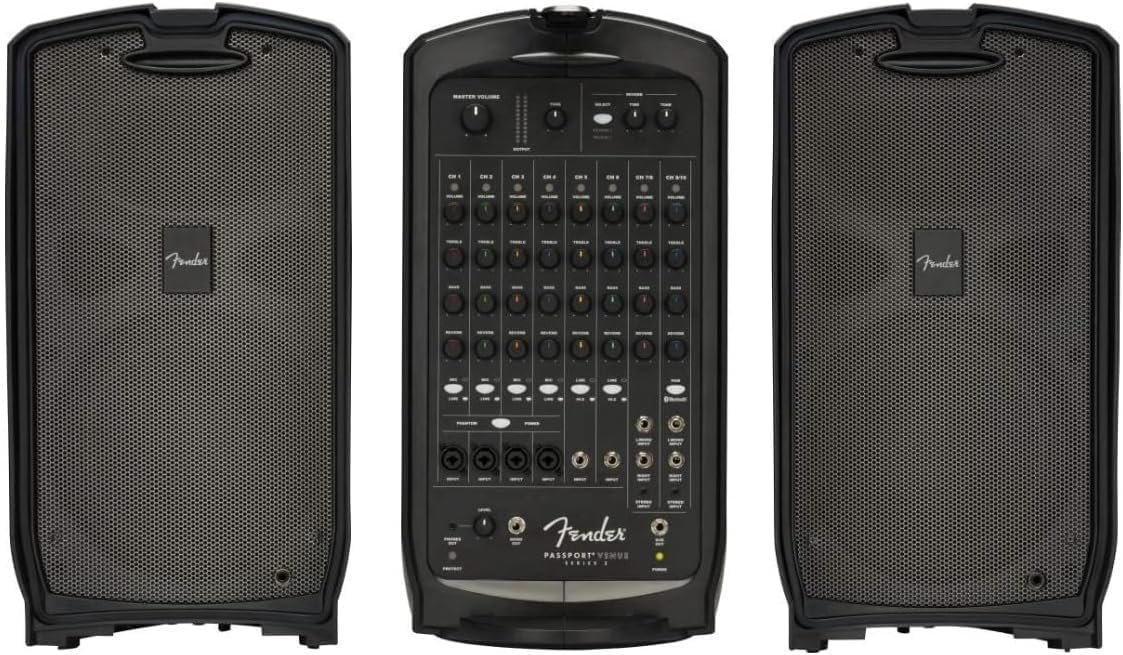 | Fender Passport Venue Series 2 | 10-channel mixer; Bluetooth; 10-inch speakers | Check Price |
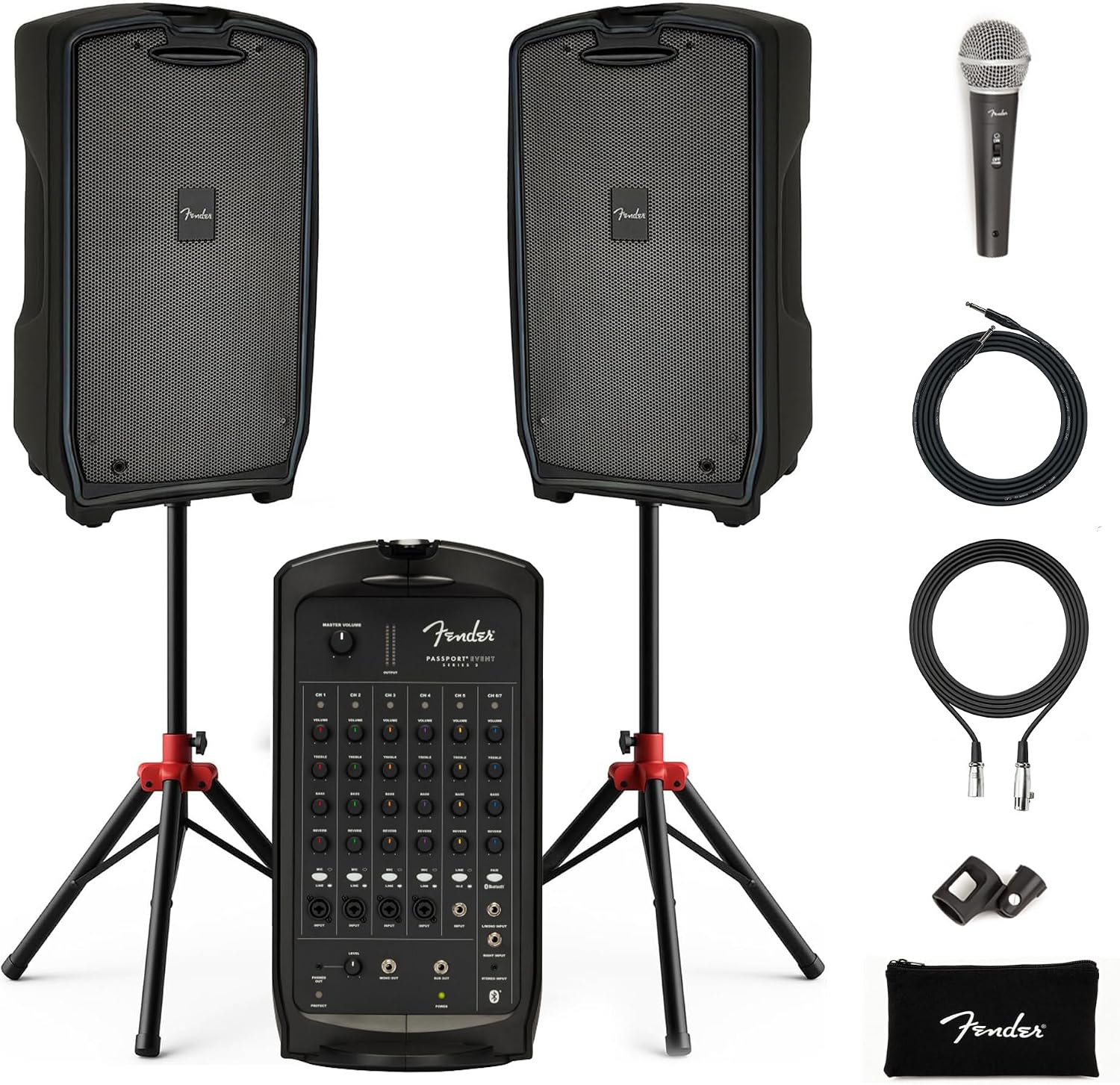 | Fender Passport Event Series 2 | 7-channel mixer; Bluetooth; 8-inch speakers | Check Price |
Behringer Europort PPA500BT (Editor’s Choice)
The PPA500BT keeps a useful balance between a compact suitcase format and real mixing controls. Its two detachable speakers use eight-inch woofers and 1.35-inch compression drivers, while the central mixer provides two mono and two stereo channels. For a singer with an instrument and backing tracks, that is a practical starting point without assembling a separate rack of equipment.
Bluetooth handles music playback, and the Klark Teknik processor provides 100 effects presets with channel sends. A five-band graphic EQ offers more overall shaping than basic bass and treble alone. FBQ highlights frequencies associated with feedback so they can be reduced; it does not make microphone placement irrelevant or automatically remove every squeal.
It remains the overall pick for its combination of transportable design, effects and hands-on control. The main limitation is having only two microphone preamps. Its advertised 500-watt system rating is not a promise of coverage for a particular crowd, and the eight-inch speakers are not a substitute for a dedicated subwoofer when deep bass is central to the performance.
Pros
- Suitcase-style transport with detachable stereo speakers
- Bluetooth playback and channel effects sends
- Five-band graphic EQ with feedback-frequency indication
Cons
- Only two microphone preamps
- Eight-inch speakers limit deep-bass expectations
Behringer Europort EPS500MP3
The EPS500MP3 favors input flexibility and self-contained playback. Its detachable powered mixer offers four microphone/line channels and two stereo channels, giving a small vocal group or mixed instrument setup more mic inputs than the PPA500BT. The mixer can stay docked in a speaker for transport or be placed within reach during a performance.
A USB MP3 player makes break music and backing tracks possible without leaving a phone connected. Stereo reverb adds ambience, while the switchable Voice-Over-Priority function lowers the stereo channels when a microphone is used. That is particularly convenient for announcements over background music, although it is less desirable when the backing track should stay at a constant level.
The two eight-inch speakers keep the system reasonably manageable at about 18.8kg in total. Behringer specifies 250 watts per side as maximum peak output, so the 500-watt headline should not be treated as a continuous-power comparison with every rival. Choose it for the four mic preamps and USB playback rather than expecting a deeply adjustable effects section or built-in Bluetooth streaming.
Pros
- Four mic/line inputs plus stereo channels
- USB MP3 playback and switchable music ducking
- Detachable mixer with onboard reverb
Cons
- Peak wattage is not a continuous-output rating
- Less effects flexibility than the PPA500BT
Fender Passport Venue
The original Passport Venue combines two full-range speaker cabinets with a ten-channel powered mixer in Fender’s familiar suitcase arrangement. Four XLR microphone inputs, two switchable high-impedance instrument channels and two stereo pairs make it a flexible choice for a small group with several different sources.
Its USB recorder is a distinctive strength. It plays MP3 and WAV files and records the stereo mix as 16-bit, 44.1kHz WAV audio, making rehearsal capture possible without connecting a computer. Channel bass, treble and reverb controls provide straightforward shaping, and the powered-subwoofer output activates a 120Hz high-pass filter on the main speakers.
This 600-watt-total model is the original Venue, with a different mixer and USB feature set from Venue Series 2. At about 44lb, it is portable rather than featherweight, and several performers may still need separate monitoring. It is especially appealing when simple stereo recording matters alongside live amplification.
Pros
- Ten-channel mixer with mic, instrument and stereo inputs
- USB stereo recording and MP3/WAV playback
- Subwoofer output with automatic high-pass filtering
Cons
- 44lb system still needs carrying and setup
- Stereo recording does not provide separate multitrack files
Bose L1 Compact
The L1 Compact takes a different approach from a pair of conventional speaker cabinets. Its slender array plugs into a powered bass enclosure, with extensions that raise the array for performance use. The interlocking design avoids separate speaker cables and keeps the setup visually unobtrusive in a small acoustic venue.
The first channel is built around an XLR microphone input with bass, treble and a fixed ToneMatch microphone preset. The second channel accepts a quarter-inch source, RCA or a stereo mini-jack; its acoustic-guitar ToneMatch setting can be bypassed for line-level equipment. Those inputs share the channel’s level control, so several connected sources do not become a fully independent multichannel mixer.
The complete extended system weighs about 29.2lb, including both extensions. It suits a solo performer or presenter who values fast assembly and a tidy stage footprint. A group needing several separately controlled microphones will want an external mixer, and the built-in bass section should not be mistaken for the output capability of a large dance-music PA.
Pros
- Quick interlocking setup without external speaker cables
- Integrated bass enclosure and two setup heights
- Mic preset plus switchable acoustic-guitar processing
Cons
- Multiple utility inputs share one channel level
- Limited independent mixing for a larger group
Yamaha STAGEPAS 600i
The STAGEPAS 600i is the hands-on choice for performers who want a conventional mixer and two separate speakers. Four mono mic/line channels and three stereo channels accommodate a useful mix of vocals, instruments and playback. The detachable mixer puts those controls beside the performer rather than behind a speaker.
Three-band channel EQ, four SPX reverb types and an automatic feedback suppressor provide useful live-sound tools. Channel four includes a high-impedance instrument setting, and the subwoofer output applies a 120Hz high-pass filter to the main speakers when connected. The USB port is for supported iPod/iPhone playback and charging; it is not a general USB-flash-drive MP3 player.
Its ten-inch speakers and 680-watt dynamic maximum output make it a more substantial system than a compact battery speaker. That rating is not continuous power, and the complete system weighs about 25.4kg. Choose it for accessible mixing and flexible connections when carrying two cabinets is acceptable, rather than for the lightest possible trip from the car.
Pros
- Ten-channel mixer with three-band channel EQ
- SPX reverb and automatic feedback suppression
- Sub output with automatic high-pass filtering
Cons
- About 25.4kg for the complete system
- USB playback is limited to supported Apple devices
Fender Passport Event
The original Passport Event is the more compact-input counterpart to the original Venue. Its seven-channel mixer includes four XLR microphone inputs, a high-impedance instrument channel and a stereo channel. Bluetooth joins the wired stereo inputs, which is convenient for music before a performance or between presentations.
Individual bass, treble and reverb controls keep adjustments familiar, while input pads help accommodate stronger signals. A mono output can feed a powered monitor, and the subwoofer output removes bass below 120Hz from the main speakers when a suitable sub is connected. Those connections give the system room to grow without replacing the complete PA.
Its 375-watt-total output and suitcase format fit vocal, acoustic and presentation duties where straightforward operation matters. At about 44lb, it still needs a proper carrying plan. It has fewer channels than Venue and lacks that model’s USB recorder, so the better choice depends on how many sources need separate control and whether recording is important.
Pros
- Four mic inputs plus instrument and stereo connections
- Bluetooth playback and individual reverb controls
- Monitor and powered-subwoofer outputs
Cons
- Fewer channels than Passport Venue
- No Venue-style USB recording
Harbinger HA300 Compact PA System
The HA300 pairs a narrow mainspeaker with a separate twelve-inch powered subwoofer. Its top section uses four 4.5-inch drivers and a piezo high-frequency driver, while amplification is divided between 100 watts for the top and 200 watts for the sub. The separate amplifiers let the top and subwoofer share the work across a 300-watt system.
Two microphone/line channels and a stereo auxiliary input provide a simple mix, with the auxiliary signal summed to mono. Bass and treble controls handle basic shaping. Connecting the top to the sub activates a 150Hz crossover, separating the low-frequency work from the mainspeaker instead of asking the small drivers to reproduce everything.
The dedicated sub is the main attraction for playback or a small performance that needs more low-end support. Portability is the compromise: the top weighs 23.3lb and the sub adds 47.5lb. The three-channel mixer is also modest beside the larger suitcase systems, so this is a better fit for a small number of sources than a band needing several independent microphone channels.
Pros
- Separate twelve-inch powered subwoofer
- Crossover divides bass and mainspeaker duties
- Simple mic/line mixer with linking connections
Cons
- Subwoofer alone weighs 47.5lb
- Only three input channels
Behringer Europort MPA40BT-PRO (Best for Speaking Events)
The MPA40BT-PRO makes the strongest case when a power outlet and a lengthy setup would get in the way. Its rechargeable battery, retractable trolley handle and wheels suit a presenter moving between rooms or making announcements outside. Bluetooth provides convenient playback alongside two microphone/instrument inputs.
An eight-inch woofer and one-inch tweeter handle the sound, with overall bass and treble controls rather than an elaborate effects section. RCA playback shares the Bluetooth/aux level control. The USB socket accepts an optional compatible Behringer wireless-microphone receiver; it does not play MP3 files from a flash drive.
Behringer rates maximum output at 40 watts and battery operation at up to twelve hours, with actual runtime depending on use. It is an appealing speech-first portable option, not a promise of coverage for a fixed crowd size. A loud band or bass-heavy event needs more headroom, while a simple presentation benefits from the small number of controls and roughly 9kg weight.
Pros
- Battery operation with wheels and retractable handle
- Two mic/instrument inputs and Bluetooth playback
- Straightforward master bass and treble controls
Cons
- Limited output for loud music or a full band
- No onboard reverb or USB-file playback
Fender Passport Venue Series 2
The Venue Series 2 keeps the suitcase concept but centers it on a ten-channel mixer with combination XLR/quarter-inch sockets. Four combo mic/line inputs, dedicated instrument connections and stereo inputs accommodate a varied small-stage setup. Bluetooth adds a straightforward way to play background music without occupying a wired connection.
Its pair of ten-inch woofers and horn-loaded tweeters are powered by a 600-watt system. Per-channel volume, bass, treble and reverb keep the important adjustments close at hand. A subwoofer output with automatic high-pass filtering makes it possible to add bass support while reducing the low-frequency demand on the main speakers.
This version is attractive for performers who want the larger Passport format with flexible combo inputs and wireless playback. At about 48lb, it is one substantial suitcase, so the transport advantage is organization rather than effortless lifting. For a solo presenter with just one microphone, its extra channels and cabinet size may be unnecessary.
Pros
- Ten channels with flexible combo and instrument inputs
- Bluetooth and individual channel reverb controls
- Powered-subwoofer connection with automatic filtering
Cons
- About 48lb to carry
- More system than a simple one-mic presentation needs
Fender Passport Event Series 2
The Event Series 2 offers the same practical suitcase idea with a seven-channel mixer and two eight-inch speakers. Four combination XLR/quarter-inch inputs make it easier to accommodate microphones and line sources, while a separate high-impedance instrument input suits a guitar without requiring that input to be treated as a microphone.
Bluetooth and wired stereo inputs handle music playback, and each channel has familiar volume, bass, treble and reverb controls. Its powered-subwoofer output activates a high-pass filter for the main speakers. That is a useful expansion route for performances that need more low-end support than the supplied speakers can comfortably provide alone.
At 375 watts and about 44lb, it offers fewer channels and smaller woofers than Venue Series 2 while retaining useful live-sound connections. It is a sensible fit for acoustic acts, presentations and small events with several microphones. The larger Venue makes more sense when additional independently controlled sources matter; the Event is easier to justify when seven channels cover the job.
Pros
- Four combo mic/line inputs and a dedicated instrument input
- Bluetooth, channel reverb and subwoofer output
- Suitcase storage keeps the core system together
Cons
- Fewer channels than Venue Series 2
- 44lb still requires deliberate transport
How to Find the Best Portable PA System
A useful portable PA brings the sound sources together, provides suitable mixing and amplification, and sends the result through speakers positioned for the audience. Microphone preamps, instrument inputs and playback connections matter as much as the headline power figure. Monitoring is another consideration: the performers may need to hear a different balance from the audience.
Write down every source before choosing the mixer. A stereo keyboard may occupy two channels, while several sockets on a shared stereo channel do not necessarily provide separate level controls. Leave some room for an extra microphone if the setup is likely to grow.
Prepackaged vs. DIY vs. All-In-One
A matched portable system keeps the speaker and amplifier choices together. An all-in-one speaker minimizes separate components, while a DIY system allows a more specific choice of mixer, powered speakers and monitoring. The right format depends on the performance and transport routine rather than one category being inherently better.
Prepackaged PA System
A suitcase-style system stores the core mixer and speakers together, then separates them for use. It is convenient when a pair of speakers and a modest mixer cover the job.
Pros
- Core amplifier and speaker components are designed to work together
- Organized storage and a repeatable setup
- Separate speaker positions allow useful audience coverage
Cons
- Limited choice of included mixer and speakers
- The complete suitcase can be heavy
- Stands, monitoring and extra cables may still be needed
All-In-One PA Systems
A powered speaker or compact column can put most controls in one place. This works especially well for a small number of sources, provided the inputs and level controls match what the performer needs.
Pros
- Fewer separate components to connect
- Compact stage footprint
- Battery options can remove the need for a nearby outlet
Cons
- Often fewer independent input controls
- One speaker does not provide a separate stereo pair
- Adding a mixer or subwoofer reduces the simplicity advantage
DIY PA Systems
Choosing a separate mixer and speakers gives more control over channel count, monitoring and future expansion. Powered speakers simplify amplification, while passive speakers require a suitably matched external amplifier.
Pros
- Choose the mixer and speakers around the actual performance
- Expand or replace individual components
- Build separate audience and monitor mixes where supported
Cons
- More connections and transport planning
- Requires careful signal-level and equipment matching
- The full cost includes stands, cables and accessories
Portability vs. Customization in PA Systems
Portability is more than the total weight. Check the heaviest single piece, the number of trips and whether wheels help on the actual route. The HA300’s separate subwoofer, for example, creates a different carrying task from a compact battery speaker.
Count the controls that are genuinely independent. A solo singer may be comfortable with two channels, while a group using several drum microphones alongside vocals and instruments needs more inputs and a considered monitoring plan. A larger setup does not automatically require a truck, but it does require somewhere safe to carry and store the equipment.
Power Considerations for PA Systems
Peak, dynamic and continuous power ratings describe different conditions. Comparing the largest number on each box is not a reliable way to predict clean volume, bass output or audience coverage. Speaker efficiency, placement, room acoustics and the material being amplified also matter.
With a matched powered system, use the supplied speakers and the connections specified by its manufacturer. With a separate amplifier and passive speakers, match impedance and power handling using the manufacturers’ guidance; there is no universal rule that simply doubling the speaker’s wattage makes a system safe or distortion-free.
For bass-heavy music, a suitable powered subwoofer can take low-frequency work away from the main speakers when the system supports the appropriate crossover. It also adds weight, cables and setup time. Speech and a vocal-and-acoustic-guitar performance may have different priorities.
Wrap-up: What’s the Best Compact PA System?
The PPA500BT remains the overall recommendation for a portable stereo system with useful effects and EQ. The EPS500MP3 offers more microphone inputs and USB MP3 playback, while the MPA40BT-PRO suits a simpler speech-first setup where battery operation is valuable.
The Bose L1 Compact favors fast solo setup. Yamaha’s STAGEPAS 600i provides a more substantial detachable mixer, and the Passport models offer different balances of channel count, recording and connectivity. The HA300 adds a dedicated subwoofer, with a considerable transport trade-off.
Choose the input layout and carrying format first. Then compare the controls and output needed for the actual performance, rather than buying more system than the job requires.
For the separate feedback-control question in a live PA setup, see Feedback Eliminator.