Looking for the best feedback eliminator? These six options cover dedicated automatic suppression, complete loudspeaker management and manual EQ with visual feedback indication.

The right choice depends on the job. A dedicated suppressor targets ringing frequencies, while a system processor adds crossover, EQ and alignment tools. None replaces good microphone technique, speaker placement and sensible operating levels. With a small PA system, consider which processing functions the mixer or speakers already provide.
Best Feedback Suppressors – Comparison Table
dbx DriveRack PA2 (Editor’s Choice)
The DriveRack PA2 remains the overall choice for a PA system that needs more than feedback control alone. Its two-input, six-output layout combines AFS suppression with crossover processing, EQ, compression, limiting and speaker-alignment delay. That makes it useful when several separate setup jobs need to be coordinated in one rack unit.
The setup wizards provide a structured starting point, while the display and direct-access controls keep the main processing functions within reach. AutoEQ adds room-response measurement with a suitable measurement microphone; AFS handles the separate task of controlling feedback. Ethernet control is another useful feature when the system includes the required network equipment.
The broader capability also brings responsibility: crossover, limiter and output settings must suit the actual loudspeakers. A network connection is needed for remote control, and the USB port is for firmware updates rather than USB audio. Choose the PA2 for integrated loudspeaker management; the AFS2 is the simpler comparison when suppression is the only missing function.
Pros
- Feedback suppression and loudspeaker processing in one unit
- Two inputs and six outputs for coordinated system management
- Setup wizards and Ethernet control
Cons
- More configuration than a dedicated suppressor
- Remote control requires a suitable network setup
dbx AFS2

The AFS2 is the focused choice when the PA already has its crossover and speaker processing sorted out. It provides two channels of automatic feedback suppression, with up to twenty-four filters per channel. Stereo-linked or dual-mono operation lets it suit a stereo path or two separately managed signals.
Fixed filters address recurring problem frequencies during setup, while live filters respond as conditions change. The filter-status LEDs show what each channel is doing, and the backlit display gives more detail about frequency, width and attenuation. The setup wizard helps make that process more approachable than a rack full of unexplained indicators.
It does not replace the crossover, system EQ and alignment tools of a DriveRack. Correct routing and operating level also remain important, especially when using mixer inserts or feeding the unit from a master output. For dedicated suppression with clear feedback about the filters themselves, the AFS2 has a particularly practical interface.
Pros
- Twenty-four filters per channel
- Fixed and live modes with stereo or dual-mono operation
- Wizard, filter LEDs and a detailed backlit display
Cons
- No integrated loudspeaker crossover or alignment tools
- Correct signal level and routing remain essential
dbx DriveRack 260

The DriveRack 260 is a flexible system processor for a more involved PA installation. Its two-input, six-output format combines feedback suppression with graphic and parametric EQ, crossover routing, compression, limiting and delay. Independent input and output processing gives it a broader role than a dedicated two-channel suppressor.
The front-panel display shows the signal path and processing blocks, while separate output mutes are useful during setup. Zone-controller support adds another option for an installation that needs accessible control away from the rack. These are practical strengths when one processor is managing several parts of a loudspeaker system.
Its computer-control approach uses RS-232 and DriveWare, so it feels older than the PA2’s Ethernet workflow. It also takes time to configure the routing and processing intelligently. Choose it for the system-management flexibility and installation features, rather than simply as the quickest way to stop one microphone feeding back.
Pros
- Flexible two-input, six-output system processing
- Independent processing and separate output mutes
- Support for installation zone controllers
Cons
- Older RS-232 computer-control workflow
- More setup work than a dedicated feedback suppressor
Behringer MiniFBQ FBQ800 Manual Equalizer

The FBQ800 is the hands-on alternative in this group: a compact stereo nine-band graphic equalizer with visual feedback indication. Its illuminated faders make broad tonal adjustments easy to see, and the FBQ function highlights a frequency band with a high signal level so the operator can investigate and reduce it.
Selectable fader ranges provide gentler or more substantial adjustment, while the input/output meters help keep track of levels. A seventy-five-hertz low-cut filter is useful for reducing unwanted rumble when that low-frequency content is not needed. The appeal is a direct physical interface without a deeper menu system.
It does not automatically place narrow notch filters. The nine broad bands also mean that cutting a troublesome frequency can remove more surrounding sound than a dedicated automatic suppressor would. Choose it for basic manual EQ and visual assistance, especially when an operator is available to make the adjustments.
Pros
- Direct faders for nine-band stereo EQ
- Visual feedback indication and input/output meters
- Switchable adjustment range and low-cut filter
Cons
- Manual adjustment rather than automatic suppression
- Broad bands provide less selective cuts than narrow notch filters
Behringer Ultracurve Pro DEQ2496
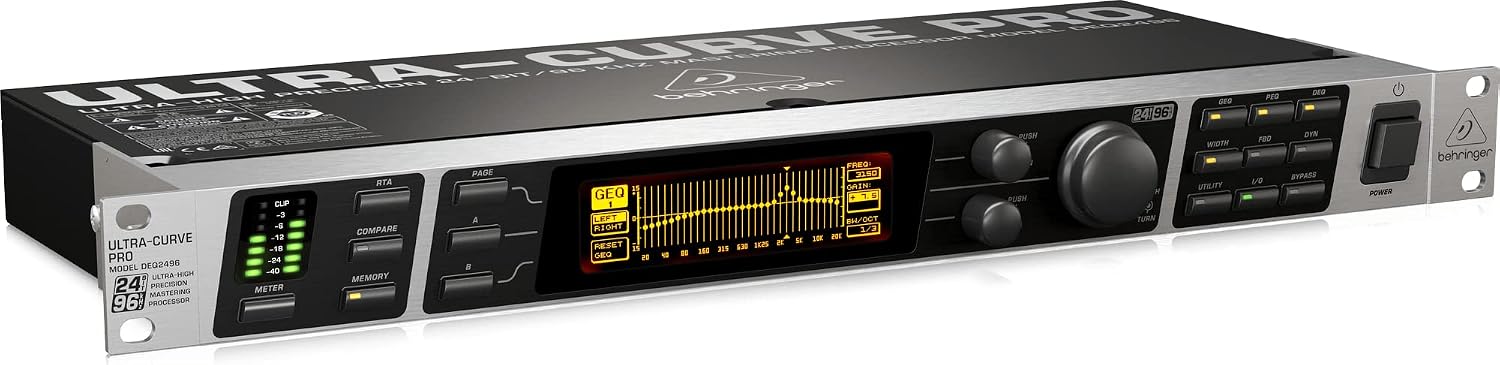
The DEQ2496 is the most measurement-oriented all-round processor in this selection. It combines graphic and parametric EQ with a real-time analyzer, dynamic processing and a Feedback Destroyer module. That makes it useful when understanding and shaping the system’s response matters alongside controlling unwanted ringing.
The Feedback Destroyer offers automatic and single-shot operation, while the display shows the filters and their attenuation. Analog and digital connections allow it to serve different signal paths. The analyzer and AutoEQ tools add another layer of system adjustment when used with the appropriate measurement setup.
Its flexibility comes with a more involved interface, and the parametric EQ and feedback filters share filter locations. The analyzer is not itself a substitute for enabling and configuring feedback suppression. Choose it when several of these processing tools will be used, rather than expecting the simplicity of a dedicated suppressor or a row of faders.
Pros
- EQ, analysis, dynamics and feedback tools in one unit
- Automatic and single-shot feedback modes
- Analog and digital connection options
Cons
- More involved menu system
- Parametric EQ and feedback processing share filter resources
Behringer FBQ1000 Feedback Destroyer

The FBQ1000 combines dedicated feedback control with parametric EQ in a two-channel rack processor. Its twenty-four filters are divided into twelve per channel, making the allocation clear when comparing it with the AFS2. It is a useful option for a system that needs focused filtering without the crossover functions of a loudspeaker manager.
Each filter can be assigned to automatic, single-shot or parametric operation. That allows known problem frequencies to be addressed while leaving other filters available to react during use. Status indicators help show which filters are active, and user presets let a prepared configuration be recalled later.
The compact display and button-and-wheel interface take some learning, particularly when mixing filter modes. It also has fewer filters per channel than the AFS2. Its strength is flexible allocation for a defined feedback-control job, provided the operator spends time preparing the system and monitoring how the processing affects the sound.
Pros
- Twelve filters per channel with flexible mode assignment
- Automatic, single-shot and parametric operation
- Status indicators and user presets
Cons
- Fewer filters per channel than the AFS2
- Compact editing interface takes time to learn
Conclusion: The Best Feedback Suppressor
The DriveRack PA2 remains the overall choice when feedback control is part of a wider loudspeaker-management job. For a system that already has the required crossover, EQ and protection, the AFS2 is the more focused option, with a clear display and a generous filter allocation.
The DriveRack 260 adds installation-oriented flexibility, while the DEQ2496 combines analysis and several processing tools. The FBQ1000 provides another dedicated automatic-filtering option. The FBQ800 serves a different need: manual graphic EQ with visual feedback indication, so it suits a setup where someone will make the cuts.
Begin with sensible microphone technique, speaker placement and operating levels. Then use filtering to address the remaining problem frequencies, keeping cuts as selective as the system allows. A suppressor can help manage feedback; it cannot make every placement or volume level workable.