Looking for the best Leslie pedals for guitar or keyboards? A rotary-speaker effect adds movement that ordinary chorus does not quite capture: a gentle swirl at slow speeds, a more urgent pulse at faster settings and the expressive transition between them.

A pedal can bring that character to a practical rig without the size and weight of a rotating-speaker cabinet. These five options range from detailed cabinet simulations to a tiny analog vibe pedal with a related flavor. They are not all trying to do the same job, so the reviews below explain where each one fits.
Best Leslie Pedals – Comparison Table
Electro-Harmonix Lester K (Editor’s Choice)
The Lester K earns the overall recommendation for putting the essential rotary controls in a clear, playable layout. Separate Slow and Fast knobs establish two speeds, while the Speed/Brake footswitch moves between them or brings the virtual rotors to a gradual stop. That makes the speed change part of the performance rather than just another static effect setting.
The Balance knob adjusts the relationship between the low-frequency rotor and high-frequency horn. It is a useful way to move between a darker wash and a brighter, more pronounced swirl without reaching for a separate EQ. Drive adds the character of an overdriven rotary cabinet’s tube amplifier, with output volume available to keep the effect at a useful level.
Mono or stereo inputs and stereo outputs make it flexible for a guitar rig or keyboard setup. The layout is approachable, but it does not offer the Ventilator II’s deeper microphone and acceleration adjustments or an expression-pedal connection.
EHX discontinued the Lester K in 2025. Its straightforward controls still make it a worthwhile established design when available, particularly for players who want speed and brake functions directly underfoot without a menu-heavy setup.
Pros
- Dedicated slow/fast settings and a foot-operated brake
- Rotor/horn balance and tube-style drive controls
- Mono/stereo inputs and stereo outputs
Cons
- No expression-pedal input
- Discontinued model rather than a current-production release
Neo Instruments Ventilator II (Best for Detailed Control)

The Ventilator II takes a more detailed approach, modeling a Leslie 122 cabinet with separate bass-rotor and treble-horn behavior. Adjustable speed, acceleration and virtual microphone distance make it especially attractive when the movement and perspective of the rotary sound matter as much as the amount of modulation.
The drive section adds simulated tube-amp saturation, and the speaker simulation can be disabled for use with a guitar amplifier. Slow/Fast, Stop and Bypass have separate footswitches, so important performance functions are easy to reach without changing a knob mid-song.
An external-control connection supports compatible switches or an expression pedal. Its stereo sockets need one qualification: the rotary effect is generated from the right/mono input, while the stereo input path is preserved in bypass. It is not a processor that independently applies the effect to both incoming stereo channels.
The larger enclosure and secondary control functions demand more space and learning than the Lester K. In return, it offers a finer degree of adjustment for players building a rig around the rotary sound, rather than using it only as an occasional color.
Pros
- Adjustable rotor behavior and virtual microphone distance
- Separate slow/fast, stop and bypass footswitches
- Remote control support and switchable speaker simulation
Cons
- Larger footprint and more involved setup
- Rotary processing uses the right/mono input rather than two independent stereo channels
DLS RotoSIM

The RotoSIM is an appealing choice for players who like shaping an effect through dedicated controls. Separate slow and fast speeds, a ramp-time knob and individual tweeter and bass levels let you work on the movement and tonal weight of the rotary effect without treating it as one fixed preset.
The ramp control is particularly useful: it changes how long the effect takes to travel between the two selected speeds. A slow transition can become part of a sustained chord, while a shorter transition suits more immediate changes. Switchable overdrive and its gain control add another layer of character.
An expression input offers continuous speed control with a compatible pedal. The two outputs are deliberately voiced differently, and the input/output routing is more specific than the phrase “stereo pedal” suggests; the second input is routed separately and mixed with the image generated from the first. That flexibility rewards a little time with the manual.
The heavy steel enclosure is roughly five inches square, so it is not a small-board option. DLS discontinued the RotoSIM in 2019, but its hands-on controls remain useful if one is available. Choose it for adjustable ramping and rotor balance rather than modern preset management.
Pros
- Dedicated ramp, slow/fast and rotor-level controls
- Switchable overdrive with its own gain control
- Compatible expression-pedal speed control
Cons
- Large, heavy enclosure
- Discontinued model with routing that needs planning
Hotone Roto (Best for Small Pedalboards)
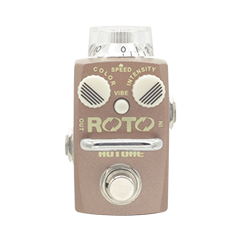
The Hotone Roto is the smallest and most vibe-oriented option here. Its analog photoelectric circuit is inspired by Uni-Vibe-style effects, giving guitarists a compact route to pulsing, swirling modulation. It is better understood as a related vintage texture than as the same detailed horn-and-drum simulation offered by the Ventilator II.
Speed, Intensity and Color keep the controls simple. Speed sets the rate of movement, Intensity adjusts its depth, and Color changes the tonal character. A Vibe switch provides another flavor, while true bypass takes the effect out of the signal path when switched off.
The enclosure is only 44mm wide and 74mm deep, which is a useful advantage on a crowded board. The trade-off is equally clear: one footswitch and a rate knob do not provide the dedicated slow/fast and brake controls found on the larger rotary simulators.
Hotone lists the Roto as discontinued. It remains an interesting compact choice for players after a warm, undulating vibe effect, but it is not the right match for someone who needs detailed cabinet realism or foot-operated rotor-speed changes during a song.
Pros
- Very small analog photoelectric design
- Simple speed, depth and tonal controls
- True bypass
Cons
- No dedicated slow/fast or brake footswitch
- Vibe-style character rather than detailed cabinet modeling; discontinued
BOSS RT-2 Rotary Ensemble
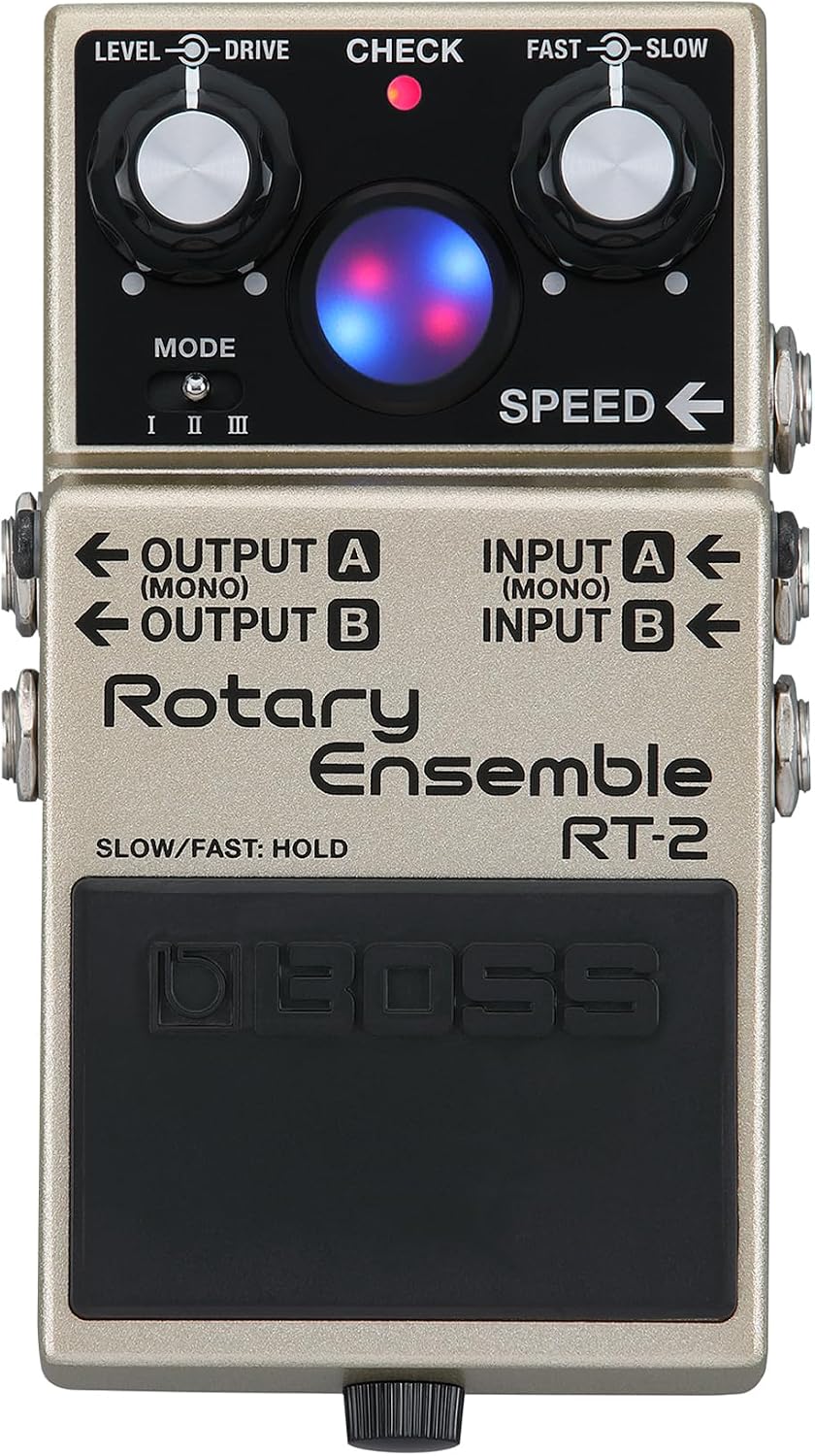
The RT-2 packs a more recent rotary design into the familiar BOSS compact format. Three modes provide a vintage-style cabinet voice and two variations with broader or more pronounced modulation. It suits players who want the rotary sound to move from a subtle background texture to a more obvious part of a guitar or keyboard arrangement.
Separate Slow and Fast controls establish the two rates, and a rear-panel Rise/Fall Time switch changes how quickly the virtual rotors move between them. The illuminated rotor display is a helpful visual cue. A second rear switch lets the Drive knob adjust either saturation or the balance between the treble and bass rotors.
Mono/stereo connections and selectable stereo or wet/dry outputs give it useful routing flexibility. The built-in pedal has several operating modes, while external switches or an expression pedal can expand performance control, including access to braking.
The compactness brings a trade-off: several functions share controls, and some settings sit on the rear panel. Players who want a dedicated switch for every action may prefer a larger pedal. For a smaller rig, the RT-2 offers a strong combination of rotary voices, speed control and modern connection options.
Pros
- Three rotary voices in a compact enclosure
- Adjustable speed transitions and a visual rotor display
- Stereo/wet-dry routing and external-control support
Cons
- Shared controls and rear-panel switches require some setup
- Additional foot controls require separately sold accessories
So, What’s the Best Leslie Pedal Out There?
The Lester K is the overall recommendation here for its balance of useful controls, stereo connections and straightforward foot operation. The Ventilator II is the stronger choice for detailed rotor and microphone adjustments, while the RotoSIM gives hands-on control over ramping and rotor levels. The Hotone Roto supplies a smaller, vibe-style alternative, and the BOSS RT-2 brings flexible rotary processing to a current compact design.
Rotary simulation or a vibe effect?
A traditional Leslie speaker uses rotating acoustic components to create changing pitch, level and tone. A simulator recreates aspects of that behavior electronically; it does not contain a rotating horn, woofer and amplifier cabinet. Uni-Vibe-style modulation has a related swirling character but is not identical to a detailed rotary-cabinet model.
Choose the controls you will use while playing
Slow and fast sounds are only part of the appeal. Acceleration, deceleration and braking can make sustained chords feel more animated, especially when the changes happen during a phrase. If those gestures are central to your playing, look for accessible foot controls or a compatible expression connection.
Plan mono and stereo routing
Stereo outputs can create a wider sense of movement through two amplification or recording channels, but a mono rig can still use a rotary effect. Input routing differs between pedals, so stereo sockets do not guarantee identical processing of both incoming channels. Match the connections and power supply to the instrument and rig rather than assuming every pedal behaves the same way.
The most useful choice is the one whose character and controls fit the music. A convincing swirl with an easy speed change is often more valuable onstage than a long list of features that remain unused.