Looking for the best JCM800 pedal? These eight drive pedals cover JCM800-focused distortion and related British-flavored rock sounds, from simple three-knob boxes to dual drives and a direct-recording preamp.

The familiar appeal is crunchy rhythm, a cutting midrange and enough gain for singing leads. A pedal can bring that character to a suitable guitar amp, but the guitar, speaker and amp settings still influence the result.
Some choices concentrate specifically on JCM800-style gain; others explore a wider vintage British range. Choose the controls and connections needed as well as the sound: a conventional overdrive into an amp and a cabinet-simulated direct setup are different ways to build a rig.
Best JCM800 Pedals – Comparison Table
JHS Sweet Tea V3 (Editor’s Choice)
The Sweet Tea V3 is the overall choice for a player who wants JCM800-style drive and a second overdrive in one enclosure. The Angry Charlie V3 side supplies the more aggressive British character, while the Moonshine V2 adds a mid-forward drive that can work alone or push the other circuit harder.
The Angry Charlie side provides volume, drive and a full bass, middle and treble section. Moonshine adds its own controls and a clean blend, letting some of the undriven signal remain in that side’s mix. An order toggle changes which circuit comes first, so stacking is part of the design rather than a fixed routing compromise.
That flexibility makes it useful for moving between rhythm and lead textures without adding another separate drive. It also means more controls and a wider footprint than a single-purpose pedal. Power it with the specified 9V center-negative supply; the standalone Angry Charlie’s higher-voltage option does not apply to the complete Sweet Tea.
Pros
- Two independently switchable drive circuits with selectable order.
- Angry Charlie three-band EQ and Moonshine clean blend.
- Broad rhythm-to-lead range in one enclosure.
Cons
- Larger footprint and more controls than a single drive.
- The complete pedal requires 9V power.
JHS Angry Charlie V3

The Angry Charlie V3 is the focused choice when the British distortion itself is the priority. It takes the JCM800-inspired side of the Sweet Tea concept and puts it in a simpler single-drive format, with enough EQ control to adapt the sound to different guitars and amplifiers.
Drive sets the amount of distortion and volume balances the output. Active bass, middle and treble controls can boost or cut their respective ranges, making it easier to keep a heavier rhythm sound defined or bring a lead part forward. This red, five-control V3 differs from earlier versions that used a simpler tone arrangement.
Its strength is shaping a substantial drive sound without needing another circuit. The trade-off is losing the separate overdrive and order switching of the Sweet Tea. It also has no dedicated cabinet-simulated output, so use it as part of an appropriate amp or amp-simulation chain rather than expecting it to replace the whole recording rig.
Pros
- JCM800-inspired distortion with active three-band EQ.
- Separate drive and output controls.
- More compact and focused than a dual-drive pedal.
Cons
- No independently switchable boost or second drive.
- No dedicated cabinet-simulated direct output.
JOYO JF-16 British Sound

The British Sound is the broad British-voiced option for someone who likes more shaping than a single tone knob provides. Its range is aimed at Marshall-inspired sounds, from vintage drive toward a more assertive roar, rather than recreating every British amplifier brand.
The six controls include level, drive, voice and low, middle and high EQ. Voice adds another way to change the character alongside the gain setting, while the three EQ bands help balance the pedal with a brighter guitar or a darker amp. The metal enclosure keeps the layout familiar and easy to adjust.
The practical appeal is being able to explore a range of British rock textures with ordinary knobs. It is less specifically focused on one JCM800 response than the Marshall or Angry Charlie choices. Spend time balancing voice and drive together, and use the amp’s own controls sparingly until the pedal’s basic sound is established.
Pros
- Six controls, including voice and three-band EQ.
- Broad Marshall-inspired rock range.
- Familiar physical layout in a metal enclosure.
Cons
- Less focused on one specific JCM800 character.
- Voice, drive and EQ take more adjustment than a three-knob pedal.
JOYO JF-32 Hot Plexi

The Hot Plexi is the straightforward route to a more driven British sound. Despite the name, JOYO describes this model as taking its cue from the JCM800, with additional distortion and output. It is a useful direction when the goal is crunch and sustain rather than another nearly clean boost.
Tone, volume and distortion keep the interface simple. Volume balances the engaged level, distortion sets the drive amount, and tone adjusts the overall brightness. True-bypass switching and support for a 9V battery or suitable adapter make it a conventional addition to a compact guitar board.
The advantage is speed: there are only a few controls between plugging in and finding a usable rock sound. The limitation is the same simplicity. There is no separate mid or bass control, and it does not provide a second footswitch for a lead boost. Choose it when one main driven texture is more useful than a large collection of adjustable voices.
Pros
- JCM800-inspired drive with a simple three-control layout.
- True-bypass switching.
- 9V battery or adapter operation.
Cons
- No independent bass or mid adjustment.
- No separate boost footswitch.
Mosky Plexi-M

The Plexi-M is the miniature option for a pedalboard with little spare space. It provides a simple distortion stage with a British-rock theme, making it appealing when the player wants one readily accessible drive sound without the width of a larger multi-control pedal.
The gold metal enclosure has tone, level and gain controls, a footswitch and an effect-status light. True bypass keeps its basic switching arrangement straightforward. The small format is the defining practical feature: it can fit where a wider drive or dual pedal would be awkward.
That compactness comes with limited shaping. A single tone control cannot adjust the low end and midrange independently, and the small knobs are less convenient for quick changes while standing. Choose it for the size and uncomplicated operation; players who need a closely shaped JCM800-style response will have more control with the three-band-EQ options here.
Pros
- Very compact metal enclosure.
- Simple tone, level and gain controls.
- True-bypass switching and status light.
Cons
- No separate bass or mid controls.
- Small knobs are less convenient for quick stage adjustments.
TC Electronic JIMS 800 Preamp
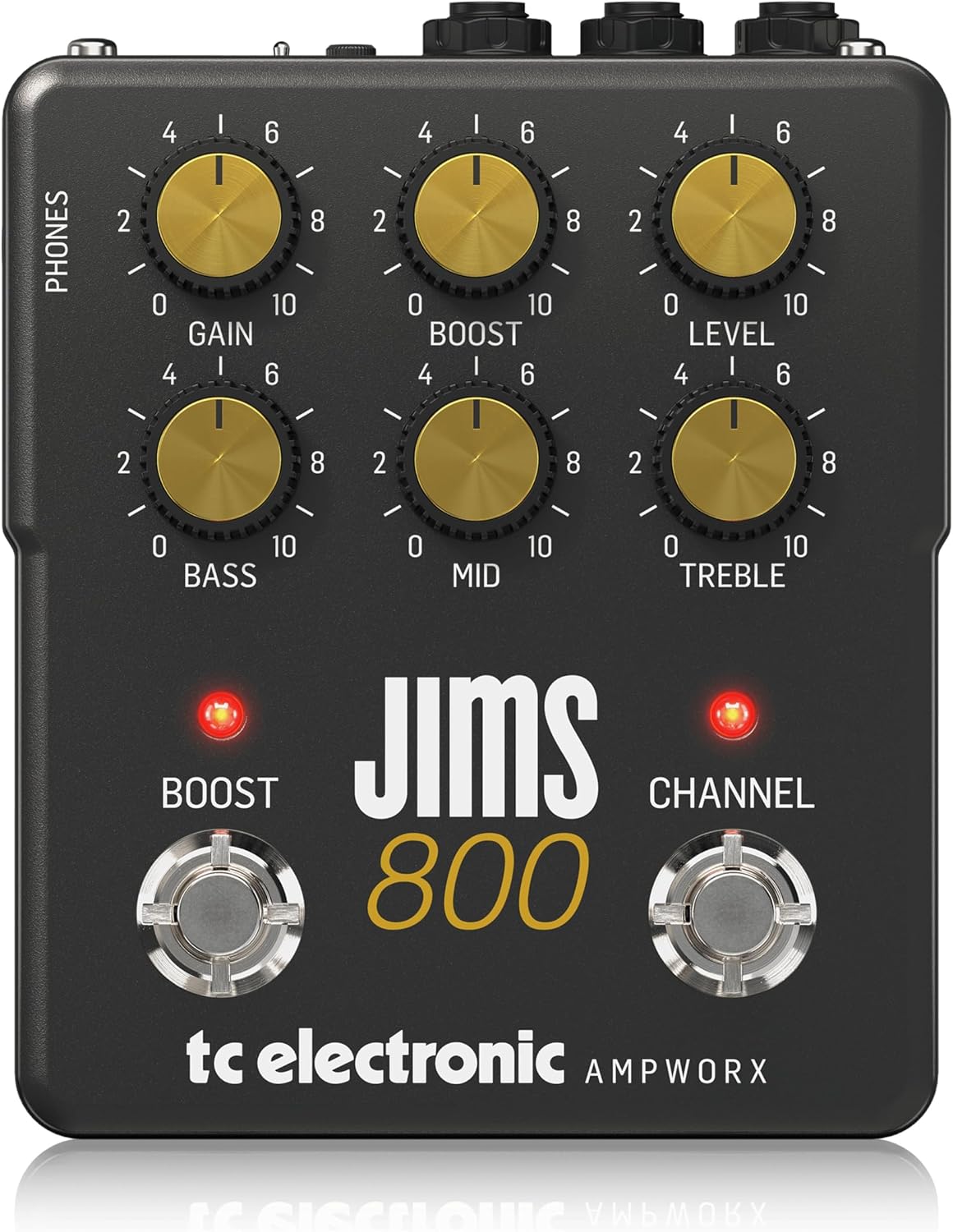
The JIMS 800 is the most complete direct-playing approach here. Its digital model takes its cue from the Marshall JMP 2203/JCM800 family, with separate clean and lead settings and a boost that can change either drive or output level. It is useful when the pedal needs to cover more than distortion into an existing amp.
Top-panel gain, level and three-band EQ settings are stored independently for the two channels. The boost can sit before the amp model for more saturation or after it for a level lift. Separate standard, cabinet-simulated DI and headphone outputs let it work with a guitar amp, a recording interface or a PA; the DI and headphone paths use an official Celestion 4×12 G12-65 cabinet response.
The benefit is a compact rig with channel changes, boost and direct monitoring already considered. It takes more setup than a conventional drive, especially when choosing dual-channel or bypass operation. Rear controls such as presence and boost position are global, and the unit needs a suitable 9V, 300mA supply. It is a preamp, not a power amplifier for a passive speaker cabinet.
Pros
- Independent channel settings and pre/post boost selection.
- Cabinet-simulated DI and headphone outputs.
- Three-band EQ and separate amp output for flexible routing.
Cons
- More setup and switching options than a basic drive.
- Requires suitable external power and cannot drive a passive cabinet.
Marshall JCM800 Overdrive
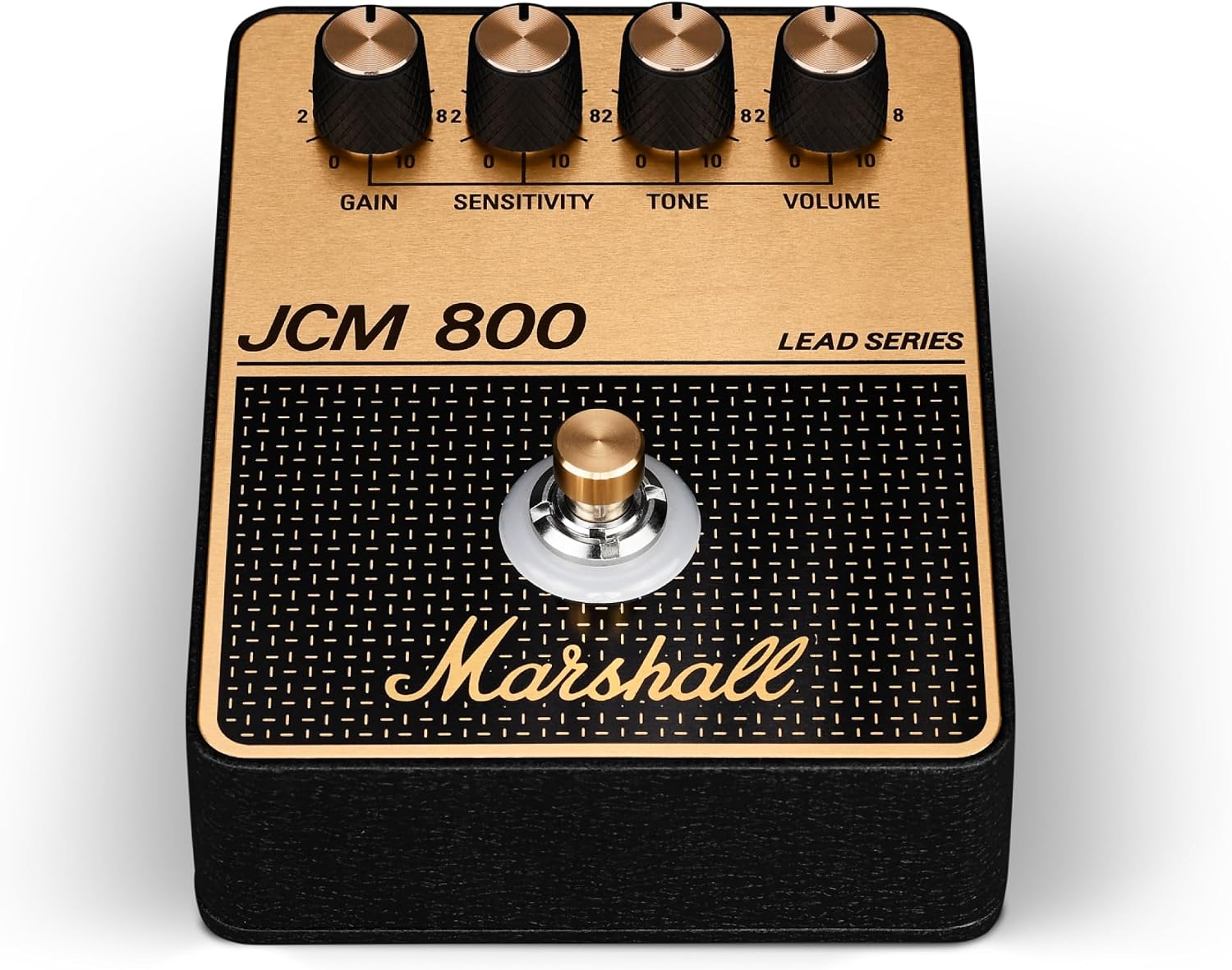
The Marshall JCM800 pedal is the direct, single-purpose choice from the maker of the amplifier. It aims at the bright, cutting distortion associated with the JCM800 range, keeping the controls focused on finding a crunch or lead texture rather than presenting a collection of unrelated amp models.
Gain sets the level before distortion, while sensitivity controls a second distortion circuit for different JCM800 tones. The tone control rolls off high frequencies after distortion and volume sets the final output. The illuminated footswitch ring shows when the effect is active, with true bypass when it is disengaged.
The attraction is a recognizable layout with two ways to shape the distortion character. The compromise is less detailed EQ than pedals with separate bass, middle and treble controls, and there is no dedicated headphone or cabinet-simulated DI connection. It runs from a 9V battery or a suitable center-negative supply, so it is a practical conventional drive rather than a complete amp replacement.
Pros
- JCM800-focused distortion from Marshall.
- Separate gain and sensitivity controls.
- True bypass with battery or 9V supply operation.
Cons
- Single tone control rather than three-band EQ.
- No dedicated headphone or cabinet-simulated DI output.
Friedman Dirty Shirley

The Dirty Shirley is the choice for a broader, vintage-leaning British drive with detailed tone shaping. Its character comes from Friedman’s Dirty Shirley amplifier rather than a claim to be an exact JCM800 replica. It is appealing for classic-rock rhythm and leads when feel and EQ flexibility matter more than matching one amp name.
Bass, middle, treble and presence provide substantial control alongside volume and gain. The side-mounted Tight switch changes the low-end response for a punchier feel. That is useful when moving between a fuller open-chord sound and a more controlled heavier rhythm texture.
The practical strength is keeping the drive adaptable to the rest of the rig. Presence can address the upper edge separately from the main tone controls, while the Tight switch offers a quick low-end adjustment. There is no separately footswitchable boost or direct cabinet simulation. Choose it for its own British-rock voice and control range, with a suitable amp or recording chain after it.
Pros
- Three-band EQ plus presence for detailed shaping.
- Tight switch adjusts low-end response.
- Separate gain and volume with true-bypass switching.
Cons
- No separately footswitchable boost.
- No dedicated cabinet-simulated direct output.
The Best Pedal for JCM800: Buying Guide
First decide whether the pedal should create a JCM800-style sound through another amp or push an actual JCM800 harder. Those are different jobs. An amp-in-a-box distortion supplies much of the gain character itself; a lower-gain boost can emphasize the amplifier’s existing drive without imitating its whole response.
Pedal or Stompbox
The words describe the same general format, not a particular sound. Overdrive, distortion, fuzz and modulation are different effects. For JCM800-focused crunch, the Marshall pedal, Angry Charlie, Sweet Tea’s Angry Charlie side, Hot Plexi and JIMS 800 have the clearest model-specific connection. British Sound, Plexi-M and Dirty Shirley explore a wider related rock palette.
Start with a clean or lightly driven guitar amp at a sensible volume. Set the pedal output near the bypassed level, raise drive until the part has enough sustain, then adjust EQ. More gain usually adds compression and noise as well as distortion, so retain enough note separation for chords.
A pedal can make driven tones available at lower room levels, but it cannot make every speaker and amplifier behave identically. Most conventional drives here also need an amp and cabinet-simulation stage for direct recording. The JIMS 800 provides dedicated cabinet-simulated connections for that purpose. None of these pedals powers a passive cabinet.
For a conventional transistor amp, our guide to overdrive pedals for solid-state amps explores the interaction further. The JOYO pedal guide also covers the brand’s wider range.
Other Factors to Consider
Three-band EQ is useful when the guitar needs more midrange focus or less low-end weight. A single tone control is quicker to use, but may leave more work for the amp. For solos, decide whether the extra footswitch should add saturation or a genuine level increase; a heavily clipping amp may turn an input boost into more drive rather than much more volume.
Check each pedal’s power specification rather than assuming every drive accepts the same voltage. The Sweet Tea requires 9V, for example, while the standalone Angry Charlie V3 and Dirty Shirley allow their specified 9–18V range. Supply polarity and available current also matter.
Try guitar-volume cleanup and different pickup positions before adding more gain. If a different distortion character is the priority, our guide to distortion pedals for punk covers other approaches.
Conclusion: The Best JCM800 Pedal Is…
The Sweet Tea V3 remains the overall choice for combining JCM800-style distortion with a separately usable overdrive and flexible circuit order. The Angry Charlie V3 offers a simpler focused version of that British drive, while Marshall’s own JCM800 pedal keeps the model-specific approach direct.
The JIMS 800 is the strongest fit when channel settings, boost and direct/headphone connections belong in the same device. The JOYO pedals and Mosky provide simpler British-rock approaches, while the Dirty Shirley favors a more independently voiced, vintage-leaning character with extensive EQ. Choose for the required sound, switching and signal path rather than assuming every British-flavored pedal is the same circuit.