Looking for the best clean amp head? These six guitar heads range from miniature practice-friendly hybrids to traditional tube designs, with different amounts of clean headroom and different ways to shape the sound.

A clear tone depends on the complete setup: guitar output, gain settings, cabinet and playing volume. More wattage does not guarantee a better sound, but enough clean headroom matters when chords need to stay clear alongside a band.
Every model here is an amplifier head, so speaker use requires a suitable cabinet and speaker cable. Headphone and direct-recording facilities vary; a line output should never be confused with the powered speaker output.
Best Clean Amp Heads – Comparison Table
Orange Micro Terror 20W

The Micro Terror is the simple, highly portable option for a player who likes a clean sound with some Orange character behind it. Keep the gain restrained and it can handle clear rhythm parts; turn it higher and the same compact head moves toward the brand’s familiar crunch. That range makes it useful when pristine clean is only part of the job.
A single 12AX7 preamp tube feeds a solid-state 20-watt output stage. Gain, tone and volume keep the controls immediate, while the auxiliary input and headphone output suit practice. The steel-cased head weighs about 0.85 kg and is specified for an 8- or 16-ohm speaker cabinet.
The appeal is how little equipment is needed to start playing. The compromise is control: one tone knob cannot shape bass, mids and treble independently, and there is no effects loop or built-in reverb. Its clean ceiling also depends on the guitar and cabinet, so it is better approached as a compact clean-to-crunch head than an unlimited-headroom band amp.
Pros
- Very compact hybrid head with straightforward controls.
- 12AX7 preamp and solid-state 20-watt output.
- Auxiliary input and headphone output for practice.
Cons
- Single tone control limits detailed EQ shaping.
- No effects loop or built-in reverb.
VOX MV50 Clean (Editor’s Choice)
The MV50 Clean is the overall pick for a small head built around clean playing rather than high-gain versatility. Its American-inspired voice, separate bass and treble controls and reduced-output settings give it a clear purpose: a compact foundation for the guitar itself or a modest pedal setup.
The analog preamp uses a Nutube 6P1, feeding a Class D power stage. Maximum output depends on the cabinet: approximately 50 watts into 4 ohms, 25 watts into 8 ohms and 12.5 watts into 16 ohms. The Clean model also has full, one-tenth and one-hundredth output settings, plus a headphone/line output for practice or direct connection.
At about 540 g, it is easy to carry with a small board. The rear EQ switch offers a fuller setting for smaller cabinets, while the front controls stay uncluttered. There is no effects loop or built-in reverb, and no separate mid control. Choose it for the focused clean approach and portability, with the cabinet’s impedance factored into expectations for volume.
Pros
- Clean-focused voice with separate bass and treble controls.
- Three output-level settings and headphone/line connection.
- Very light Nutube-preamp/Class D design.
Cons
- Rated output falls as cabinet impedance increases.
- No effects loop, built-in reverb or dedicated mid control.
Bugera G5 INFINIUM

The G5 INFINIUM is the small tube head for home playing that still provides a proper effects loop and two channels. The clean side keeps things simple with volume and tone, making it easy to establish a clear sound before using pedals or switching to the separate overdrive channel.
An ECC83-family preamp tube and a 12BH7 output tube produce up to 5 watts, with 1-watt and 0.1-watt settings for quieter use. Built-in reverb adds space, and the emulated headphone/recording output offers a choice of cabinet character. The loop can accommodate pedal or rack levels, a useful detail in a compact home setup.
The clean channel has less EQ adjustment than the overdrive side: the three-band controls and MORPH shaping belong to the driven channel. Five watts also means limited clean volume with a band. Use the reduced-output settings to manage loudness, and follow the manual’s standby instructions for headphone practice; the direct signal does not include the power-stage response.
Pros
- Two channels, reverb and a level-switchable effects loop.
- 5-, 1- and 0.1-watt settings for quieter playing.
- Cabinet-emulated headphone/recording output.
Cons
- Limited clean headroom for loud band use.
- Clean channel has one tone control rather than three-band EQ.
PRS MT15 Mark Tremonti

The MT15 is an appealing choice when a strong clean channel needs to share a head with a serious lead sound. Its clean side has its own volume and three-band EQ, allowing clear chords to have a different balance from the high-gain channel rather than forcing both sounds through one set of tone settings.
The compact tube head includes a global presence control and a series effects loop. Pulling the clean treble control engages a gain boost, useful for moving toward a more driven response without changing channels. A reduced-power setting adds flexibility, while the supplied footswitch handles clean/lead selection.
The practical strength is the separation between the two channel personalities. For purely clean use, leave the boost disengaged and set the channel volume with the guitar’s strongest attack in mind. It can still be loud in a small room, and it has neither built-in reverb nor a headphone output. It makes more sense for someone who values both channels than for a player seeking the simplest clean-only practice head.
Pros
- Independent clean and lead EQ with separate channel levels.
- Clean-channel pull boost and global presence.
- Series effects loop and supplied channel footswitch.
Cons
- No built-in reverb or headphone output.
- Compact tube format still requires careful volume control at home.
Quilter SuperBlock US
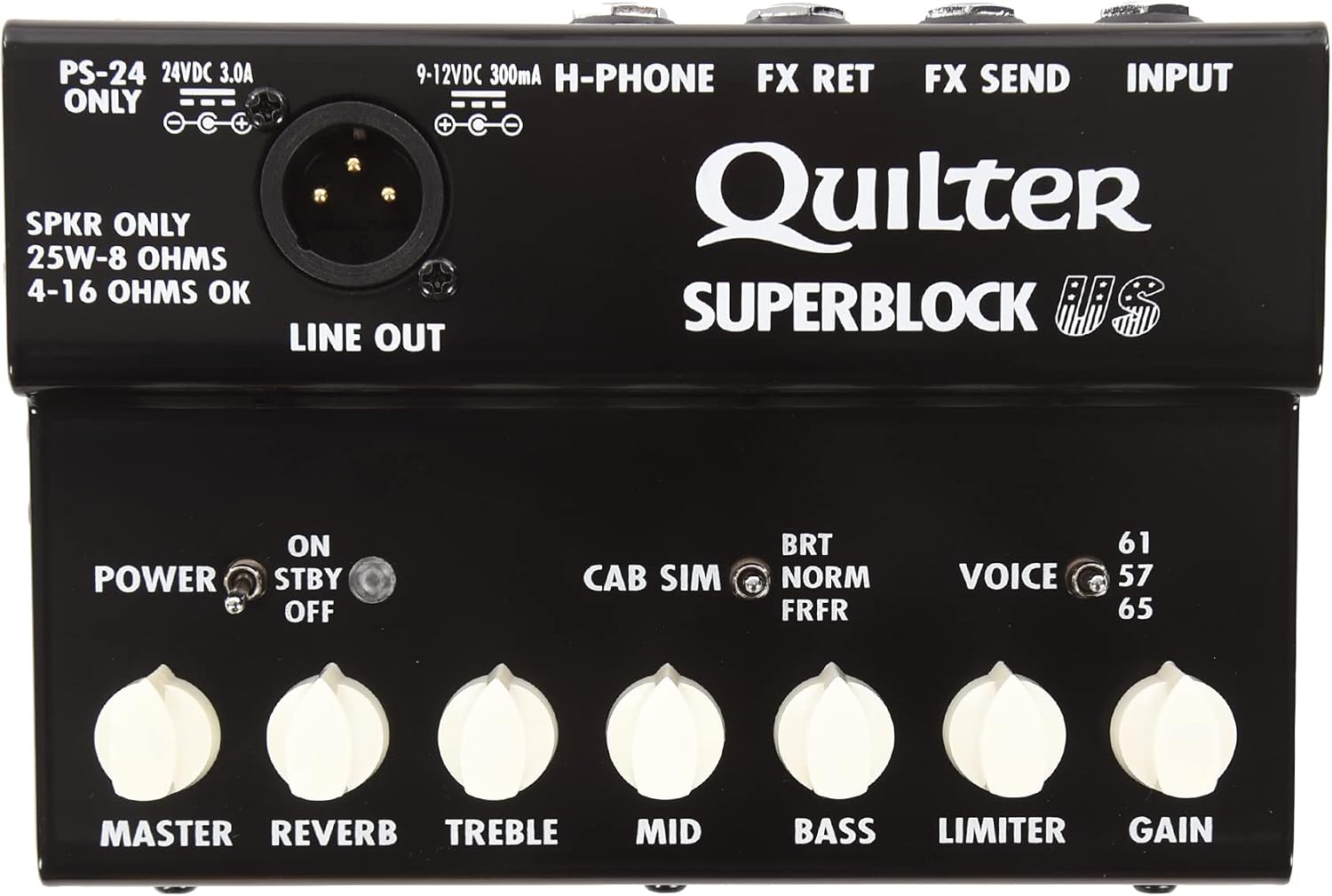
The SuperBlock US puts a complete guitar amplifier in a pedalboard-sized enclosure. It is a useful choice for clean players who want to keep the same core sound when moving between a speaker cabinet, headphones and a direct feed to a PA or recording setup.
Three American-oriented voices draw on ’57 tweed, ’61 blonde and ’65 black-panel sounds. Gain, limiter and three-band EQ provide more shaping than a single tone knob, while reverb and an effects loop support a compact board. The speaker output is rated at 25 watts into 8 ohms with the PS-24 supply; XLR and headphone outputs add cabinet-simulation options.
The appeal is flexibility without carrying a conventional head shell. A separate low-power connection also permits practice from a suitable pedal supply. The main limitation is clean stage volume: this is a small amp, not a substitute for every high-headroom rig. Its closely spaced controls also suit occasional adjustment better than large, easily grabbed stage knobs.
Pros
- Three American voices with gain, limiter and three-band EQ.
- Reverb, effects loop and cabinet-simulated direct/headphone outputs.
- Pedalboard-sized amplifier with a powered speaker output.
Cons
- Clean stage headroom depends on cabinet and volume needs.
- Small, closely spaced controls are less convenient for quick adjustments.
Bugera V22HD INFINIUM

The V22HD INFINIUM offers a more traditional tube-head layout, with a dedicated clean channel and a separate route into lead sounds. It suits someone who wants warm, clear rhythm parts, onboard reverb and physical tone controls rather than a miniature head with only the essentials.
The 22-watt design uses three 12AX7 preamp tubes and two EL84 output tubes. Normal and bright inputs provide different starting points for the guitar, while bass, middle, treble and presence controls shape the response. The included footswitch selects the channel and switches reverb, making those changes practical during a song.
INFINIUM monitors output-tube performance and provides an indication when a tube needs attention; it is not a promise of a fixed service life. The cabinet and playing level still determine how far the clean channel can go before breakup. Compared with the smaller hybrids here, this is a larger tube-based setup that makes the most sense when its traditional controls and second channel will actually be used.
Pros
- Two-channel tube design with onboard reverb.
- Normal/bright inputs and bass, middle, treble and presence controls.
- Supplied channel/reverb footswitch and output-tube monitoring.
Cons
- Larger tube-head format than the miniature alternatives.
- Clean headroom remains limited by output and cabinet choice.
Buying Guide for the Best Clean Amp Heads
Choose for the volume and connections needed, not simply for a tube or solid-state label. A clean home-practice sound, a pedal platform and a loud band rig place different demands on an amplifier. Speaker sensitivity and cabinet design also affect how much useful volume reaches the room.
Is Tube Amplification the Right Choice?
Vacuum tubes can provide a responsive transition from clean playing into breakup, but they are not automatically more accurate or more musical than solid-state circuits. The Micro Terror and MV50 combine a tube-based preamp with solid-state power; the Quilter uses a tubeless approach. Each can be useful for clean guitar.
Solid-state does not necessarily mean digital modeling. Transistors and diodes can form analog circuits, while a modeling amp uses digital processing for part of its sound. Judge the actual features and response needed rather than assuming the technology alone settles the choice.
Tube Amplification Advantages
- Many players enjoy the touch-sensitive transition into breakup.
- Traditional controls can make a focused sound easy to find.
- A suitable clean channel can work well with pedals.
These are reasons to consider a particular design, not guarantees that every tube amp stays clean at every volume. A low-powered head may reach its most driven sound before it reaches the clean stage level needed.
Tube Amplification Disadvantages
- Tubes are consumable parts and can require qualified servicing.
- A traditional tube power section needs the correct speaker load.
- Useful breakup can still be too loud for a small room.
Follow the individual manual for cabinet impedance, power switching and headphone use. Reduced-output modes change loudness, but headphone outputs may take their signal before the power stage. Never connect a powered speaker output to a mixer or recording interface.
Conclusion: The Best Clean Amp Head
The VOX MV50 Clean is the overall choice for its focused clean voice, light weight and useful output settings. The Orange Micro Terror remains an appealing clean-to-crunch travel companion, while the Bugera G5 adds low-power tube operation and practice connections.
Choose the PRS MT15 when a separate lead channel matters as much as the clean side, the Quilter SuperBlock US for a compact cabinet/direct rig, or the Bugera V22HD for a traditional two-channel tube setup with reverb. Match the head to the cabinet and required clean volume before choosing the smallest enclosure or largest wattage figure.