Looking for the best stool or chair for your guitar practice? A useful seat leaves room for the instrument, puts your feet where you need them and suits the space in which you play. Height, shape and practical storage help narrow the choice.

The Gibraltar 6608 remains the overall choice here for its adjustable height and open, armless design. The Fender adds a backrest at barstool height, Alfred combines a folding seat with a guitar stand, and the Gibson offers a lower fixed-height alternative. These are different ways to build a comfortable practice setup, rather than one design that fits everyone.
Top 4 Best Guitar Stools
Gibraltar 6608 (Editor’s Choice)
The 6608 is a drum throne that makes a useful guitar stool because the important features carry over: an armless seat, adjustable height and a base that folds for transport. Its motorcycle-style top has cutouts around the thighs, leaving room to position the legs without the edge of a large round seat getting in the way.
The vinyl-covered foam seat is supported by a double-braced tripod. A knurled support stem and memory lock set the height between 18 and 24 inches, making it easier to return to a preferred position after packing down. That range is the main advantage over the fixed-height barstools below, particularly when the setup changes between instruments or rooms.
The practical compromise is that this is a backless throne without a built-in foot ring. The player needs a suitable floor or foot-support position, and the seat and base separate for compact transport rather than folding into one flat piece. For a guitarist who wants to adjust the playing height and keep the instrument clear of armrests, it is the most adaptable starting point in this group.
Pros
- 18-to-24-inch height adjustment with a memory lock
- Armless motorcycle-style seat with thigh cutouts
- Double-braced base collapses for transport
Cons
- No backrest or built-in foot ring
- Seat and base need separating for compact packing
Fender Blackout Backrest Barstool, 30-Inch (Best with a Backrest)
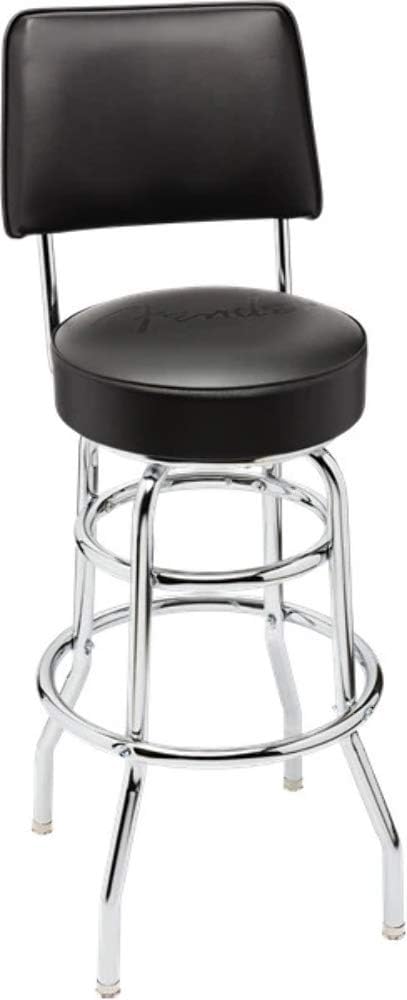
The Fender Blackout Backrest Barstool gives a practice corner the familiar look of a music-store barstool, with a backrest to lean against between passages. The embossed Fender logo is more understated than a brightly printed seat, while the chrome-plated frame gives it a recognizable vintage character.
This is the 30-inch model with a heavy-gauge one-inch tubular-steel frame and a 360-degree swiveling seat. The foot ring provides somewhere to rest the feet at that height. Its armless layout leaves space for the guitar body, and the swivel is convenient when turning toward a music stand or another player without moving the whole stool.
The fixed height is the main consideration. Thirty inches can be useful for a raised playing position, but it may make floor pedals or a floor-level foot support awkward to reach. That depends on the player and setup, not on whether the guitar is acoustic or electric. Assembly is required, and this is furniture to keep in a room rather than a flat-folding seat for frequent transport.
Pros
- Backrest and an armless playing space
- 360-degree swivel and a foot ring
- Chrome-plated tubular-steel frame with an embossed logo
Cons
- Fixed 30-inch height can put floor pedals out of comfortable reach
- Does not fold flat for travel
Alfred’s StagePlayer Guitar Stand and Stool (Best for Folding Storage)

The StagePlayer is the space-saving option because one folding frame serves as both a seat and a guitar stand. Its padded cradle gives the instrument somewhere to rest between playing sessions, reducing the number of separate pieces to place around a small practice area. The footrest is another useful feature for seated playing.
Alfred’s design opens in a single motion and locks into position. To store it, remove the retractable pin beneath the seat and fold the frame flat. There is no initial assembly to work through, making it more convenient for a changing rehearsal space than a barstool that stays built around four rigid legs.
The trade-off is adjustability. The fixed seat and footrest geometry need to suit the player; they cannot be tuned to the same range of heights as the Gibraltar. The compact padded seat also offers a different feel from a broad upholstered barstool. Choose the StagePlayer when folding storage and the integrated guitar cradle solve a practical problem, then make sure that both the playing position and stand support suit the instrument.
Pros
- Seat and padded guitar cradle in one folding frame
- Folds flat using a retractable locking pin
- Footrest and no initial assembly
Cons
- Fixed seat and footrest positions
- Compact seat offers less room to change position
Gibson Logo Barstool, 24-Inch

The Gibson Logo Barstool is a simple fixed-height seat for a practice room that does not need packing away after every session. The black vinyl swivel top and chrome-finished base keep the appearance classic, with the Gibson logo giving it a clear place in a guitar-focused room.
At 24 inches high, this model sits lower than the Fender 30-inch stool. Its foot ring offers a raised resting position, while the armless layout leaves the guitar body unobstructed. The French-seam seat detail is a useful visual touch, but the more important decision is whether that fixed height and ring position let the player hold the instrument comfortably.
The stool requires assembly, with the hardware and tools included. It does not adjust in height or fold flat, so it is better suited to a regular home or studio position than frequent travel. Choose it for a straightforward lower barstool and familiar styling; a player who needs to change height often will get more flexibility from the Gibraltar.
Pros
- Fixed 24-inch height offers a lower barstool position
- Vinyl swivel seat with a foot ring
- Armless design and included assembly hardware/tools
Cons
- No height adjustment or backrest
- Rigid frame is less convenient for regular transport
How to Choose the Best Guitar Chair or Stool: A Buyer’s Guide
Chair or Stool?
Start with room for the guitar. Armrests can interfere with the instrument, while a backrest may be useful when resting between passages. Some stools have backrests and some chairs do not adjust, so the name alone tells you little. Try the seat with the guitar in its normal playing position rather than judging it only as ordinary furniture.
Height and Foot Support
The seat should let you reach the supports and pedals you actually use without balancing awkwardly. A foot ring may suit a raised barstool position; a lower seat may work better with floor pedals or a separate foot support. There is no height that automatically suits every acoustic or electric guitarist. Classical-guitar supports and individual playing positions add another reason to check the complete setup.
Adjustability
Height adjustment is useful when more than one player uses the seat or when you change instruments and playing positions. Fixed-height stools can still work well when their dimensions suit the room and player. In this group, the Gibraltar adjusts from 18 to 24 inches; the Fender and Gibson have fixed barstool heights. A backrest and a footrest do not necessarily adjust just because a seat has them.
Comfort and Stability
Padding, seat shape and cover material affect the feel, but thicker cushioning is not a guarantee of comfort. Look for a stable base and enough space to change position without hitting the guitar. Comfort varies between players, and changing position or taking a break can be useful during a longer session.
Storage and Transport
A folding frame is easier to store than a rigid barstool. The Alfred folds flat, while the Gibraltar packs down by separating the seat and collapsing its tripod base. The Fender and Gibson are better treated as room furniture. If the seat will travel regularly, include the packing process in the decision rather than considering weight alone.
Price and Useful Features
Spend on the features that improve the actual setup: suitable height, stable support, instrument clearance and practical storage. Branding and finish can make a seat pleasant to keep in a music room, but they do not establish a universal advantage in comfort. An integrated guitar stand is useful only when it supports the instrument securely and fits the available space.
The Best Guitar Practice Chair or Stool: Our Verdict
The Gibraltar 6608 remains the overall pick for its height adjustment and open seat design. The Fender Blackout adds a backrest at a taller fixed height, the Alfred StagePlayer combines folding storage with a guitar cradle, and the Gibson provides a lower barstool option. Choose around the guitar, foot position and room first; the right setup is the one that feels natural to return to for regular practice.