What’s the best intermediate drum set? A useful upgrade should support the playing you want to develop: stronger control of dynamics, comfortable positioning and a setup that can grow with your music. The right choice also depends on where you can practice and whether an acoustic or electronic kit makes more sense.

The Pearl Export is the overall acoustic recommendation, while the Yamaha and Roland offer electronic practice and recording options. The Roadshow has a different role as a complete, straightforward acoustic setup. Compare the playing surfaces, hardware and upgrade priorities rather than assuming every four- or five-piece kit offers the same experience.
Top 4 Best Intermediate Drum Sets
| Image | Model | Price |
|---|---|---|
| Pearl Export EXX725S/C (Editor's Choice) | Check Price |
 | Pearl Roadshow RS525SC/C706 | Check Price |
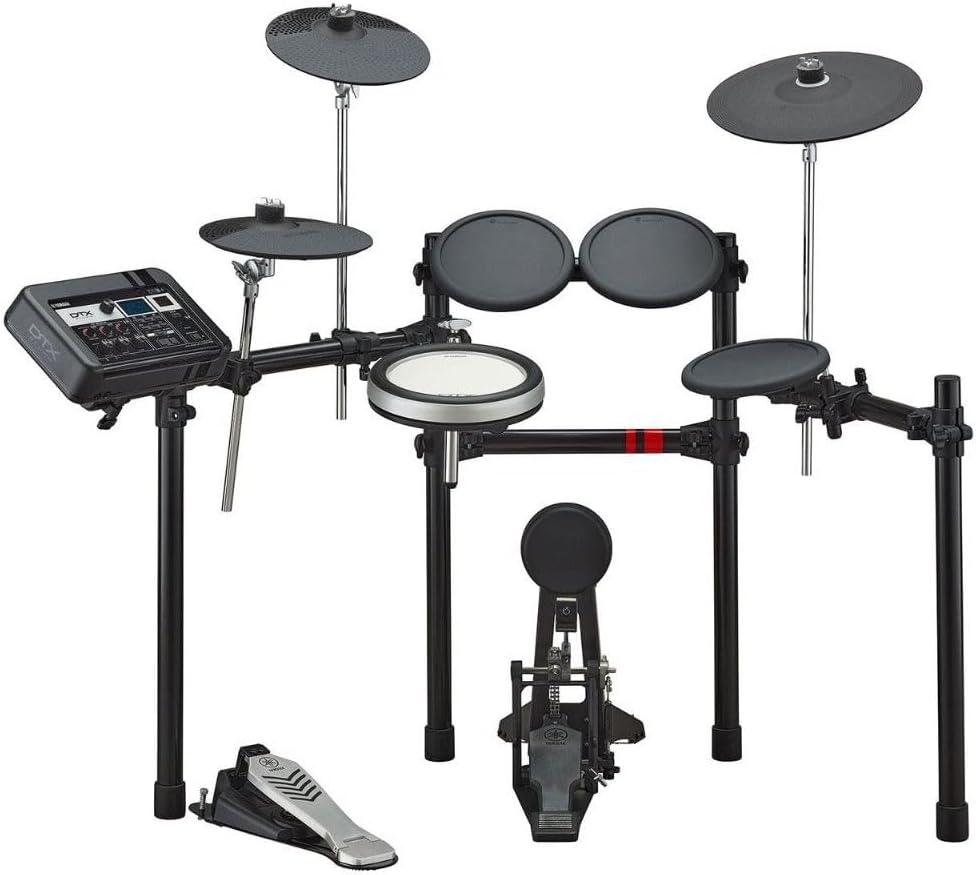 | Yamaha DTX6K-X | Check Price |
 | Roland TD-11K-S | Check Price |
Pearl Export EXX725S/C (Editor’s Choice)
The Export is the overall choice for players who want an acoustic foundation they can shape over time. This New Fusion configuration combines a 22-by-18-inch bass drum, 10- and 12-inch rack toms, a 16-inch floor tom and a matching 14-inch snare. It offers a practical spread of sizes for developing a balanced, full-kit sound.
The six-ply poplar/Asian mahogany shells, Opti-Loc tom mounts and 830-series hardware distinguish this version. The P930 Demonator pedal is another useful part of the setup, giving the bass drum a dedicated, adjustable playing interface rather than leaving the pedal choice until later.
The strongest reason to choose it is flexibility: heads, tuning and cymbal choices can adapt the kit to different musical settings without replacing the drums. Cymbals are a separate purchase, so the complete budget needs to allow for them. It is also a full-volume acoustic instrument. For a drummer with suitable practice space, the Export provides a sensible platform for rehearsals and performance.
Pros
- Useful New Fusion drum-size combination
- Opti-Loc mounts, 830 hardware and P930 pedal
- Flexible foundation for head and cymbal choices
Cons
- Cymbals need a separate budget
- Acoustic volume requires suitable practice space
Pearl Roadshow RS525SC/C706
The Roadshow is the practical choice when the aim is a complete acoustic setup rather than a shell-and-hardware upgrade. Its five drums, stands, pedal, throne and starter cymbals provide the basic working kit. That can make sense as a dedicated rehearsal instrument or a second kit for a player who wants to keep another setup elsewhere.
This configuration uses a 22-by-16-inch bass drum, 10- and 12-inch rack toms, a 16-inch floor tom and a 14-by-5.5-inch snare. Poplar shells and double-braced stands keep the design conventional, while the 16-inch crash/ride and 14-inch hi-hats cover the essential cymbal positions.
The compromise is that completeness matters more here than a wide range of specialist sounds. The starter cymbal selection is limited, so a developing player may prefer to budget for chosen cymbals before other changes. Heads and tuning are further ways to tailor the response. It remains a loud acoustic kit, making room suitability as important as the convenience of the package.
Pros
- Complete acoustic setup with throne and starter cymbals
- Conventional five-drum layout
- Useful dedicated practice or second-kit role
Cons
- Limited starter cymbal selection
- Less scope for quiet practice than an electronic kit
Yamaha DTX6K-X
The DTX6K-X is the electronic choice for players who want more detailed sound shaping and a physically struck kick pad. Its DTX-PRO module puts Ambience, Compression and Effect controls on three Kit Modifier knobs. That makes it easy to change the overall character of a kit without turning every adjustment into a long menu session.
The eight-inch XP80 snare uses Yamaha’s Textured Cellular Silicone surface and supports three zones. The PCY135 ride also has three zones, giving the kit useful distinctions between playing areas. A separate KP65 kick pad allows a conventional bass-drum pedal to strike a physical surface, which is valuable for working on foot technique.
The main compromise is in the toms: the three seven-inch TP70 pads use single-zone rubber surfaces rather than the snare’s TCS construction. The hi-hat uses a separate controller instead of a moving cymbal on a conventional hi-hat stand. Choose it for the module, expressive snare and ride, and compact layout, while allowing for those differences in feel.
Pros
- DTX-PRO module with direct Kit Modifier controls
- Three-zone TCS snare and three-zone ride
- Separate physical kick pad
Cons
- Small, single-zone rubber tom pads
- Controller-based hi-hat rather than a conventional moving hi-hat
Roland TD-11K-S
The TD-11K-S is a compact electronic option with a particularly useful mesh-head snare. Its PDX-8 pad distinguishes head and rim playing, while the KD-9 kick pad provides a cloth playing surface and can accommodate a double pedal. Those details make it more substantial for technique practice than a layout built entirely around simple flat pads.
The TD-11 module combines SuperNATURAL sounds with backing songs, Quick Record/Quick Play and Coach functions. These are useful tools for checking timing and following progress, rather than features reserved for beginners. USB connections also support computer integration and backing-track use, giving the kit a role beyond playing its internal sounds alone.
The toms are single-zone PD-8A rubber pads, so they do not offer the snare’s head-and-rim playing options or adjustable mesh feel. The CY-5 hi-hat supports separate bow and edge triggering for more varied articulation. Budget for a kick pedal and throne as needed. It is a practical compact kit when the mesh snare and practice functions matter most.
Pros
- Mesh snare with separate head and rim response
- KD-9 kick pad supports double-pedal use
- Coach, quick recording and USB facilities
Cons
- Single-zone rubber toms differ from the mesh snare
- Kick pedal and throne require a separate allowance
Buyer’s Guide: How to Find the Best Intermediate Drum Set
The best intermediate drum set should solve a specific limitation in the current setup. That might be unstable positioning, limited cymbal choice, a kick response that makes foot practice awkward, or a practice room where full acoustic volume is impractical. Identify that limitation before choosing a larger kit.
Where Are You Playing?
An acoustic kit needs space and produces substantial sound. An electronic kit can send its audio to headphones, but stick impacts and pedal vibration still travel through the room and floor. Consider the actual home or rehearsal space, storage and transport rather than assuming electronic means completely silent.
Short-Term vs. Long-Term
Compare the complete setup, including cymbals, stands, pedals, seating and monitoring. A complete entry-level kit may be useful for regular practice, while an upgrade-oriented acoustic kit lets the player choose those components independently. The label “intermediate” matters less than how the hardware and playing surfaces support the next stage of learning.
Heads, tuning and cymbal choices can make worthwhile changes to an acoustic kit. On an electronic kit, confirm which additional pads the module supports before planning expansions. Our guides to double bass pedals and drum thrones cover two parts of the setup that strongly affect playing position and control.
All in the Feel
Compare rebound, pad size, available playing zones and hi-hat response. Mesh, silicone and rubber surfaces feel different, and a kit may combine several types. A multi-zone snare or cymbal can distinguish playing areas, while a single-zone tom offers a more limited set of articulations. Try soft strokes, accented notes and normal sticking patterns rather than judging only by the loudest preset sound.
What Style of Music Are You Playing?
Acoustic and electronic kits can both serve several styles. The useful questions are the required dynamics, cymbal articulation, stage layout and amplification. For computer-based sounds, check the kit’s audio/MIDI connections and current driver requirements. An audio interface is relevant for recording analog audio, while USB MIDI carries performance information to compatible software.
Watch Your Tone
On acoustic drums, dimensions, heads, tuning, bearing edges and construction all contribute to the result. Wood species alone does not guarantee a universal ranking of warmth or quality. On electronic kits, the sound engine, trigger response and editing controls work together; a large sound count is not a substitute for useful dynamics.
Players comparing an initial setup can also read our beginner drum set guide and budget electronic drum set comparison. For a broader starting point, see our discussion of learning an instrument.
Verdict: What’s the Best Intermediate Drum Set?
The Pearl Export remains the overall acoustic recommendation for its useful configuration and adaptable hardware foundation. The Roadshow favors a complete, straightforward practice setup. For electronic playing, the Yamaha DTX6K-X offers an appealing module and expressive snare/ride combination, while the Roland TD-11K-S centers its appeal on a mesh snare, physical kick pad and practical coaching tools.
Choose the kit that lets you practice regularly and develop the techniques that matter to your music. Comfortable positioning and useful response are more valuable than extra pieces that the space or playing style does not need.