Looking for the best acoustic-electric bass guitar? These instruments combine a hollow acoustic body with a pickup for amplified playing. They can be useful for quiet practice and acoustic arrangements, but the right body size, scale length and electronics matter more than expecting a large unplugged sound from every model.

The Fender CB-60SCE remains the overall pick for its solid spruce top, 32-inch scale and practical Fishman controls. The smaller Ibanez PNB14E takes a different approach with a short parlor-scale layout, while the Dean EAB provides a longer 34-inch scale. The comparison also includes two CB-60SCE part numbers from the same model family, rather than treating them as unrelated designs.
Best Acoustic-Electric Bass Guitars: Comparison Table
Fender CB-60SCE Acoustic-Electric Bass (Editor’s Choice)
The CB-60SCE is a well-balanced choice for a player who wants acoustic practice and straightforward amplified use in one instrument. Its solid spruce top sits over a concert-sized body with mahogany back and sides. The cutaway provides access beyond the lower positions without turning the instrument into a large jumbo bass.
A 32-inch scale shortens the reach compared with a standard 34-inch electric bass, while the slim-taper neck and rolled fingerboard edges emphasize playing comfort. The Fishman Classic Design system provides volume and three-band EQ, so the amplified balance can be adjusted at the instrument rather than only at an amp.
It earns the overall choice for combining those practical dimensions with a solid top and useful controls. The hollow body still needs sensible stage placement to manage feedback, and unplugged volume is better suited to personal practice or a restrained arrangement than competing with a drummer. Its strengths are versatility and a familiar playing layout, not an exemption from the usual limits of acoustic bass.
Pros
- Solid spruce top with a cutaway concert body
- 32-inch scale and rolled fingerboard edges
- Fishman controls with volume and three-band EQ
Cons
- Hollow body can feed back at amplified stage levels
- Unplugged projection has limits in a loud ensemble
Ibanez PNB14E Acoustic-Electric Bass

The PNB14E is the compact option here, built around a parlor body and a roughly 24.8-inch scale. That short reach changes the experience substantially from a full-sized acoustic bass. It is an appealing instrument for relaxed practice, travel or a player who prefers less distance between frets.
An okoume body, maple neck and 18-fret layout keep the design simple. The Ibanez undersaddle pickup feeds an AEQ-2T preamp with a tuner and two-band EQ. A quarter-inch output connects to suitable amplification, so its usefulness does not depend on producing a large acoustic sound from the small body.
The short scale calls for strings suited to the instrument rather than an ordinary long-scale set. Its compact body also favors intimate playing over unamplified projection. That is a fair trade when portability and reach are the attraction: the PNB14E offers a genuinely different physical format instead of merely making a conventional acoustic bass a little smaller.
Pros
- Compact parlor body with a roughly 24.8-inch scale
- Undersaddle pickup and two-band EQ with tuner
- 18-fret layout with a maple neck
Cons
- Needs strings suited to its short scale
- Small body is not intended for strong unplugged projection
Dean EAB Acoustic-Electric Bass Guitar
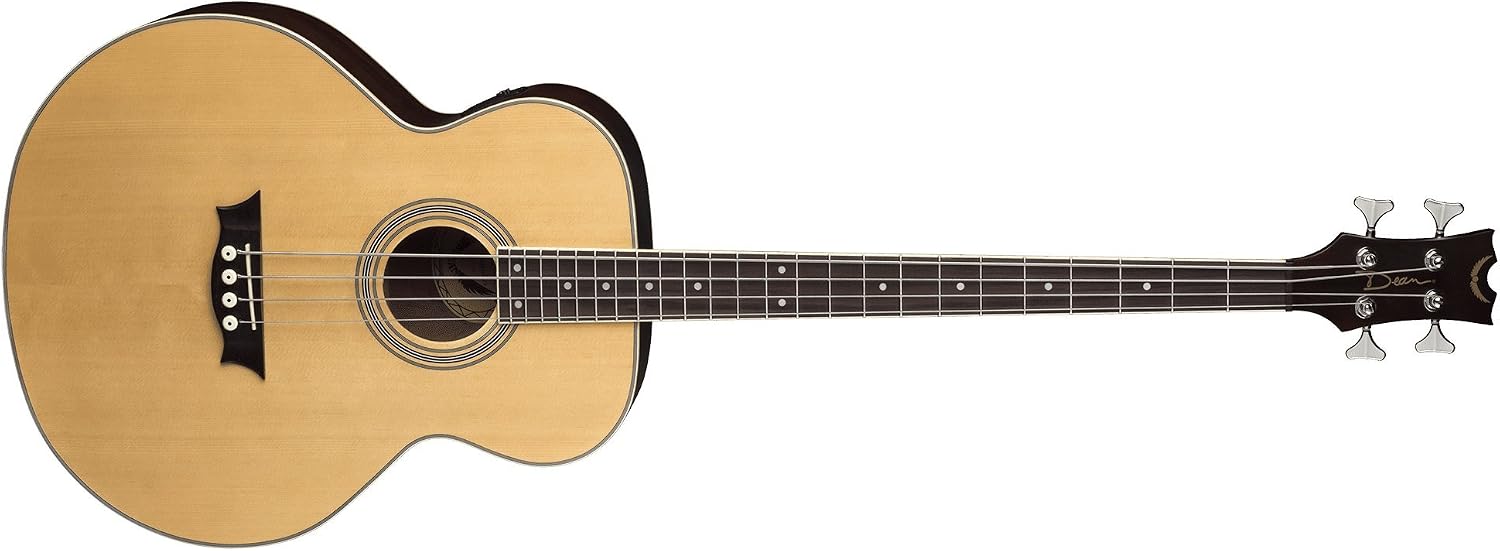
The EAB takes the traditional full-bodied route, with a spruce top, mahogany back and sides, and a non-cutaway outline. Its 34-inch scale will feel more familiar to players coming from a standard long-scale electric bass. That makes it a different proposition from the compact PNB14E or the 32-inch Fenders.
The mahogany neck carries a rosewood fingerboard, with a matching rosewood bridge and die-cast tuners. A passive piezo system provides basic volume and tone adjustment for connection to suitable amplification. The simplicity is part of the appeal: there is less onboard control to learn than on a multi-band active preamp.
The larger body and longer reach will not suit every player, and the passive electronics offer less tone shaping at the instrument. It is worth considering for a straightforward acoustic-electric bass with familiar long-scale spacing. Comfortable action and a suitable amplified setup matter more than assuming that a basic instrument is automatically the best fit for every beginner.
Pros
- 34-inch scale with familiar long-scale spacing
- Spruce top with mahogany back and sides
- Simple passive piezo controls
Cons
- Large non-cutaway body needs a comfortable seated fit
- Basic volume and tone controls provide limited onboard shaping
Ibanez AEB10E Acoustic-Electric Bass Guitar

The AEB10E adds useful connection flexibility to a traditional cutaway acoustic-bass design. The spruce top and dark violin sunburst finish give it a more decorative appearance, while the 32-inch scale keeps the playing reach shorter than a standard 34-inch bass. The cutaway makes higher positions more accessible.
A Fishman pickup works with an Ibanez preamp and onboard tuner. The combination of quarter-inch and balanced XLR outputs is particularly useful when moving between a bass amp and a suitable mixer or recording setup. That connection choice is a practical reason to consider it alongside the simpler AEB5E.
Its advantage is the amplified setup rather than a promise of more unplugged volume than every competitor. A hollow body can still respond to loud stage sound, so placement and gain need attention. The AEB10E suits a player who wants an acoustic-style instrument with flexible outputs, while a simpler bass may be enough for occasional home amplification.
Pros
- 32-inch scale with a cutaway body
- Fishman pickup with onboard EQ and tuner
- Balanced XLR and quarter-inch outputs
Cons
- Amplified stage use still needs feedback management
- Extra connection features may be unnecessary for simple home use
Fender CB-100CE Acoustic-Electric Bass

The CB-100CE pairs a dreadnought cutaway body with a Jazz Bass-profile neck. Its laminated spruce top and laminated mahogany back and sides give it a different construction from the solid-top CB-60SCE. The satin appearance, binding and black pickguard keep the design traditional.
Scalloped X-bracing supports the top, while a compensated saddle sits in the rosewood bridge. The Fishman Isys III pickup and preamp add an onboard tuner and tone controls for amplified playing. A dual-action truss rod provides neck-relief adjustment as part of a normal setup.
The appeal is the combination of an established bass-neck profile and an acoustic body with practical electronics. The dreadnought shape needs enough room when seated, and laminated construction should not be confused with an all-solid instrument. It is a useful model to compare when body feel and the neck profile matter more than choosing the smallest acoustic bass.
Pros
- Dreadnought cutaway with a Jazz Bass-profile neck
- Fishman Isys III electronics and onboard tuner
- Compensated saddle and dual-action truss rod
Cons
- Large body can feel bulky for some players
- Laminated top differs from the solid-top CB-60SCE
Fender CB-60SCE 0961715021

This CB-60SCE carries the 0961715021 part number. It belongs to the same concert-bass family as the overall pick, with a solid spruce top, mahogany back and sides, and a cutaway. It is worth recognizing that shared design before treating the two versions as completely different instruments.
The 32-inch scale and slim-taper neck keep the reach manageable without moving to the very short scale of the PNB14E. Rolled fingerboard edges and Fishman Classic Design electronics reinforce the same practical brief: an acoustic-style bass that can move from personal practice to an amplified setup.
The useful comparison is its condition, setup and complete cost against the other CB-60SCE version. A different part number does not by itself establish a better sound or a larger body. This remains an option for a player who likes the concert-sized Fender format, with the same need to judge unplugged projection and manage amplified feedback.
Pros
- Solid spruce top and concert cutaway format
- 32-inch scale with a slim-taper neck
- Fishman Classic Design electronics
Cons
- Closely related to the other CB-60SCE in this comparison
- Hollow-body projection and feedback limits still apply
Ibanez AEB5EBK Acoustic-Electric Bass Guitar

The black AEB5E offers the cutaway AEB body and 32-inch scale in a simpler electronic package than the AEB10E. A spruce top, contrasting binding and dot-marked fingerboard give it a straightforward acoustic-bass appearance. Its appeal is the combination of familiar proportions and uncomplicated amplified use.
The pickup is Ibanez’s own undersaddle design, feeding a two-band preamp with an onboard tuner. This is a different system from the Fishman-equipped AEB10E. The controls provide useful adjustment at the instrument without making the sound depend entirely on the amplifier’s EQ.
A quarter-inch connection covers ordinary bass-amp use; the AEB10E is the model to compare when a balanced XLR output is important. The AEB5E is a sensible option for home practice and small amplified arrangements, while its hollow body still calls for care at louder stage levels. Choose it for the simple cutaway format rather than expecting the electronics of the more elaborate model.
Pros
- 32-inch scale with a cutaway body
- Ibanez undersaddle pickup and two-band preamp
- Onboard tuner and a traditional black finish
Cons
- Less connection flexibility than the AEB10E
- Not a substitute for an amplified bass in a loud acoustic ensemble
How to Select the Best Acoustic-Electric Bass
An acoustic-electric bass combines a hollow body with a pickup system. Standard four-string bass tuning is E-A-D-G, an octave below the lowest four strings of a guitar. The instrument can be played without an amp, but its low notes usually need amplification to hold their place in a busy ensemble.
Acoustic and Amplified Playing
For quiet practice, hearing the instrument directly can be convenient. In a band, the pickup provides a more practical route to an audible bass line. A bigger body can change the acoustic response, but size alone does not guarantee enough projection alongside drums or several guitars.
A hollow acoustic body also behaves differently on a loud stage. Monitor placement, gain and EQ affect feedback. A suitable amp or direct connection is useful, but the pickup cannot remove the body’s acoustic response to surrounding sound.
Buyer’s Guide: Scale and Setup
Compare scale length as well as overall size. The PNB14E has a much shorter scale than the 32-inch Ibanez and Fender models here, while the Dean EAB uses a 34-inch scale. That changes fret spacing and the strings required; choose strings designed for the actual instrument.
Comfortable action matters. Notes should be fretted without excessive effort, with a setup that suits the player’s touch. Neck relief, nut slots and saddle height work together, so an uncomfortable example should be assessed on its own rather than treated as proof that every instrument of that model plays badly.
Comfort and Sound
Hold the bass seated and standing if possible. A deep body can move the fretting arm farther forward, even when the scale is short. Check the reach to the first frets, the position of the picking hand and whether the body rests comfortably.
Listen to notes across the neck at a consistent playing strength. Unplugged balance and amplified balance can differ. A pickup system and useful EQ can help shape the sound, but they do not guarantee perfect intonation or identical tone at every position.
Body Design and Construction
Parlor, concert and dreadnought-style bodies offer different proportions. A cutaway improves access to higher frets, while a non-cutaway body keeps a more traditional outline. These are practical choices rather than a simple ranking from small to large.
A solid top is different from an all-solid body. Layered back and sides or a laminated top are separate construction choices; wood names alone do not establish build quality. Look for secure joints, tidy fretwork and smoothly operating tuners alongside the specification.
Electronics and Connections
Basic passive controls keep the instrument simple, while an active preamp can provide more onboard EQ and a tuner. Battery-powered systems need a working battery even when the pickup itself is passive. Read the controls for the actual model rather than assuming every acoustic-electric bass uses the same system.
A quarter-inch output is useful for a bass amp or a suitable input. A balanced XLR output adds another connection option, as on the AEB10E, but should not be assumed on the AEB5E. For recording, match the output to an appropriate interface or direct-input setup.
The Best Acoustic-Electric Bass: Final Thoughts
The Fender CB-60SCE remains the overall recommendation for its solid spruce top, concert cutaway body, 32-inch scale and practical electronics. Its 0961715021 version shares the same general design, so compare the actual instrument and setup rather than counting the two as unrelated alternatives.
The PNB14E stands apart for its compact parlor format, the Dean EAB for long-scale spacing and simple passive controls, and the AEB10E for its output flexibility. The CB-100CE and AEB5E offer other familiar cutaway layouts. Choose the body and reach that suit the player, then compare the current price and amplified sound of that configuration. For a broader starting comparison, see the guide to beginner bass guitars.