Looking for the best trombone mouthpiece for jazz? Start with the instrument and the sound required: a small-shank lead-tenor mouthpiece, a deeper tenor design and a large-shank bass mouthpiece serve different jobs. Cup diameter, depth and rim shape all matter, but the shank must fit the trombone first.

These six choices cover several jazz roles rather than one universal setup. The Bach 3505G is the overall pick for players who prefer a roomy small-shank mouthpiece and a fuller sound. The Denis Wick 12CS favors lead work, while Yamaha’s Douglas Yeo model is specifically for bass trombone.
The 6 Best Trombone Mouthpieces for Jazz
Bach 3505G (Editor’s Choice)
The Bach 3505G brings a deep 5G cup to a small-shank mouthpiece. Its 25.50mm cup diameter and medium-wide, semi-flat rim make it a roomy choice compared with the smaller, shallower options below. For a player who wants a broad, rounded tenor sound rather than the brightest possible lead edge, that combination is its main attraction.
Bach pairs this cup with its larger G-style throat and 429 backbore. The result is a substantial playing format: it makes sense for someone already comfortable with a fairly generous mouthpiece and able to support it with a steady air stream. It can also preserve a familiar 5G-style rim feel when moving to an instrument that takes a small shank.
It remains the overall choice here for that useful combination of depth, diameter and small-shank fit. The trade-off is that it is not the most compact high-register specialist in the group. A player seeking quick, bright lead response may prefer the Wick 12CS or a shallower Bach, and the 3505G should not be mistaken for a large-shank 341-series model.
Pros
- Deep 5G cup with a roomy 25.50mm diameter.
- Medium-wide, semi-flat rim.
- 5G-style design in a small-shank format.
Cons
- Larger playing format may demand more air and adjustment.
- Small shank does not fit a large-shank receiver directly.
Yamaha YAC YEO-REP (Best for Bass Trombone)

The Yamaha Douglas Yeo Replica is the bass-trombone choice in this group. Its 28.72mm inner rim diameter and 8.00mm throat are substantially larger than the small-shank tenor designs. The semi-deep cup is built around a broad, substantial sound, making this a different musical tool from a compact lead-tenor mouthpiece.
The semi-flat, semi-thin rim and semi-wide backbore are part of that open bass-trombone format. For a jazz bass part that needs a centered low register and enough breadth to underpin a section, it is a compelling starting point. Its appeal is the specific Yeo design rather than a claim that one famous player’s setup will suit every embouchure.
The size is also the limitation. It requires a suitable bass-trombone receiver and a player comfortable supplying air to a large mouthpiece. It is not a substitute for a small-shank tenor model simply because both instruments are trombones. Players moving from a smaller mouthpiece should judge response, articulation and upper-register comfort alongside the attraction of a bigger sound.
Pros
- Purpose-built bass-trombone format.
- 28.72mm inner diameter and 8.00mm throat.
- Semi-flat rim with a semi-deep cup.
Cons
- Large dimensions require substantial air support.
- Not a small-shank tenor mouthpiece.
Denis Wick DW5880-12CS (Best for Lead Trombone)
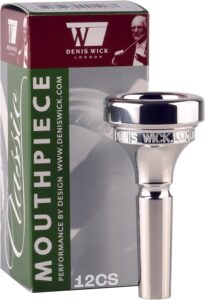
The Denis Wick 12CS is the most explicitly lead-oriented choice here. Its Classic design uses a 24.7mm cup diameter, a 6.5mm rim width and a 6.1mm throat, with a V-type backbore. That is a more compact playing format than the deep Bach 5G and the much larger Yamaha bass model.
The wide rim is a distinctive part of the feel. Wick describes the 12CS as suited to lead players, pairing rim support with a clear, resonant upper register. For a jazz section part that needs definition and a clean edge, it offers a coherent alternative to simply choosing the largest cup available.
The DW5880 version is silver-plated and uses the small-shank fitting. It does not include interchangeable small and large shanks. The main trade-off is personal rim preference: a broad rim can feel supportive to one player and less flexible to another. Judge articulation and lip movement as well as how easy the mouthpiece makes the upper part feel.
Pros
- Manufacturer positions the 12CS for lead playing.
- Wide rim and compact 24.7mm cup diameter.
- Small-shank silver-plated Classic design.
Cons
- Wide rim will not suit every player’s preferred feel.
- Not a large-shank fitting.
Bach 3413G

The Bach 3413G is the large-shank, deep-cup option for a player who wants more room than a 5G. Its 26.26mm cup diameter and medium-wide, rounded rim form a substantial mouthpiece. Bach combines that rim size with a deep bass-style cup, a .276-inch throat and the 429 backbore.
That design makes sense for a darker, weightier sound and lower-register work on an appropriate instrument. It is worth considering when a player wants to retain a reasonably defined rim feel while moving toward a more generous cup. It is a different proposition from a small, shallow lead mouthpiece, not simply a larger model number to buy for better performance.
The compromise is the amount of mouthpiece to manage. It may feel less immediate in the upper register to someone accustomed to a smaller cup, and it needs the correct large-shank receiver. Choose it because its size and response suit the musical role, rather than assuming that every tenor or bass trombone uses the same fitting.
Pros
- Deep cup with a substantial 26.26mm diameter.
- Medium-wide, rounded rim.
- Large-shank design for an appropriate receiver.
Cons
- Generous cup can require adjustment from smaller setups.
- Not a small-shank lead-tenor replacement.
Bach 35015EW
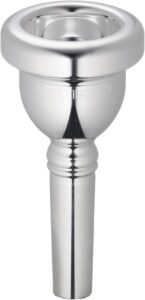
The Bach 35015EW is the specialist here for a bright, high-register approach. Its very shallow cup has an approximate 24.30mm diameter, paired with an extra-wide, well-rounded cushion rim. That combination is much more specific than an all-purpose beginner mouthpiece.
The shallow cup and supportive rim are intended for sustained upper-register work. A player looking for a brilliant lead sound may find that format appealing, particularly if a broad cushion rim already feels comfortable. The rim is a major part of the design, so its feel deserves as much attention as the shallow cup.
The compromise is versatility. A very shallow cup may not provide the breadth or lower-register feel wanted for every jazz setting, and a wide rim can change lip flexibility. It does not raise the instrument’s pitch by itself or replace the technique needed for high notes. It is best treated as a purpose-driven small-shank option rather than a universal upgrade.
Pros
- Very shallow cup for a bright upper-register approach.
- Extra-wide, rounded cushion rim.
- Compact 24.30mm cup diameter and small shank.
Cons
- Specialist cup may feel restrictive for broader low-register work.
- Wide rim changes the feel compared with narrower designs.
Bach 3507C

The Bach 3507C offers a useful middle ground between the deep 5G and the very shallow 15EW. It has a 24.75mm cup diameter, a medium-shallow cup and a medium-wide rim with a relatively gentle edge. It is a small-shank mouthpiece with a more compact diameter than the 5G.
The medium-shallow cup is the attraction for a player seeking a clear, lively sound without choosing the most extreme shallow design in the group. For jazz tenor playing, it is a sensible model to compare when the 5G feels larger than necessary but the 15EW seems too specialized.
It still needs to match the player and the instrument. A medium-shallow cup will not feel like a deep symphonic design, and the 7C cannot make high notes effortless or correct intonation on its own. Its strength is a conventional combination of rim, diameter and cup depth that offers a more balanced alternative to either extreme.
Pros
- 24.75mm diameter with a medium-shallow cup.
- Medium-wide rim with a comparatively gentle edge.
- Conventional small-shank alternative to deeper or very shallow cups.
Cons
- Not the same breadth of cup as the deep 5G.
- Small shank requires the appropriate receiver.
How to Choose a Trombone Mouthpiece?
Start with the receiver. Small- and large-shank mouthpieces are different fittings, not grades of quality. A mouthpiece can have a familiar cup size while using a different shank, so read the complete model designation before comparing the playing characteristics.
Then consider the musical role. A lead-tenor part, a warm small-group tenor sound and a big-band bass part do not necessarily call for the same cup. Jazz is not a rule that every player needs a large, shallow mouthpiece. The Yamaha Yeo and Bach 15EW illustrate how different suitable roles can be.
Cup diameter affects the room available to the lips, while depth, throat and backbore contribute to the response and feel of the complete design. A deeper or larger mouthpiece is not automatically better, and a shallower cup does not change the instrument’s tuning or supply high notes without technique.
Rim shape is equally personal. A wider cushion can feel supportive, but some players prefer the freedom of a different profile. Compare comfortable articulation, flexibility, tone and endurance across the registers actually used in the music. Keep the instrument and routine consistent so the comparison is useful.
Manufacturer size systems are not interchangeable across brands. Use their dimension charts as a starting point, then judge the complete design rather than treating one number as a guarantee. Silver plating is a common finish here; it is not proof that a mouthpiece will produce a particular sound for every player.
So, the Best Jazz Mouthpiece for Trombone Is…
The Bach 3505G remains the overall pick for a player who wants a roomy, deep small-shank mouthpiece and a fuller tenor sound. The Denis Wick 12CS is the lead-focused option, and Yamaha’s Yeo Replica belongs with bass trombone. Bach’s 3413G, 35015EW and 3507C cover different large-shank, high-register and medium-shallow preferences.
Choose the fitting first and the playing role second. The best result is a mouthpiece that supports the sound and response required without forcing the player to fight its size or shape.