Are you looking for the best Plexi pedals? These four options bring British-style crunch and overdrive to a pedalboard, with different approaches to gain, EQ and boost functions.

A good match should work with your guitar and amplifier, whether you want one classic-rock sound or more control for different songs. Here is what each pedal does well and where its limits matter.
Best Plexi Pedals – Comparison Table
| Image | Model | Price |
|---|---|---|
| Wampler Plexi-Drive Deluxe (Editor's Choice) | Check Price |
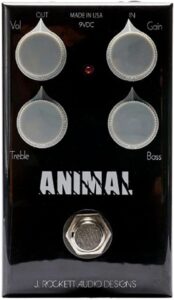 | J. Rockett Animal Tour Series | Check Price |
 | Catalinbread Dirty Little Secret | Check Price |
 | Carl Martin PlexiTone-S | Check Price |
Wampler Plexi-Drive Deluxe (Editor’s Choice)
The Plexi-Drive Deluxe is the most versatile starting point here for players who want to shape the pedal around different guitars and amplifiers. Its active three-band EQ gives more direct control over bass, mids and treble than a single tone knob.
The separate, mid-focused pre-gain boost is particularly useful for leads. It pushes the drive circuit harder rather than acting as a completely transparent volume lift after the distortion. Bass and bright switches provide additional ways to adapt the voice to a lean-sounding rig or a darker guitar.
That combination keeps it as the overall pick. It covers a broad range of British-style crunch without requiring another boost pedal, although the larger enclosure and extra controls make it less streamlined than the Carl Martin. Set the gain structure first, then use the EQ to fit the band mix rather than boosting every frequency.
Features
- Active bass, middle and treble controls.
- Separately switched pre-gain boost, plus bass and bright switches.
Pros
- Flexible EQ makes it easier to adapt to different rigs.
- Built-in boost adds another useful gain texture.
Cons
- Larger and more involved than a compact three-knob pedal.
- Pre-gain boost adds saturation rather than a pure post-drive volume lift.
J. Rockett Animal Tour Series
The Animal Tour Series focuses on the bark and response of an overdriven British amp rather than offering a large set of voicing switches. Separate bass and treble controls let you trim the bottom end and brightness without committing both adjustments to one tone knob.
Its gain and volume controls work together: lower gain can leave more room for the guitar’s dynamics, while a stronger output setting can push the amplifier harder. That makes it a useful option for players who use the guitar’s volume control to move between cleaner rhythm sounds and more driven passages.
This Tour Series version has four knobs and no Snarl switch; that switch belongs to the earlier Animal design. Its straightforward layout is an advantage for quick adjustment, but it lacks the Wampler’s separate boost and the Catalinbread’s internal mode selection. Choose it for the core voice and response rather than a long list of extra functions.
Features
- Volume, gain, bass and treble controls.
- Top-mounted connections and true-bypass switching.
Pros
- Separate low- and high-frequency adjustment in a compact layout.
- A focused option for guitar-volume-controlled dynamics.
Cons
- No separately switched boost.
- No Snarl switch or selectable Super Lead/Super Bass modes.
Catalinbread Dirty Little Secret
The Dirty Little Secret works well as the foundation of a British-voiced pedalboard. Its Super Lead and Super Bass modes offer two related responses, with bass, middle and treble controls plus preamp and master knobs to shape the gain structure.
The attraction is how it can become the base sound that other pedals feed. A boost or fuzz placed before it changes what reaches its drive circuit, while the three-band EQ helps keep the result from becoming too thick or sharp.
The practical limitation is access: the mode switch is inside the enclosure, so it is a setup choice rather than a footswitchable change during a song. The two modes also do not represent different amplifier wattages. They alter the pedal’s voicing and response; your amplifier and cabinet still determine the final sound and volume.
Features
- Super Lead/Super Bass modes selected by an internal switch.
- Three-band EQ with preamp and master controls.
Pros
- Useful as a consistent core sound for a larger pedalboard.
- Two voicings offer more setup flexibility than one fixed response.
Cons
- Changing modes requires opening the enclosure.
- No separate footswitch for a lead boost.
Carl Martin PlexiTone-S
The single-channel PlexiTone-S is the direct, uncomplicated choice. Level, Drive and Tone controls keep the interface familiar, while the circuit draws on the high-gain side of the larger PlexiTone with a tighter low end and a smoother top.
That makes it appealing when the basic British-style drive sound is the priority and additional switches would be a distraction. The tone control trims high frequencies, giving a useful way to soften an overly sharp guitar or amplifier combination.
Its simplicity is also the compromise. You cannot adjust bass and mids independently, and there is no separate boost to switch in for a solo. It is better suited to finding one dependable driven sound and using the guitar or another pedal for variation than to replacing several gain stages on a complex board.
Features
- Single-channel layout with Level, Drive and Tone.
- Compact format based on the larger PlexiTone’s high-gain voice.
Pros
- Quick to set up and easy to revisit on stage.
- Focused voicing avoids an unnecessarily complicated interface.
Cons
- No independent bass or midrange controls.
- No separate footswitchable boost.
How to Choose the Best Plexi Pedal for Your Guitar
A Plexi-style pedal aims to evoke the character of a cranked British amplifier. It does not turn every clean amp into an identical vintage Marshall, and it still needs an appropriate amplifier or modeling setup after it.
Choose the Gain Structure You Will Actually Use
For one dependable rhythm sound, a straightforward pedal can be easier to manage than several modes. If a set moves between crunchy rhythm and saturated leads, a separately switched boost may be more useful. Remember that a boost placed before distortion generally adds drive; a clean volume increase depends on the signal chain and available headroom.
Match the EQ to the Guitar and Amp
More bass can sound impressive alone and become muddy in a band. Start with a balanced setting, then adjust the lows for the cabinet and the highs for the guitar. A three-band EQ offers more control, while separate bass and treble knobs still provide useful flexibility without as many settings.
Check How You Change Sounds
A footswitchable function and an internal switch serve different purposes. The Dirty Little Secret’s internal modes are intended for setting the basic voice, while the Wampler’s boost can be engaged during a performance. Choose according to how often you need to change sounds.
Keep the Rest of the Rig in Mind
The amplifier’s own gain and EQ affect every pedal here. A clean amp provides a different platform from an already driven one. Test at realistic playing volume if possible, and use the correct power supply specified for the exact pedal.
For related sounds, see our guide to pickups for Hendrix-style tone and our discussion of overdrive pedals for solid-state amps. A bass preamp pedal is a different tool; choose a drive pedal for the instrument and signal chain you actually use.
The Wampler remains the overall recommendation for its EQ and separate boost. The Animal favors a focused, responsive four-knob approach, the Dirty Little Secret suits a foundation-drive role, and the PlexiTone-S keeps the controls especially simple. Compare those differences before deciding which extras matter on your board.