Looking for the best passive pickups for metal? These six options cover punchy bridge humbuckers, a complete six-string set and a dedicated seven-string bridge pickup. The right choice depends on the character you want from the guitar: a sharper attack, fuller mids or a heavier low end.

The EMG H4 remains the overall pick for its straightforward bridge-pickup role and strong, balanced metal voice. The other models offer distinct alternatives, from the Dimebucker’s cutting response to the fuller sound of the Super Distortion. Match string count, pickup dimensions and wiring to your guitar before choosing.
Top 6 Best Passive Pickups for Metal
EMG H4 (Editor’s Choice)
The H4 gives a metal guitar a strong bridge voice without a powered pickup circuit. EMG uses overwound coils and ceramic bar magnets, with shielding to help reduce interference. It is a useful starting point for a player who wants an assertive humbucker rather than a softer vintage-style response.
Its appeal is the balance between weight and definition. The bass is geared toward a firm response, while the mids and upper frequencies provide presence for riffs and harmonics. That combination makes sense for heavy rhythm playing without reducing the choice to output alone.
The H4 keeps the overall recommendation because it addresses the central job here so directly: a substantial, responsive passive bridge sound for hard rock and metal. It is not simply an active 81 with the battery removed; the electronics and response are different. Players seeking a gentler, lower-output character may prefer a less forceful design.
Pros
- Overwound coils and ceramic magnets for a strong bridge voice
- Shielded construction helps reduce interference
- Focused choice for heavy rhythm playing
Cons
- Single bridge pickup rather than a matched set
- Less suited to players seeking a mild vintage-style response
Seymour Duncan SH-13 Dimebucker

The Dimebucker takes a sharper route to a heavy guitar sound. Its ceramic magnet and dual stainless-steel rails produce a high-output bridge design with pronounced attack. The rails also give it a distinctive appearance alongside conventional screw-and-slug humbuckers.
A leaner midrange character and cutting top end make this an appealing option when a dark-sounding guitar needs more bite. Rhythm parts can retain that percussive edge, while leads have a more pointed voice than a warm, rounded humbucker. A bright guitar and aggressive amp setting may call for some restraint with treble.
Four-conductor cable supports additional wiring arrangements, including a coil split with suitable switching. Splitting changes both the sound and level; it does not preserve the full humbucker response. Wax potting is another useful detail for high-gain work, though it cannot make a complete guitar rig immune to feedback.
Pros
- Strong attack and cutting bridge character
- Dual stainless-steel rails
- Four-conductor wiring supports additional switching
Cons
- Pronounced top end may be too sharp in a bright setup
- Split-coil sound differs in level and body
DiMarzio DP100 Super Distortion

The Super Distortion is the fuller-bodied option here for players who want a muscular bridge sound. Its ceramic magnet and high-output winding give the amp a strong signal, with substantial bass and a pronounced midrange. This is a thick, classic heavy-rock voice rather than a scooped one.
That midrange weight is the main attraction for lead lines and dense rhythm parts. It can help a guitar sound substantial without relying entirely on extra amplifier gain. In an already bass-heavy rig, however, that generous low end may need balancing with pickup height and amp EQ.
Four-conductor wiring opens up split and parallel arrangements for a different response. The DP100 is primarily a bridge pickup, and DiMarzio specifically designs it around solid-body guitars. Choose it for its full, assertive character; players after a particularly lean low end or delicate vintage clean sound may want a different balance.
Pros
- Full bass and pronounced midrange
- High-output ceramic bridge design
- Four-conductor wiring for split or parallel options
Cons
- Can add too much weight to an already bass-heavy rig
- Not the natural choice for a restrained vintage clean voice
Seymour Duncan Invader 7-String Bridge

This Invader is the seven-string bridge version, with a passive-mount format. Its oversized pole pieces are more than a visual signature: they are part of a design built around overwound coils and three ceramic magnets. It is a deliberately bold approach to a heavy guitar sound.
The attraction is the substantial low end and strong output, particularly for a player who wants lower strings to sound large and forceful. That weight gives riffs a different emphasis from the Dimebucker’s sharper attack. It also makes bass control important when the guitar, tuning and amp already produce plenty of low-frequency energy.
Four-conductor wiring allows further switching choices, and the pickup is wax potted for high-gain use. This exact version belongs in a suitable seven-string guitar; the six- and eight-string Invaders are separate versions. It is an appealing specialist choice for a thick bridge sound, with less reason to choose it if a leaner response is the priority.
Pros
- Dedicated seven-string bridge version
- Overwound coils, three ceramic magnets and oversized poles
- Four-conductor wiring and wax potting
Cons
- Heavy low-end character needs balancing in some rigs
- This version is not for six- or eight-string guitars
Seymour Duncan Nazgûl & Sentient 6-String Set
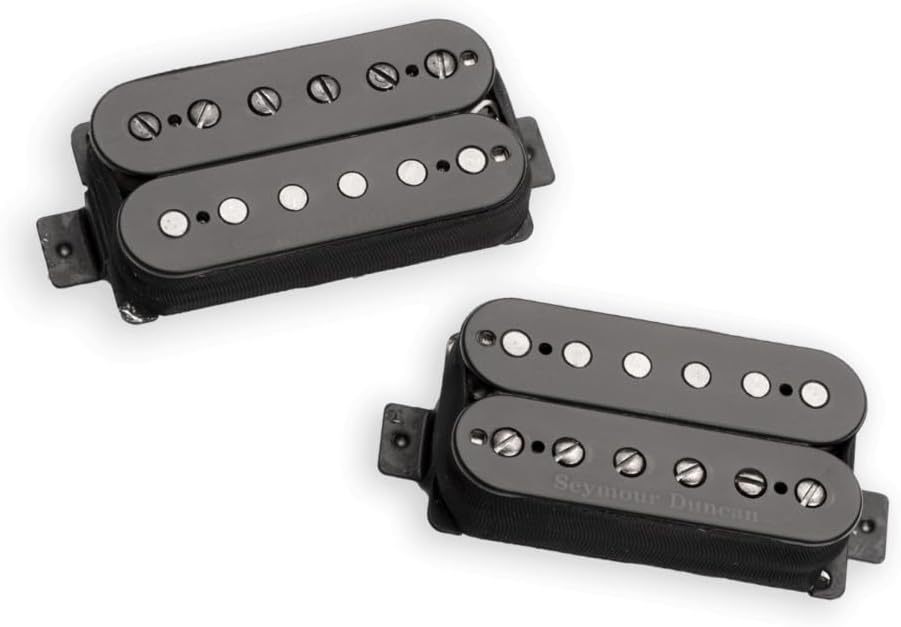
The Nazgûl and Sentient pair makes sense when both humbuckers need to work together. The bridge Nazgûl uses a ceramic magnet for an aggressive, focused voice; the neck Sentient uses Alnico 5 and a more moderate output. The result is two complementary roles rather than the same sound at both ends of the guitar.
The bridge is the attraction for tight, percussive riffs and lower tunings. Switching to the neck offers a smoother direction for leads and cleaner passages. That contrast is useful in a metal setup where rhythm precision matters, but every section of a song should not have the same attack.
Both pickups have four-conductor wiring, supporting additional switching with the appropriate controls, and are wax potted. This is the conventional six-string set, not the separate seven-string or Rails version. It is a strong option for a complete passive upgrade, although buying two pickups is unnecessary when only the bridge needs changing. The Nazgûl’s aggressive character also favors heavier playing over a restrained vintage bridge voice.
Pros
- Complementary ceramic bridge and Alnico 5 neck pickups
- Focused bridge response with a smoother neck alternative
- Four-conductor wiring on both pickups
Cons
- A full set is unnecessary for a bridge-only change
- Aggressive bridge voicing is less suited to vintage restraint
DiMarzio DP222 D Activator-X Bridge

The D Activator-X Bridge combines the bar-pole appearance of the X2N with its own tuning and slightly lower output. It remains a powerful passive bridge humbucker, using a ceramic magnet and a strong low-and-midrange foundation. The point is not simply to make the loudest possible pickup.
DiMarzio tunes the two coils to let the upper frequencies remain more open alongside that weight. That makes the DP222 an interesting choice for heavy rhythm playing when a powerful sound still needs definition. Rolling back the guitar volume offers another way to approach cleaner passages, although the amp’s gain setting still matters.
Its four-conductor cable supports split and parallel wiring, giving access to brighter alternatives with suitable switching. The bar design uses universal spacing for standard and F-spaced applications, though physical mounting dimensions still matter. This is the bridge model; it should not be chosen for the neck position. Its forceful response is the appeal for metal, rather than a soft vintage-style voice.
Pros
- Powerful ceramic bridge design with bar pole pieces
- Four-conductor wiring for additional switching
- Universal string spacing for standard and F-spaced applications
Cons
- Bridge-only model
- High-output character may be more forceful than some players need
What Is the Difference Between Passive and Active Pickups?
The central difference between active and passive guitar pickups is the powered electronics. A passive pickup sends its signal through the guitar’s passive controls without requiring a battery for the pickup itself. An active system uses a powered preamp, often with a battery inside the guitar.
A powered circuit can shape and buffer the signal, but active pickups do not automatically include a three-band equalizer. Nor are output, noise or dynamics determined by the active/passive label alone. The particular pickup, wiring, guitar controls and amplifier all contribute. Active pickups for metal offer another approach rather than a universally better or worse one.
What Makes Passive Pickups Good to Use for Metal?
A convincing metal sound needs more than a large output number. Listen for the balance between low-end weight, note separation and the attack of a picked riff. The Super Distortion emphasizes a full midrange, the Dimebucker takes a sharper direction, and the Invader puts more weight behind its low end. Those differences matter as much as how hard a pickup drives the amp.
Lower tunings also make the guitar’s setup, string choice and amplifier EQ important. A powerful pickup cannot compensate for loose-feeling strings or an indistinct amp setting. With a high-gain amp, reducing bass or gain can sometimes preserve the definition that more distortion obscures.
Before fitting a replacement, match string count, pickup dimensions, mounting and wiring to the guitar. Four-conductor designs can support useful switching options, but the guitar needs the appropriate controls and connections. Coil splitting changes the sound and generally reduces output; it is an alternative voice rather than the same humbucker tone at a lower noise level.
Which Passive Pickup Should You Choose?
The EMG H4 remains the overall choice for a direct, balanced bridge upgrade aimed at heavy music. For a complete six-string pair, the Nazgûl and Sentient offer a useful contrast between focused rhythm attack and a smoother neck response. The other models earn their place through a distinct character, so choosing the one that complements the guitar is more useful than chasing output alone.