Looking for the best MIDI keyboard for GarageBand? Start with the parts you will actually play: keys for melodies and chords, pads for drums, and performance controls for adding expression. A compact keyboard can make recording ideas easier without taking over the desk.

These four controllers range from a portable 25-key model to larger 49-key instruments with pads and faders. For GarageBand, separate ordinary MIDI note input from deeper mixer and transport integration. The latter depends on the controller, software and operating system, so a large control panel does not automatically mean every function will work without setup.
Top 4 Best MIDI Keyboards for GarageBand
| Image | Model | Price |
|---|---|---|
| Korg microKEY-25 (Editor's Choice) | Check Price |
 | M-Audio Oxygen 49 IV | Check Price |
 | Akai Professional MPK49 | Check Price |
 | Novation Impulse 49 | Check Price |
Korg microKEY-25 (Editor’s Choice)
The microKEY-25 is the overall choice for a compact GarageBand setup focused on recording notes rather than managing a large control surface. Its 25 velocity-sensitive Natural Touch mini keys leave room on the desk for a laptop or another instrument. Octave buttons extend the available note range without making the keyboard physically larger.
The joystick combines pitch bend with modulation-style control in one place. With the arpeggiator active, it instead changes the arpeggio type and gate time, making it a useful performance tool for repeating patterns. The Sustain/Tap button also changes role, providing sustain for normal playing or tap tempo for the arpeggiator.
USB carries MIDI and powers the controller, keeping the basic setup simple. The limitations follow directly from the size: mini keys and a two-octave playing span are less suitable for broad two-handed piano parts. There are no drum pads or mixer faders. For melodies, bass lines and portable sketching, that focused design is exactly the attraction.
Pros
- Compact velocity-sensitive mini keyboard
- Joystick and onboard arpeggiator
- USB power with octave-shift controls
Cons
- Limited room for two-handed playing
- No drum pads or mixer faders
M-Audio Oxygen 49 IV
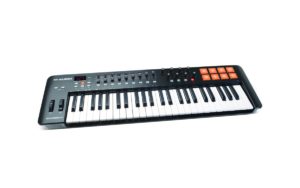
The Oxygen 49 IV gives the player more keyboard range and a useful set of pads in one unit. Its 49 velocity-sensitive keys provide more room for chord voicings and bass-and-melody parts than the Korg. Eight velocity-sensitive pads offer a separate surface for entering percussion without using the piano keys.
Eight assignable knobs and nine faders make it appealing for a broader production setup. Pitch and modulation wheels follow a conventional layout, while dedicated transport and track buttons provide additional control options in supported software. Those facilities are most valuable when the chosen DAW can make proper use of them.
The keyboard is USB-powered and class-compliant for USB MIDI. DirectLink is a separate integration feature, so ordinary note input should not be confused with installing a full control-surface package. For GarageBand, choose it primarily for the keys and pads unless the required control mappings are confirmed for the exact software setup. Its larger footprint is the other trade-off beside the microKEY.
Pros
- 49 velocity-sensitive keys and eight drum pads
- Eight knobs and nine faders
- USB-powered, class-compliant MIDI connection
Cons
- Deeper control integration depends on software support
- Takes more desk space than the Korg
Akai Professional MPK49
The MPK49 is the performance-oriented choice for players who want substantial keys and a larger pad section. Its 49 semi-weighted keys send velocity and channel aftertouch, offering an extra layer of expression with instruments that respond to it. This is a controller action rather than a hammer-action piano keyboard.
Twelve velocity- and pressure-sensitive MPC-style pads are arranged in four banks, giving access to 48 pad assignments. Note Repeat and the arpeggiator add rhythmic performance options, while eight knobs, eight faders and eight buttons operate across three control banks. USB and five-pin MIDI connections also give it a role in a setup with external instruments.
The benefit is a wide range of playable controls; the cost is space and a more involved configuration. GarageBand can be the starting point for recording performances, but the presence of transport controls and banks does not establish automatic support for every function. Choose it when the keys, pads and wider MIDI possibilities justify that extra complexity.
Pros
- Semi-weighted keys with channel aftertouch
- Twelve pads, four pad banks and Note Repeat
- USB plus five-pin MIDI connections
Cons
- Larger, more involved controller than a simple note-entry keyboard
- Advanced control functions need compatible software and setup
Novation Impulse 49
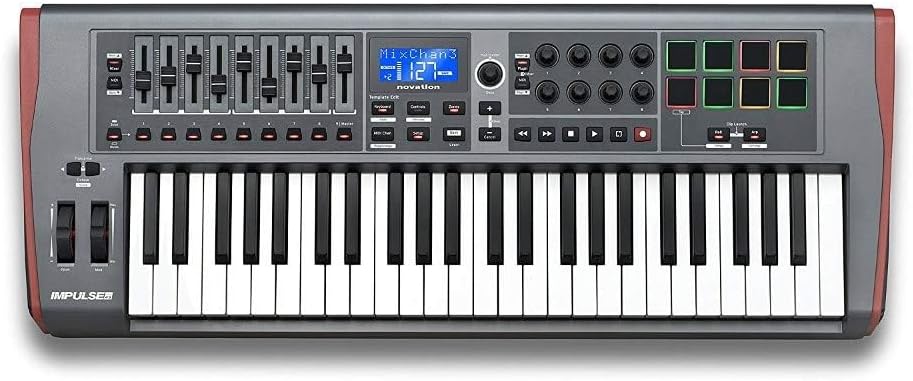
The Impulse 49 balances a playable keyboard with a broad set of performance controls. Its semi-weighted keys send channel aftertouch, and eight pressure-sensitive pads provide another way to play software instruments. An onboard arpeggiator with pad-based rhythm editing adds a useful creative feature beyond simple note entry.
The panel has eight rotary encoders, nine faders and nine assignable buttons, along with pitch and modulation wheels. The LCD helps show settings, while sustain, expression and five-pin MIDI connections make it adaptable to a larger keyboard setup. It is especially appealing to players who expect to use more than one music application.
The software distinction matters: Automap is no longer supported for newer operating systems, and the later HUI firmware is intended for DAWs that support HUI. Neither should be treated as a promise of full GarageBand mixer control. For GarageBand alone, assess it mainly as a keyboard and pad controller; its fuller control surface is a stronger benefit when the other software in the setup supports it.
Pros
- Semi-weighted keys with aftertouch
- Pads, arpeggiator and a substantial control panel
- Sustain, expression and five-pin MIDI connections
Cons
- Automap is no longer a current integration solution
- Full control-surface operation depends on the DAW
Buyer’s Guide: How to Select the Best MIDI Keyboards for GarageBand
These MIDI controllers send performance information to software; they do not contain the piano, synth or drum sounds being heard. In GarageBand, select a software-instrument track and an appropriate patch. Recording MIDI captures the notes and performance data rather than an audio recording from the keyboard.
Choose the playing layout first. Twenty-five mini keys are convenient for portable melodies and bass lines, while 49 full-size keys offer more space for chords and two-handed parts. Semi-weighted action is different from piano-style hammer action, and aftertouch only produces a useful change when the instrument and software respond to that message.
Rotary Controls and Knobs
Knobs can transmit control messages for parameters such as modulation or tone. Whether a particular knob operates a particular GarageBand control depends on the available mapping or integration. Do not assume that a general MIDI Learn feature or a Logic Pro setup guide applies unchanged to GarageBand.
Pads
Pads provide another way to enter drum notes or trigger sounds in a compatible instrument. Velocity sensitivity lets the software respond to how firmly a pad is struck. Pad banks change the assigned notes; they do not add more physical pads. These MIDI pads also serve a different purpose from acoustic drum practice pads or a snare drum.
Wheels and Joysticks
Pitch bend changes the pitch of a responding instrument, while modulation can control a feature such as vibrato or filter movement. The result depends on the selected sound. A joystick combines movements in one control, while separate wheels give each function its own physical surface.
Faders
Faders are useful when supported software can assign them to levels or other parameters. A controller with many faders is not automatically a better GarageBand purchase if those mappings are not available. A more focused keyboard may be easier to use when the main task is playing and recording notes.
Before buying, check current support for the exact Mac, operating system and GarageBand version. Basic USB MIDI, optional editor software and deep DAW integration are separate requirements. Legacy DirectLink and Automap instructions should not be treated as current universal setup steps. Use a suitable data-capable cable or adapter for the Mac’s ports, and confirm the controller is detected before troubleshooting individual controls.
Conclusion: The Best MIDI Controller for GarageBand
The Korg microKEY-25 is the overall choice for compact note entry and portable sketching. Choose the Oxygen 49 IV when more keys and a separate pad section are the priority. The MPK49 favors a substantial key-and-pad performance setup, while the Impulse 49 adds another flexible keyboard action and control layout.
For GarageBand, spend on the surfaces you will actually play. Extra faders, banks and transport buttons are useful when the software supports them, rather than a reason to buy a larger controller by themselves.
For a genre-focused production comparison, see Keyboards for Hip Hop Production.