Looking for an acoustic guitar that is affordable and still sounds good? These four models are among the best cheap acoustic guitars to consider, with useful differences in body shape, construction and playing feel.

The Yamaha FG800 remains the overall choice for its solid spruce top and straightforward acoustic design. The Jasmine adds a cutaway, while the Epiphone and Fender offer their own take on a full-size dreadnought. Treat the under-$200 category as a budget target: current prices and the cost of a setup or accessories can change the total.
Top 4 Best Cheap Acoustic Guitars Under $200 — Comparison Table
| Image | Model | Price |
|---|---|---|
| Yamaha FG800 (Editor's Choice) | Check Price |
 | Jasmine S-34C | Check Price |
 | Epiphone Songmaker DR-100 | Check Price |
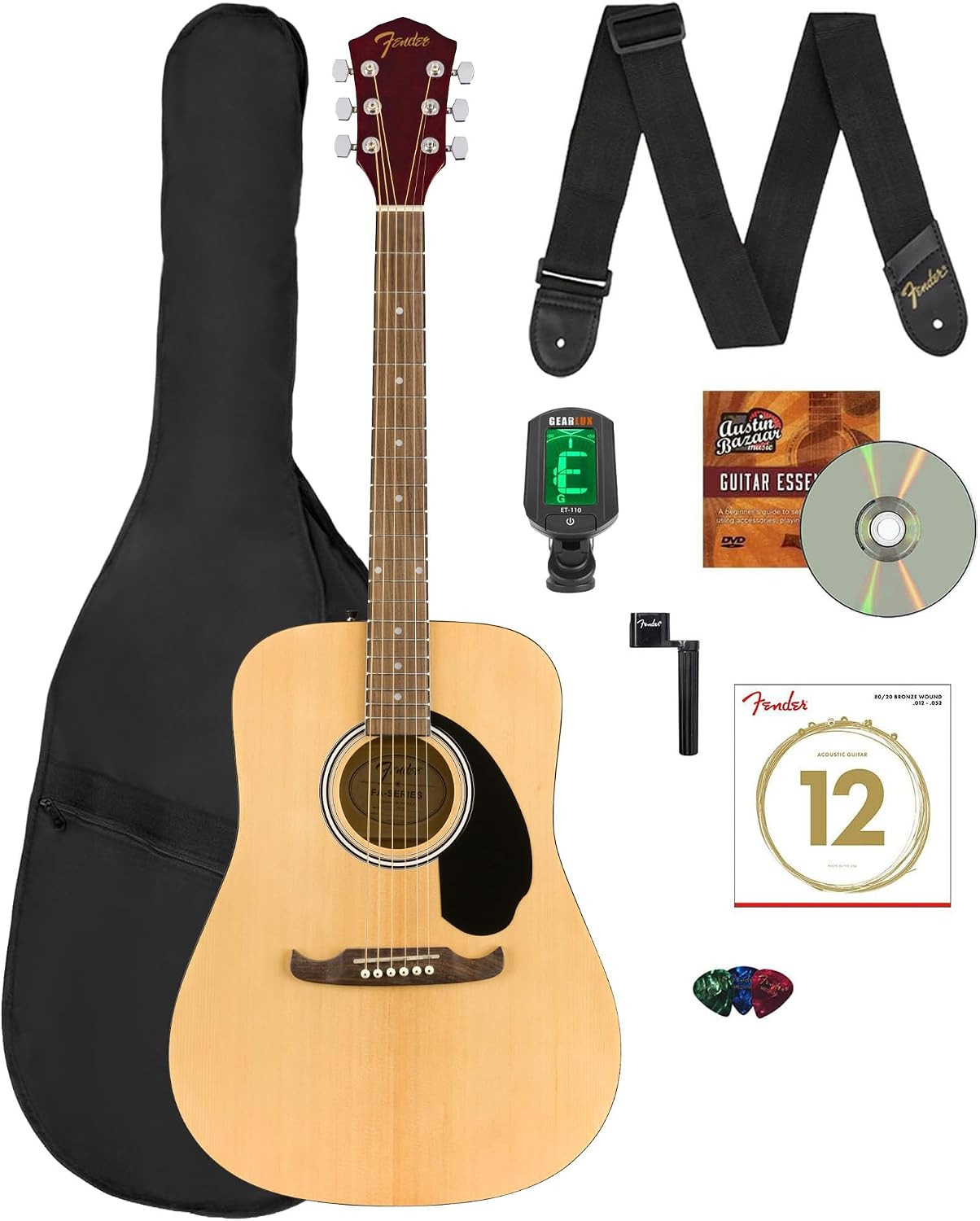 | Fender FA-125 | Check Price |
Yamaha FG800 (Editor’s Choice)
The FG800 puts the emphasis on the soundboard: a solid spruce top supported by scalloped bracing. Yamaha’s traditional Western body provides a familiar dreadnought-style outline, with a design that keeps the focus on acoustic playing.
The dreadnought-style shape gives strummed chords a substantial foundation, while the solid top is an appealing feature for a player who wants to explore changes in picking strength and articulation. The 650 mm scale and 43 mm nut make it a conventional full-size steel-string instrument, not a compact travel guitar.
Die-cast tuners and a restrained layout keep the focus on playing. This standard FG800 has no built-in pickup or preamp, so amplification calls for a microphone or a separate pickup system. It should not be confused with the cutaway acoustic-electric FGX models.
The Yamaha keeps the overall recommendation for its solid-top construction and versatile acoustic role. The main compromise is size: the broad body can be less comfortable than a smaller guitar, and there is no cutaway for easier access above the body joint.
Pros
- Solid spruce top with scalloped bracing
- Full-size body suits strummed accompaniment
- Straightforward acoustic design with die-cast tuners
Cons
- Large body may not suit every player
- No cutaway or built-in pickup
Jasmine S-34C
The S-34C stands out through its grand-orchestra shape and Venetian cutaway. That cutaway gives the fretting hand more room near the upper frets, making the Jasmine an interesting alternative when a plain dreadnought feels too limiting for melodic playing.
Jasmine combines a select spruce top, sapele back and sides, and its Advanced X bracing. A slim nato neck carries a 25.5-inch scale, with a rosewood fingerboard and bridge. The 43 mm nut and full scale keep it firmly in full-size steel-string territory despite the different body outline.
Choose the S-34C when its shape and neck profile suit the way you play. It offers more upper-fret access than the non-cutaway models here, but it remains a full-size instrument. A player who wants a compact body or factory-fitted electronics should look for a model designed around those requirements.
Pros
- Venetian cutaway improves upper-fret access
- Slim neck with a full 25.5-inch scale
- Advanced X bracing and rosewood fingerboard
Cons
- Full-size dimensions despite the alternative body shape
- Playing comfort still depends on the individual setup
Epiphone Songmaker DR-100
The Songmaker DR-100 keeps the traditional dreadnought approach. A select spruce top and mahogany body provide its basic construction, with a square-shouldered outline that feels familiar for chord accompaniment. The Vintage Sunburst version adds a distinctive look without changing the instrument’s essential role.
Its SlimTaper C neck, 25.5-inch scale and 43 mm nut offer a conventional full-size playing format. Premium die-cast tuners complete the hardware. This is an appealing combination for a player who wants an uncomplicated acoustic rather than onboard controls and a stage-oriented preamp.
The DR-100 suits someone who wants a familiar strumming guitar with a slim neck profile. Its non-cutaway body provides less upper-fret access than the Jasmine, and there is no built-in pickup or preamp for direct amplification. The linked Vintage Sunburst model is the right-handed version.
Pros
- Traditional square-shouldered dreadnought
- SlimTaper C neck and die-cast tuners
- Select spruce top and mahogany body
Cons
- Full-size body and no cutaway
- No built-in pickup or preamp
Fender FA-125
The FA-125 is a straightforward dreadnought with familiar Fender styling. Its all-laminate construction uses a spruce top with basswood back and sides, giving it a different starting point from the solid-top Yamaha. A natural finish keeps the appearance simple and traditional.
The nato set neck has a walnut fingerboard, while the Viking-style walnut bridge and modern 3+3 headstock give the instrument its visual identity. The 25.3-inch scale is slightly shorter than the scales of the Yamaha, Jasmine and Epiphone here. The 43 mm nut remains a conventional width for a steel-string acoustic.
The Fender suits chord practice and everyday accompaniment. Its laminate body still needs protection from excessive heat, moisture and dryness.
The linked natural FA-125 is available as an accessory bundle, though the guitar itself should be the deciding factor. Its non-cutaway body and lack of onboard electronics keep the design simple. Allow for a comfortable setup and suitable accessories instead of choosing only by the number of extras pictured.
Pros
- All-laminate dreadnought construction
- Walnut fingerboard and Viking-style bridge
- Slightly shorter 25.3-inch scale
Cons
- No cutaway or onboard electronics
- Full-size body may be less comfortable than a smaller guitar
How to Choose the Best Cheap Acoustic Guitar
What Are Acoustic Guitars?
A steel-string acoustic uses its top and hollow body to turn string vibration into an audible sound. It can be played without an amplifier. Built-in amplification requires a pickup system; a plain acoustic can instead be recorded or amplified with a microphone or a suitable added pickup.
Finding a Guitar That Fits Your Budget
Compare the complete cost, including a case or bag, tuner, spare strings and any setup work. A comfortable guitar that encourages practice is more useful than a large accessory bundle attached to an instrument that does not fit the player. Lower-priced acoustic guitars can be useful too, provided the construction and playing condition meet your needs.
Materials and Construction
Budget instruments use different combinations of solid and laminated wood. A solid spruce top is a useful feature, but the wood label alone does not determine tone. Body dimensions, bracing, construction, strings and setup also influence the result.
Look at the joints, bridge, fret ends and finish. Cosmetic simplicity is not necessarily poor workmanship, and an expensive-looking finish does not establish good playability. Check for structural problems rather than assuming every inexpensive instrument needs corrective work.
Sound Quality
Try the guitar with the kind of playing you expect to do: soft picking, firm strumming or both. Listen for balance between strings and whether the response suits your touch. A larger body may provide the character you want for accompaniment, while a smaller one can offer a more comfortable playing position.
Feel and Playability
Neck shape, nut width, body size and string height all affect comfort. Play several positions along the neck and listen for unwanted buzzing or notes that fail to ring clearly. A cutaway helps upper-fret access, but it does not change the width or profile of the neck. Choose the correct handed version too; a symmetrical-looking body does not make a right-handed guitar interchangeable with a left-handed one.
Neck relief is the slight forward curve of the neck; action is the string height above the frets. The truss rod addresses relief, while the nut and saddle also affect action. Have an experienced technician assess needed work rather than filing frets or making major adjustments on the assumption that a budget guitar must need them.
Appearance
Choose a look that makes you want to pick up the instrument, while keeping sound and comfort first. Natural and sunburst finishes can be equally practical choices; neither is evidence of better construction by itself.
Laminate or Solid Top?
Laminate construction combines layers of wood, while a solid top uses solid wood, commonly in joined pieces. A well-made laminate guitar can still be enjoyable to play. A solid top can offer an appealing response to picking dynamics, but it does not guarantee that every guitar will sound better than every laminate model.
Both types need sensible care. Avoid extreme temperatures and humidity, and use an appropriate case or bag. Do not assume a laminate guitar is weatherproof or that age alone will reliably improve its sound.
Final Thoughts: the Best Affordable Acoustic Guitar
The Yamaha FG800 remains the overall pick for its solid spruce top and straightforward acoustic design. The Jasmine is worth considering for its cutaway, the Epiphone for its traditional shape and SlimTaper neck, and the Fender for a simple all-laminate dreadnought. Choose the one that feels comfortable and fits the complete budget, rather than expecting one model to suit every player.