What’s the best budget loop pedal? The right choice depends on whether you want a simple backing loop, saved phrases for songwriting or rhythms to practice against. A looper records a phrase and repeats it, leaving your hands free to add another part.
These six pedals cover compact one-switch designs and more feature-rich options. If you are comparing loop pedals under $100, check current prices carefully: not every model here will fall within that budget. Focus on the controls, memory and connections you will actually use.
Best Cheap Loop Pedals: Comparison Table
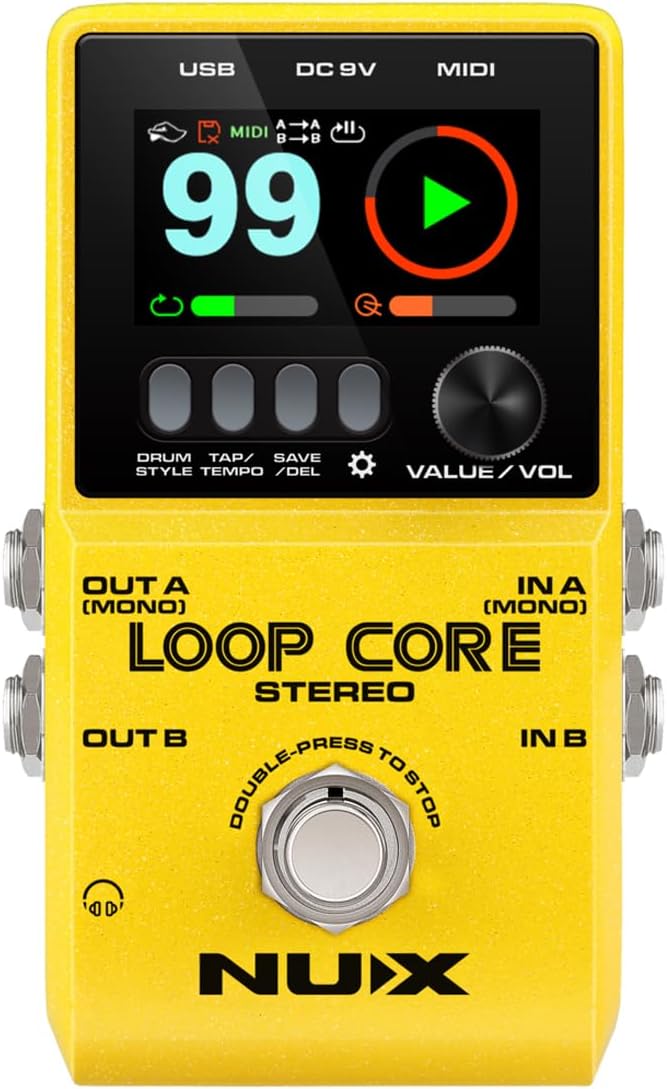
NUX Loop Core Stereo NCL-2 (Best for Practice)
The Loop Core Stereo is the most fully featured practice companion in this group. It combines up to six hours of recording with 99 memory slots, so it can hold more than the one backing phrase used in a single session. The color LCD makes the selected memory and looping status easier to follow than a few small indicator lights.
Stereo inputs and outputs, a headphone connection and external MIDI control give it room to work beyond a basic guitar-and-amp setup. Its rhythm section provides a useful framework for timing practice. NUX’s firmware V2.2.1 expands the drum library to 70 patterns and adds MIDI clock synchronization, making an update worthwhile for players who need those functions.
The extra capability also means more settings and a more involved interface than the Ditto. A single onboard footswitch still handles several operations, so an external MIDI controller may be useful for a more elaborate live routine. Choose the NUX for saved ideas, rhythms and flexible connections; choose a simpler pedal when immediate one-loop operation is the priority.
Pros
- 99 memory slots and up to six hours of recording
- Color display, stereo connections and headphone output
- Rhythms and external MIDI control
Cons
- More menus and setup than the one-knob alternatives
- Some expanded features require the appropriate firmware update
TC Electronic Ditto Looper (Editor’s Choice)

The original Ditto keeps the overall recommendation for players who want to make a backing loop and get on with playing. One level knob and one footswitch keep the layout focused. Its small housing is especially useful on a crowded pedalboard or in a simple practice setup.
Five minutes of recording time covers a substantial phrase, with repeated overdubbing for adding parts. Undo and redo let the player remove or restore the last layer, which is useful when trying a lead idea or changing an accompaniment. The dry guitar signal stays analog, while the recorded loop uses 24-bit uncompressed audio.
The main trade-off is scope. This is a mono looper without the NUX’s rhythm section or a bank of separately selectable phrases. Several commands share the footswitch, so stopping and undoing still take a little practice. Its focused layout suits players who prefer to build one idea at a time.
Pros
- Compact one-knob layout
- Five-minute loop with overdubbing and undo/redo
- Analog dry-through and true bypass
Cons
- Mono operation
- No rhythm section or selectable phrase bank
Electro-Harmonix Nano Looper 360

The Nano Looper 360 is particularly useful when saving several short ideas matters more than recording one very long performance. Its six minutes of total recording time can be divided among 11 independent loop slots. A dedicated selector knob makes it easy to choose the phrase to work on next.
The level control adjusts loop playback while the dry signal remains at unity level. Unlimited overdubbing and last-layer undo/redo support building up an arrangement, and the mono format keeps connections straightforward. Separate record, play and memory indicators help show what the pedal is doing.
The shared memory is the important limit: six minutes is the total available across the 11 slots, not six minutes for each. It also requires external power and does not take a battery. Choose it for a small collection of saved parts and a clear front-panel layout; the NUX offers considerably more storage and a rhythm section.
Pros
- 11 independently selectable saved loops
- Dedicated loop selector and playback-level controls
- Overdubbing with undo/redo
Cons
- Six-minute recording capacity is shared across all slots
- No battery operation or built-in rhythms
Mooer Micro Looper MLP1

The Micro Looper is a useful option when a small pedalboard needs a generous single-loop recording time. Mooer specifies up to 30 minutes, giving it more room for a long backing phrase than the Ditto. A level knob and one footswitch keep the operating layout compact.
The footswitch handles recording, playback, overdubbing, stopping and clearing, with undo/redo available for changing a layer. The recorded loop is retained when power is removed, which is convenient for returning to the same practice idea. True bypass is another part of its straightforward signal-path design.
The longer recording time does not turn it into a library of separate phrases or a drum machine. Several commands share one switch, so learn the press patterns before relying on it during a performance. It is most appealing when one long loop and a small footprint are more useful than menus, rhythms or multiple memories.
Pros
- Up to 30 minutes for a single loop
- Small footprint and simple level control
- Loop retention and true bypass
Cons
- No selectable phrase bank or built-in rhythms
- Shared footswitch commands need practice
Donner Looper EC839

This small Donner Looper offers a straightforward way to build a backing part without filling a pedalboard. Ten minutes of looping time provide room for more than a short exercise, while the single level knob controls how prominently the recorded part sits under the live guitar.
Overdubbing and last-layer undo/redo make it useful for trying harmonies, adding a second rhythm part or removing a take that does not work. The mono input and output suit a simple guitar-and-amp chain. Its aluminum housing, analog dry-through and true-bypass design keep the focus on basic looping.
The limitation is flexibility rather than a missing essential control. There is no phrase-selection bank or rhythm section, and multiple operations rely on different presses of the same footswitch. Choose it for compact, uncomplicated practice; move to the NUX or EHX when saving and selecting separate ideas is more important.
Pros
- Ten minutes of looping in a compact housing
- Overdubbing with undo/redo
- Simple level control and mono connections
Cons
- No separately selectable phrase bank
- Single-switch commands take practice
BOSS RC-1 Loop Station

The RC-1’s best feature is the circular loop indicator. Its illuminated segments make loop progress and operating status easier to follow at a glance. That visual reference is useful when learning where to close a phrase or preparing to add another layer.
Twelve minutes of stereo recording time and stereo input/output connections make it more flexible than the tiny mono models. The broad BOSS foot pedal handles the core looping operations, while optional external footswitches can provide more direct access to functions such as stopping. Battery operation is also useful for a simple practice rig.
This is still a focused single-phrase looper. It retains the recorded phrase after power-off, but does not provide the NUX’s rhythm library or the EHX’s selector for multiple saved loops. Choose it for clear visual feedback, stereo use and a familiar pedal format.
Pros
- Clear circular loop-status indicator
- Twelve minutes of stereo recording
- Battery power and optional external footswitch control
Cons
- One retained phrase rather than a selectable memory bank
- No built-in rhythm section
Conclusion: The Best Budget Loop Pedal
The TC Electronic Ditto is the overall choice for compact, straightforward looping. It keeps the controls focused and provides the core functions needed to lay down a backing phrase and play over it. The Donner offers a similar basic approach with a longer stated recording time, while the Mooer provides more room for a long single loop.
The Nano Looper 360 is useful for keeping several short phrases ready to revisit. The NUX Loop Core Stereo goes further with a large memory bank, rhythms, stereo routing and MIDI control. The RC-1 stands out for its circular display and straightforward stereo setup.
Separate recording duration from memory slots when comparing pedals. Thirty minutes for one loop is different from being able to select several saved ideas. Equally, overdubbing adds layers to the current loop; it does not automatically create independently selectable song sections.
Good loop timing comes from closing the first phrase cleanly. Practice the record, overdub, stop and undo commands before taking a pedal into a performance. Compare current prices, allow for suitable power and any external controls, and choose the layout that keeps attention on the music.