Looking for the best bridge for Bigsby? The most useful upgrade is one that matches the guitar and lets the strings move freely. Roller saddles are one solution, but a well-set-up conventional or offset-style bridge can also work well with a Bigsby vibrato.

These six bridges serve different mounting systems, so they are not interchangeable. The KAISH gold model remains the overall starting choice for a suitable small-post Tune-O-Matic setup; the black KAISH uses larger post holes, and the Fender options belong to offset-style mounting arrangements. Measure the existing bridge before choosing a replacement.
The 6 Best Bridges for Bigsby
KAISH Gold Tune-O-Matic Roller Bridge (Editor’s Choice)
The gold KAISH is a practical roller-bridge option for a guitar that already has the right small-post layout. Six independently adjustable saddles let the intonation be set string by string, while the rollers give the strings a moving contact surface during vibrato use. The gold finish also makes it a natural visual match for gold-equipped hardware.
This K1396 version has 4.2mm bridge holes for 4mm post tops, with approximately 73.5mm post spacing and 52mm outer-string spacing. It includes M4-threaded posts and separate thumbwheels. Those measurements distinguish it from the larger-post black version below; the finish is not the only difference between the two.
The rollers can reduce friction at the bridge, but they cannot correct a binding nut or guarantee that the guitar returns perfectly to pitch. Nor is this a universal Les Paul, SG or Gretsch replacement. Choose it when the small-post dimensions and gold finish match the existing instrument, keeping the original posts where appropriate.
Pros
- Six roller saddles with individual intonation adjustment.
- Small-post dimensions suit an appropriate Tune-O-Matic layout.
- Gold finish with separate height-adjustment thumbwheels.
Cons
- Does not fit larger 5mm or 6mm post tops.
- A bridge change alone cannot cure every tuning problem.
KAISH Black Tune-O-Matic Roller Bridge
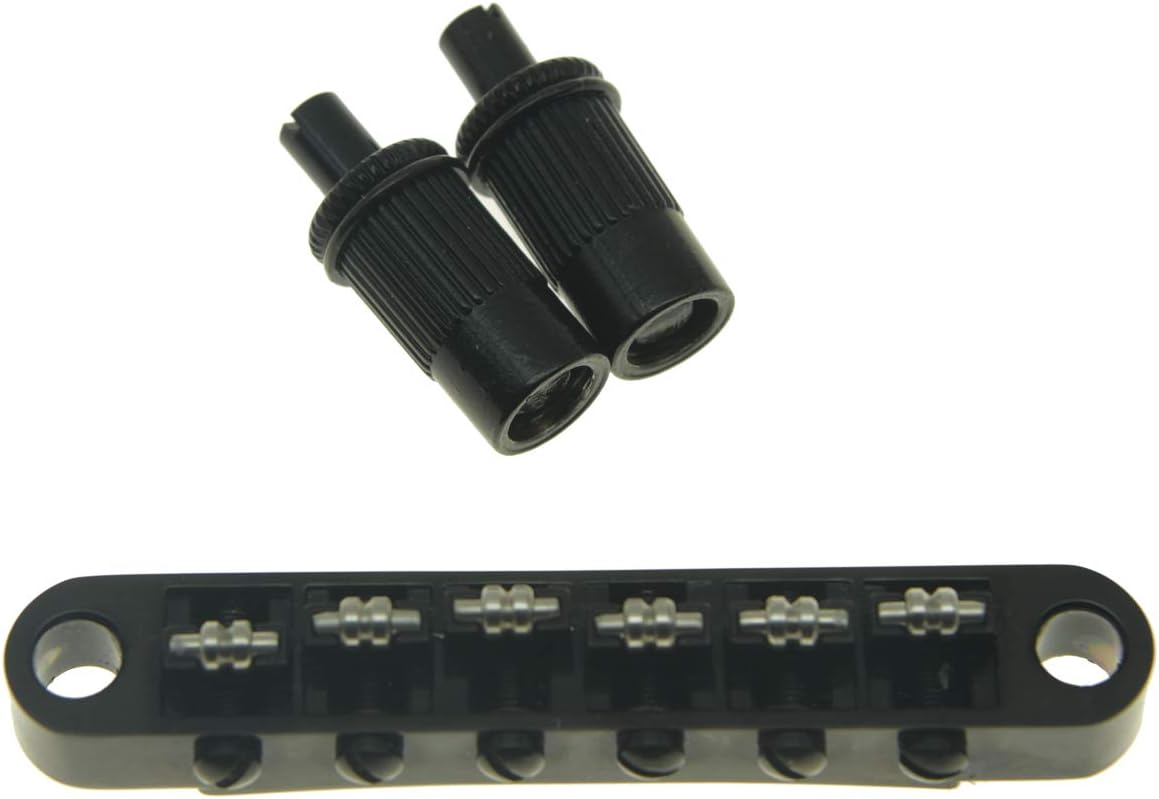
The black KAISH offers the same basic appeal as the gold model: individual intonation adjustment with roller saddles rather than fixed string notches. Its dark finish suits a guitar with black hardware, and the saddle-retention design helps keep the small moving parts located within the bridge. It is a straightforward mechanical upgrade rather than a different vibrato system.
The important distinction is the mounting. This K1395 version uses 6.3mm holes over 6mm post tops, with M8-threaded posts and anchors. The specified post spacing is 73.5mm, the outer-string spread is 52mm and the saddle radius is 14 inches. That makes it a different fit from the small-post gold KAISH, even though their overall shape looks similar.
Check the saddle radius as well as the post dimensions: matching the spacing alone does not establish that the string heights will suit the neck. Installing new anchors may also involve more work than reusing an existing compatible bridge. Choose it for a matching large-post guitar, with the setup adjusted around the actual neck and vibrato geometry.
Pros
- Roller saddles with individual intonation adjustment.
- Large-post design with M8 posts and anchors.
- Black finish for a coordinated hardware setup.
Cons
- Not interchangeable with the small-post gold model.
- Fixed 14-inch saddle radius must suit the instrument.
Allparts GB-0596-002 Gold Roller Tunematic Bridge

The Allparts GB-0596-002 is another route to a gold roller bridge, with a conventional Tunematic layout and separate saddles. Its appeal is a familiar adjustment scheme: set the overall height, then intonate each string without changing the tailpiece. For a suitable guitar, that keeps the upgrade focused on the string contact points.
Allparts specifies large mounting holes, 2-29/32-inch post spacing and 2-1/16-inch string spacing for this model family, with a 15-inch saddle radius. The gold -002 version is the one linked here. Those dimensions are more useful than a broad promise that it fits a particular guitar brand, since post layouts vary within the same range.
The flatter saddle radius deserves attention on a more tightly curved fingerboard, and the large holes are not a substitute for correctly sized posts. A roller bridge also needs a sensible string path and a well-prepared nut to do its job. Choose this model for a measured match, especially when the gold finish and flatter radius suit the existing setup.
Pros
- Six roller saddles in a familiar Tunematic layout.
- Published post spacing, string spacing and saddle radius.
- Gold finish matches an existing gold hardware scheme.
Cons
- Large mounting holes require the appropriate posts.
- 15-inch saddle radius may not suit a more curved neck.
Fender Mustang Guitar Bridge Assembly

The Mustang bridge is the offset-style option for a guitar that already uses compatible bridge thimbles. Its single-groove barrel saddles give each string a defined resting place, rather than the multiple grooves of a vintage Jaguar or Jazzmaster saddle. That can be appealing when a simple, clearly located string path is the priority.
The chrome-plated assembly has six intonation screws and springs, plus two posts with height-adjustment screws. The posts are approximately 2-7/8 inches apart. It is a different mounting approach from a Tune-O-Matic: the posts sit in body thimbles rather than attaching to the threaded studs used by the roller bridges above.
This is not a drop-in conversion for an ordinary Les Paul or a universal Bigsby bridge. It belongs on an appropriately configured offset-style instrument, and the body thimbles are not included. Choose it when the guitar already has the matching layout and the saddle radius suits the neck; fitting it elsewhere calls for a properly planned installation.
Pros
- Single-groove barrel saddles locate each string clearly.
- Individual intonation adjustment with two height-adjustable posts.
- Chrome finish and a compact offset-style layout.
Cons
- Requires compatible body thimbles, which are not included.
- Not a direct replacement for a Tune-O-Matic mounting system.
Fender American Vintage Jaguar/Jazzmaster Bridge

This Fender assembly preserves the traditional Jaguar and Jazzmaster approach. Six threaded saddles offer several string-groove positions, while their individual height adjustments give more control over the string arc than a fixed-radius barrel-saddle design. That flexibility can help retain the feel of a vintage-style offset guitar.
The nickel-plated bridge comes with two mounting posts and uses the offset-style body-thimble arrangement. Each saddle can be intonated separately. Bigsby includes the Fender Jag/Jaz bridge among the bridge types used with its tailpieces, so rollers are not the only workable solution when the guitar is configured for this design.
The many small adjustments demand a careful setup, and the threaded saddles are less simple than a single-groove design. This assembly is not a universal swap for a Gretsch or Tune-O-Matic-equipped guitar, and body bushings are not included. Choose it for the appropriate offset mounting layout when retaining the traditional adjustable saddle system matters.
Pros
- Individually adjustable saddle height and intonation.
- Threaded saddles allow a choice of string-groove position.
- Traditional nickel-plated offset-style construction.
Cons
- More small adjustments than a fixed-radius barrel bridge.
- Requires the correct body thimbles; bushings are not included.
TonePros TP6R-C Nashville Roller Bridge

The TP6R-C combines roller saddles with a bridge body that locks to its posts. That is useful when restringing: the bridge stays in place instead of lifting away with the strings. In use, the rollers provide a moving contact surface while the locking system keeps the bridge securely located.
TonePros specifies stainless-steel saddles, a Zamak body and brass posts and thumbwheels. The TP6R uses a 12-inch radius, approximately 74mm post spacing and 4mm post tops, with 10-32 threads for the intended Nashville-style installation. The linked -C model is chrome; it is not the larger-post metric TPFR.
The locking design is a practical advantage, but it does not make every Nashville-looking guitar an exact match. Check the spacing, threads, post tops and saddle radius before fitting it, and address nut friction separately. Choose the TP6R-C for a compatible Nashville-style setup when secure bridge retention is as important as the roller saddles.
Pros
- Locking bridge retention is useful during string changes.
- Stainless-steel roller saddles with individual intonation adjustment.
- Clearly specified Nashville-style dimensions and 12-inch radius.
Cons
- Not the large-post metric TPFR version.
- Correct fit and nut setup still determine the result.
FAQs About the Best Bigsby Bridges
Does a Bigsby Need a Roller Bridge?
No. Bigsby works with several bridge types, including rocking bars, conventional Tune-O-Matics, roller bridges and suitable Fender-style bridges. Rollers can reduce friction at the saddle, but a well-set-up conventional bridge can also work. The nut is another major source of friction and should not be overlooked.
What Measurements Matter?
Check post spacing, post-top diameter, thread type, string spread, saddle radius and available height. Also identify whether the guitar uses threaded studs, body thimbles or a floating wooden base. Parts with a similar silhouette can use completely different mounting systems. Even within Gretsch guitars, the model and existing hardware matter more than the brand name.
Can You Put a Bigsby on Any Guitar?
Different Bigsby models suit different body shapes and string paths. A bridge replacement and a vibrato installation are separate jobs: fitting a tailpiece may require drilling or a model-specific mounting adapter. A no-drill kit is only useful when it is explicitly designed for that guitar and vibrato combination. The guide to choosing a vibrato system covers the broader options.
How Does a Bigsby Work?
The arm rotates the string-anchoring bar against a spring, changing string tension and pitch. The bridge supports and intonates the strings; it is not itself the tailpiece. The strings must move freely across their contact points and return to their resting tension. A Bigsby is intended for expressive pitch movement, rather than the extreme range associated with a locking dive-bomb system.
What Should Be Checked During Setup?
Start with freely moving strings at the nut and saddles, then set relief, action and intonation. Check the string path and clearance around the back of the bridge. If a replacement requires drilling, new anchors or changes to the bridge base, have a qualified guitar technician plan the work rather than forcing a near match into place.
Conclusion: Best Bridges to Use for Bigsby
The gold KAISH is the starting pick for a compatible small-post Tune-O-Matic guitar. The black KAISH and Allparts offer different large-hole configurations, while TonePros adds locking retention to a Nashville-style roller bridge. The Fender assemblies serve appropriately configured offset-style instruments. Choose by the existing mounting system first, then consider the saddle design and finish; no single bridge is the right fit for every Bigsby-equipped guitar.