What’s the best baritone ukulele? The right choice combines the deeper D-G-B-E tuning with a comfortable neck, useful features and a sound that suits the music. A baritone keeps the ukulele’s four-string simplicity while offering a lower register than a standard soprano, concert or tenor.
That tuning matches the highest four strings of a guitar, making familiar chord shapes useful for guitarists. The Caramel CB103 adds onboard electronics, while the Córdoba, Kala, Makala and Oscar Schmidt models focus on acoustic playing. Here is how their construction and practical features compare.
Top 5 Best Baritone Ukuleles:
Caramel CB103 Baritone Ukulele (Editor’s Choice)
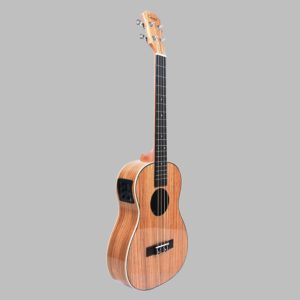
The Caramel CB103 is the most versatile choice here for a player who wants both acoustic practice and a direct connection to an amplifier. Its striped zebrawood body and high-gloss finish make it visually distinctive, while the baritone format provides the lower D-G-B-E tuning that many guitarists find immediately familiar.
The onboard EQ gives separate bass, middle and treble controls, so small tonal adjustments can be made at the instrument. A built-in tuner is useful before practice or a performance, and the pickup avoids the need to add an external system simply to plug in. The mahogany neck and bound body complete an instrument with more emphasis on practical features than a plain acoustic baritone.
The electronics need battery power, and the glossy surface has a more polished feel than the satin-finished alternatives below. Those are the main trade-offs for the additional controls. The CB103 is the overall pick for its combination of acoustic use, onboard tuning and amplified flexibility; a player who never plugs in may prefer to put the emphasis on a solid acoustic top instead.
Pros
- Built-in pickup with three-band EQ
- Onboard tuner
- Distinctive zebrawood body and standard baritone tuning
Cons
- Electronics require battery power
- High-gloss finish may not suit players who prefer satin
Córdoba 20BM Baritone Ukulele
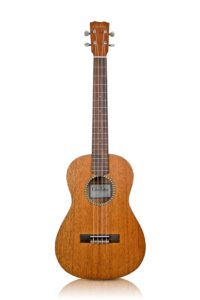
The Córdoba 20BM is the acoustic choice for someone who values a solid top and understated decoration. Its solid mahogany soundboard sits above mahogany back and sides, with a natural satin finish that keeps the grain in view. The dual-herringbone wood rosette adds detail without making the instrument look busy.
A 20-inch scale and 38 mm nut give it the familiar reach of a full-size baritone. The mahogany neck has a C-shaped profile, while 19 frets and standard D-G-B-E tuning make it useful for chord work and melodies. Aquila baritone strings complete a design aimed at a rounded acoustic voice rather than the higher, more percussive character associated with a small soprano.
There is no onboard pickup or tuner, so it is less self-contained for amplified playing than the Caramel. The solid top also deserves appropriate humidity care. For a player who mainly practices, accompanies singing or records with a microphone, the 20BM offers a strong combination of restrained styling and meaningful acoustic construction.
Pros
- Solid mahogany top
- Natural satin finish and herringbone rosette
- 20-inch scale with a 38 mm nut
Cons
- No onboard electronics
- Solid top needs sensible humidity care
Kala KA-B Baritone Ukulele
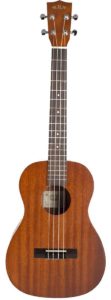
The Kala KA-B takes a classic approach: a mahogany body, cream binding and a satin finish. It has enough visual detail to look finished without relying on an ornate rosette or a glossy surface. For a player who wants a straightforward acoustic baritone, that simplicity is a large part of the appeal.
The baritone scale gives more space between frets than a smaller ukulele, and the instrument has 18 frets. Its mahogany neck, geared tuners and Graph Tech NuBone saddle provide a conventional layout, with no onboard controls to interrupt the body. D-G-B-E tuning lets guitarists carry over familiar shapes while adapting to the four-string arrangement.
The KA-B is a practical choice for regular practice and acoustic accompaniment, especially when a satin feel is preferable to the Caramel’s gloss. It does not offer the Córdoba’s solid-top specification or the Caramel’s built-in pickup. Choose it for a familiar, uncomplicated baritone rather than expecting one instrument to cover every recording or stage setup.
Pros
- Satin finish with contrasting cream binding
- Mahogany body and neck
- Graph Tech NuBone saddle and geared tuners
Cons
- No built-in pickup or tuner
- No solid-top specification
Kala Makala MK-B Baritone Ukulele Bundle
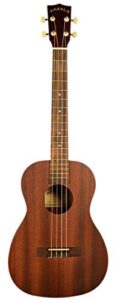
The Makala MK-B is the plainest-looking baritone in this group, and that is part of its charm. The satin-finished mahogany body dispenses with decorative binding, leaving a traditional shape and a simple soundhole rosette. It is an approachable way to explore the lower baritone register without an elaborate appearance.
The MK-B has a mahogany neck, geared tuning machines and an 18-fret baritone layout. This bundle adds useful learning essentials, including a gig bag, clip-on tuner, strap and instructional material. The separate tuner is particularly helpful for a beginner, while the bag makes carrying the instrument to lessons more convenient.
The distinction from the KA-B is mainly in the simpler trim and components: the Makala uses a plastic nut and saddle rather than the KA-B’s NuBone saddle. It is also fully acoustic, with no pickup for direct amplification. For someone trying baritone for the first time, the combination of a conventional instrument and practical accessories is more useful than decorative extras.
Pros
- Simple satin-finished mahogany design
- Bundle includes a bag, tuner and learning material
- Familiar 18-fret baritone format
Cons
- Plastic nut and saddle
- No onboard electronics
Oscar Schmidt OU53S Baritone Ukulele
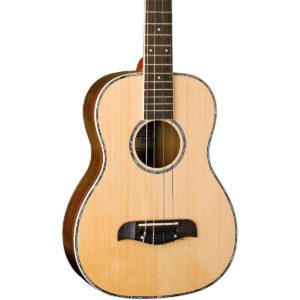
The Oscar Schmidt OU53S is the most decorative acoustic model here. A pale solid spruce top contrasts with rosewood back and sides, while an abalone rosette and gloss finish give it a more polished appearance than the satin mahogany instruments. The visual contrast is striking without changing the familiar baritone outline.
The solid spruce soundboard is its central construction feature, making this a different acoustic proposition from the mahogany-topped Córdoba. Chrome hardware and die-cast tuners complete the traditional design. For a player choosing by appearance as well as materials, the OU53S offers a clear alternative to an all-mahogany look.
This is an acoustic baritone without onboard amplification controls. The gloss finish will not appeal to everyone, and the solid top benefits from appropriate humidity care. Its appeal lies in the spruce-and-rosewood construction and detailed finish. Players who need a direct amplified connection will find that feature in the Caramel instead.
Pros
- Solid spruce top
- Rosewood back and sides
- Abalone rosette and gloss finish
Cons
- No built-in pickup
- Gloss finish and decorative trim may not suit minimalist tastes
How to Pick the Best Baritone Ukulele: Basics
Size, Weight, and Sound of Baritone Ukulele
A baritone generally has a larger body and longer scale than a tenor ukulele. It remains more compact than a full-size classical guitar, but its lower tuning gives it a different voice from a standard G-C-E-A ukulele. Check scale length, nut width and the playing position rather than choosing by overall length alone.
Four strings and familiar guitar chord shapes can make a baritone an appealing instrument to learn. Beginners still need suitable tuition and regular practice; no model removes the need to develop clean fretting and steady rhythm. The broader question of which instruments are easier for adult beginners to learn also depends on musical goals.
Set-Up and Material of Baritone Ukulele
A solid top and a laminated body describe construction, not finish. Laminate is still wood, and it is not immune to humidity or temperature changes. A solid top may offer a different acoustic response, but neither construction guarantees perfect action or intonation. Look for comfortable string height, clean frets and accurate notes along the neck.
Do not file frets or tuner parts simply because another owner reported a problem. If an instrument buzzes or is difficult to play, have the cause identified before modifying it. Bridge, nut and fretwork adjustments can affect one another.
Geared Tuners
Geared machines allow small, controlled changes in pitch. New strings often need repeated tuning as they settle; this is not, by itself, evidence that the tuners are faulty. A tuner helps establish pitch, while intonation concerns how accurately notes remain in tune as they are fretted.
Strings and Pitch for Baritone Ukuleles
Standard baritone tuning is D-G-B-E, matching the highest four strings of a guitar. Standard soprano, concert and tenor ukuleles are usually tuned G-C-E-A, so the same shapes produce different chord names. Use strings intended for the instrument’s scale and chosen tuning rather than tightening a D-G-B-E set arbitrarily to G-C-E-A.
Pickup and EQ features matter if the instrument will plug into an amplifier. For acoustic playing, neck feel, setup and the soundboard may matter more. Choose between these priorities before paying for features that will go unused.
The Best Sounding Baritone Ukulele: Our Choice
The Caramel CB103 remains the overall pick for its onboard tuner, three-band EQ and acoustic-electric versatility. The Córdoba 20BM and Oscar Schmidt OU53S put the emphasis on solid acoustic tops, while the Kala KA-B and Makala MK-B offer straightforward satin-finished alternatives. The best fit is the one whose tuning, neck and practical features support the way it will actually be played.