Looking for the best amplifier for B&W 702 S2 speakers? These floorstanders reward an amplifier with suitable load capability and enough clean headroom for the room. Source connections and system format matter too: a stereo integrated amp and a multichannel power amp solve different problems.
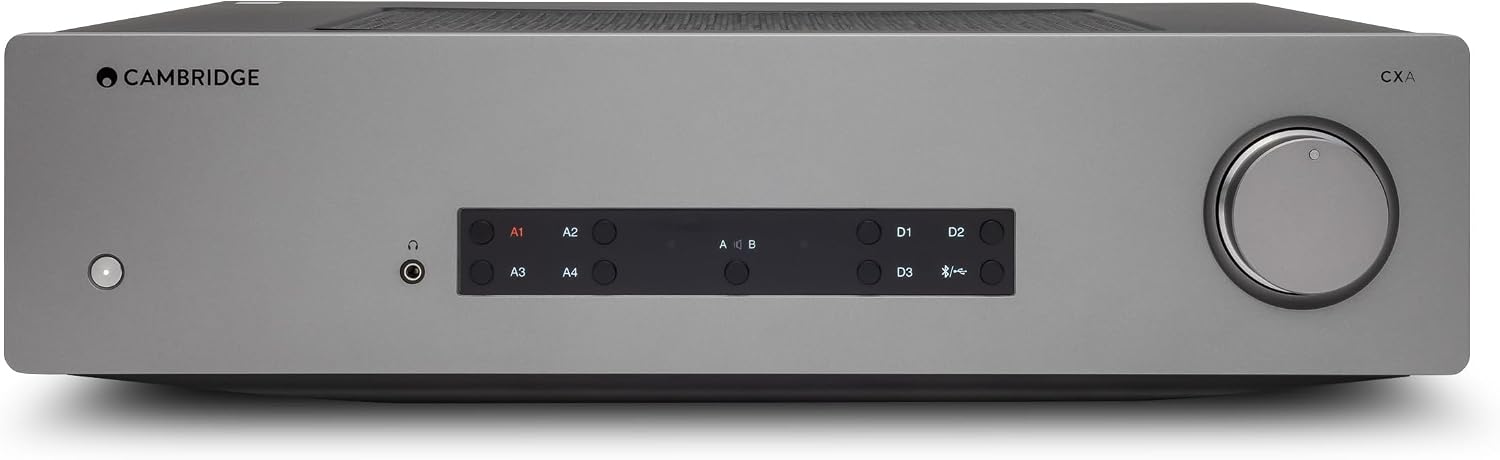
The Cambridge Audio CXA81 Mk II is the overall stereo choice here, combining analog and digital inputs with useful 4-ohm output capability. Yamaha’s A-S3200 takes an analog-focused approach, while the MX-A5200 belongs in a separates system with a suitable volume-controlled preamplifier or AV processor.
The 3 Best Amps for B&W 702 S2 Tower Speakers
| Image | Model | Price |
|---|---|---|
| Cambridge Audio CXA81 Mk II (Editor's Choice) | Check Price |
 | Yamaha AVENTAGE MX-A5200 | Check Price |
 | Yamaha A-S3200BL | Check Price |
Cambridge Audio CXA81 Mk II (Editor’s Choice)
The CXA81 Mk II is the most complete stereo starting point in this group. Its built-in DAC and USB computer-audio input sit alongside optical, coaxial, RCA and balanced XLR inputs, so a digital library and conventional sources can share one amplifier. Bluetooth aptX HD adds a convenient wireless route without turning the front panel into an AV receiver’s control center.
Cambridge rates it at 80 watts per channel into 8 ohms and 120 watts into 4 ohms. The Mk II uses an ESS ES9018K2M DAC, with headphone, preamp and subwoofer outputs providing useful expansion options. Those connections make it a practical match for a 702 S2 stereo system whose sources include a computer, streamer or disc player.
There is no phono stage, HDMI input or bass/treble adjustment. Vinyl needs an external phono preamp, and a separate streamer is required for network playback. Its power rating is also a reason to consider listening distance and desired level, not a guarantee of unlimited headroom. It earns the overall choice for combining a capable stereo output stage with the most useful source flexibility here.
Pros
- 80W into 8 ohms and 120W into 4 ohms per channel.
- USB audio, optical/coaxial and balanced XLR inputs.
- Bluetooth aptX HD plus preamp, subwoofer and headphone outputs.
Cons
- No built-in phono stage or HDMI.
- No bass/treble controls or built-in network streaming.
Yamaha AVENTAGE MX-A5200
The MX-A5200 is the separates-system option, particularly when the 702 S2 pair will be part of a larger home theater. It provides eleven power-amplifier channels with individual XLR and RCA input choices. A compatible AV processor or stereo preamplifier handles source selection and volume, leaving the Yamaha to drive the speakers.
Its normal 8-ohm rating is 150 watts per channel over 20Hz–20kHz at 0.06% THD with two channels driven. The toroidal transformer, large capacitors and separate channel inputs make it a substantial platform for a multichannel installation. That rating should not be read as 150 watts continuously from all eleven channels together, and the 200-watt bridged rating is a different operating configuration.
For a stereo pair, use the normal unbridged front-channel connections and follow Yamaha’s channel-specific impedance and selector instructions. The unit has no source selector, DAC, phono stage or listening-volume control, so it is not a standalone replacement for an integrated amp. It makes sense when a suitable preamp or processor and extra channels are already part of the plan; otherwise, much of its size and hardware will go unused.
Pros
- Eleven power-amplifier channels for a separates system.
- Balanced XLR and unbalanced RCA inputs.
- 150W-per-channel 8-ohm rating with two channels driven.
Cons
- Requires a separate volume-controlled preamp or AV processor.
- Large chassis; channel/load and bridging rules need careful setup.
Yamaha A-S3200BL
The A-S3200 is the analog-focused integrated amplifier for a system built around records and high-quality line sources. Its MM/MC phono stage, balanced inputs and traditional tone controls offer a different kind of flexibility from the Cambridge’s digital inputs. The illuminated level meters add useful visual feedback and give the front panel a distinctive, classic hi-fi character.
Yamaha specifies 100 watts per channel into 8 ohms and 150 watts into 4 ohms over 20Hz–20kHz at 0.07% THD for the US model. A toroidal transformer and balanced amplifier architecture underpin the design. Pre-out and main-in connections allow external equipment to be integrated, while the headphone output supports private listening.
There is no built-in DAC, Bluetooth or network streaming, so digital sources need suitable external conversion. It is also a large, heavy amplifier that deserves a solid, ventilated shelf. Main Direct bypasses the normal volume control and must be fed by equipment with its own volume adjustment. Choose it for a substantial analog stereo system, rather than expecting an all-in-one digital hub.
Pros
- MM/MC phono stage and balanced analog inputs.
- 100W into 8 ohms and 150W into 4 ohms per channel.
- Tone controls, level meters and pre-out/main-in connections.
Cons
- No built-in DAC, Bluetooth or network streaming.
- Heavy chassis; Main Direct requires external volume control.
B&W 702 S2: Recommended Amplifier Power and Impedance
Bowers & Wilkins specifies the 702 S2 at 8 ohms nominal, with a minimum impedance of 3.1 ohms. Its recommended amplifier range is 30–300 watts into 8 ohms on unclipped program material. That is a compatibility range, not a requirement to buy a 300-watt amplifier.
The speaker uses a decoupled Carbon Dome tweeter, a Continuum midrange and three Aerofoil-profile bass drivers. Its 90dB sensitivity rating is measured at 2.83V/1m. Those details help describe the design, but room size, distance and bass demands still determine how much clean amplifier headroom is useful.
How to Choose the Right Amp for Passive Speakers
Impedance and Load Capability
Impedance changes with frequency, so the nominal 8-ohm label does not describe the speaker at every point. Consider the minimum impedance and the amplifier’s specified loads as well. There is no universal rule that amplifiers work best only between 6 and 12 ohms.
On the MX-A5200, the front CH.3 A/B terminals support lower speaker impedances than the other channels, and bridged operation has stricter requirements. Follow the manual for the chosen channels and selector position; do not select bridging simply to chase the largest wattage number.
Power and Listening Distance
Compare output ratings under their stated load, frequency range, distortion and channel-count conditions. A two-channel continuous rating is more useful for this stereo pairing than an isolated peak figure. A power-handling recommendation also does not make high volume automatically safe: reduce the level if the sound becomes strained or distorted.
As with other speaker-and-amplifier pairings, a moderate room at a sensible level can need much less power than loud listening at a long distance. Choose enough headroom for the use, with ventilation and placement considered alongside the electronics.
Sensitivity and System Format
Higher sensitivity generally produces more output for the same input under comparable measurement conditions, but it does not guarantee better sound. Make sure sensitivity figures use the same reference before comparing them. A 2.83V sensitivity rating and a 1-watt rating are directly equivalent only at 8 ohms.
For two-channel playback, an integrated amp keeps source selection, volume and amplification together. A power amp such as the MX-A5200 needs an upstream preamp or processor. Digital sources require a DAC somewhere in the chain, and a conventional turntable needs a suitable phono stage. These connections matter more than a promise of a universal sonic match.
So, Which Is the Best Amp for Bowers & Wilkins 702 S2?
The Cambridge Audio CXA81 Mk II is the overall choice for a flexible stereo system with digital and analog sources. The Yamaha A-S3200 suits an analog-first setup with MM/MC vinyl support, while the MX-A5200 serves a properly configured separates or multichannel system. Match the format and inputs to the room and sources, with enough clean output for the intended listening level.