Looking for the best tremolo system? These three bridges take different approaches to pitch control: a locking retrofit for suitable Tune-O-Matic/stopbar guitars, a blade-pivot Strat-style system and a refined six-screw vintage design.

Start with the guitar’s existing bridge layout. The Floyd Rose FRX, Super-Vee BladeRunner and Wilkinson/Gotoh VSVG are not interchangeable installations. Once the hardware matches, compare the feel, adjustment method and maintenance involved.
Best Tremolo Systems – Comparison Table
| Image | Model | Price |
|---|---|---|
| Floyd Rose FRX Tremolo System (Editor's Choice) | Check Price |
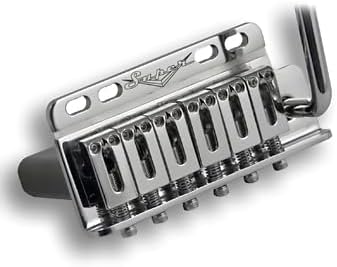 | Super-Vee BladeRunner Tremolo System | Check Price |
 | Wilkinson/Gotoh VSVG Vintage Tremolo | Check Price |
Floyd Rose FRX Tremolo System (Editor’s Choice)
The FRX is the feature-rich choice for adding a locking tremolo to a suitably equipped Tune-O-Matic/stopbar guitar. That makes it an interesting route for a Les Paul-, SG- or Flying V-style instrument whose owner wants more expressive pitch control without the usual recessed Floyd Rose conversion.
The bridge mounts at the existing stud locations, while a separate locking assembly sits behind the original nut in the truss-rod-cover area. Bridge fine tuners allow small pitch corrections after the strings are locked. The selected version here is the gold FRTX03000, with the same FRX layout rather than a conventional Strat-style replacement bridge.
The appeal is a substantial change in capability on a compatible guitar. Installation still involves geometry and clearance checks, and two wood screws secure the locking nut assembly. Floyd Rose also notes that some guitars need minor body clearance work because of their neck angle. It is a specialist retrofit with more setup involved than a simple non-locking bridge.
Pros
- Locking tremolo retrofit for suitable Tune-O-Matic/stopbar guitars.
- Surface-mounted bridge with fine tuners.
- Uses existing bridge mounting locations.
Cons
- Not a replacement for a standard Stratocaster tremolo.
- Nut mounting and some guitars’ clearance requirements involve modification.
Super-Vee BladeRunner Tremolo System
The BladeRunner keeps the familiar look and six-saddle layout of a Strat-style bridge but changes the pivot mechanism. This exact bright-nickel version is the right-handed, six-screw-mount model, aimed at a compatible Strat-style installation.
Super-Vee’s tempered spring-steel blade flexes as the arm moves, replacing the conventional metal-on-metal pivot action. The design targets a smooth return toward the resting position without adding a locking nut. The complete bridge includes an arm, mounting screws, return springs and adjustment tools.
It is the appealing choice for a player who wants familiar string changes and a different approach to vibrato feel. Because it is non-locking, the nut, string trees and string winding still affect tuning behavior. Two-point installations can require the manufacturer’s adapter kit, and block depth matters on thinner bodies; this six-screw version is not a universal fit.
Pros
- Blade pivot rather than a conventional metal-on-metal fulcrum.
- Familiar non-locking six-saddle format.
- Right-handed six-screw model with installation hardware.
Cons
- Nut friction can still affect tuning stability.
- Two-point or thin-body installations may need different parts.
Wilkinson/Gotoh VSVG Vintage Tremolo
The VSVG is the traditional-looking six-screw option with useful mechanical refinements. It suits a player who wants vintage-style bent-steel saddles and conventional controls without moving to a locking-nut system.
Five elongated mounting holes reduce binding around the screws, while a round locating hole keeps the bridge positioned laterally. Staggered string holes in the steel block help make the break angles over the saddles more consistent. The saddles lock after adjustment, and Gotoh specifies 10.8mm string spacing, or 54mm across the six strings.
The strength is that these details address specific weaknesses of a basic vintage-style bridge without changing its general character. Intonation adjustment is less familiar than simply turning a spring-loaded saddle screw: Gotoh’s procedure uses a separate adjusting bolt and requires releasing the saddle lock first. Match the mounting pattern and rout before treating it as an upgrade for a particular guitar.
Pros
- Bent-steel saddles with a locking adjustment.
- Elongated mounting slots and staggered string holes.
- Traditional appearance with 10.8mm string spacing.
Cons
- Intonation adjustment requires the correct separate-bolt procedure.
- Six-screw pattern and body clearance must match.
FAQs About the Best Tremolo Systems
What Does a Tremolo System Do?
A guitar’s tremolo or vibrato system changes string tension when the arm is moved, raising or lowering pitch according to the design and setup. Strictly speaking, vibrato describes pitch variation, while tremolo describes a change in volume. “Tremolo bridge” remains the familiar hardware term.
The arm is one component of the system, not the whole mechanism. The bridge, pivot, springs and string-contact points work together. A floating setup allows movement in both directions, while a decked or blocked arrangement restricts movement. The available range depends on the bridge geometry, clearance and spring balance.
What Makes a Good Tremolo Bridge?
Construction and Adjustment
Look at how the bridge pivots, how the saddles are secured and how the arm tension is set. The VSVG uses locking bent-steel saddles, the BladeRunner changes the pivot mechanism, and the FRX adds string locking and fine tuners. These are different solutions, rather than a single feature that makes every bridge better.
Pitch Range
Choose for the effects you actually use. Gentle chord shimmer and deeper pitch dips place different demands on the setup. Raising pitch requires clearance and a suitable floating arrangement; lowering pitch is also limited by the strings and the mechanism. A bridge should not be forced beyond its available travel.
Tuning Stability
A bridge that returns consistently to its resting position still depends on the rest of the instrument. Nut friction, string trees, winding, saddle contact and setup can all affect tuning. A locking system reduces movement at particular contact points, but it still needs correct installation and adjustment. Changing string gauge or tuning can require rebalancing a floating bridge.
Design and Fit
The FRX is for suitable Tune-O-Matic/stopbar layouts, not a normal Stratocaster rout. Its body clearance and locking-nut arrangement need checking. The six-screw BladeRunner and VSVG address Strat-style applications; compare screw positions, string spacing, block depth and body clearance for the exact guitar.
Do not confuse bridge locking with locking tuners or assume any tremolo can be installed without modification. A bridge used with a Bigsby is another arrangement with different requirements. If your Strat project also involves electronics, our Strat humbucker guide compares pickup options.
Conclusion: The Best Tremolo System
The Floyd Rose FRX is the Editor’s Choice for its locking retrofit capability on a suitable Tune-O-Matic/stopbar guitar. It is the most involved change here, so its application matters as much as its feature set.
For a compatible Strat-style guitar, the Super-Vee BladeRunner offers a blade-pivot approach without a locking nut. The Wilkinson/Gotoh VSVG keeps the traditional format while refining the mounting holes, string path and saddle adjustment. Choose the system that matches the guitar first, then the pitch control and maintenance you want.