Looking for the best tubes for Fender Hot Rod Deluxe? The standard design uses three 12AX7-family tubes and a pair of 6L6GC power tubes, so there are two separate decisions: renewing the small-signal section or replacing the output pair. These four options cover both jobs without treating every valve as an interchangeable tone upgrade.
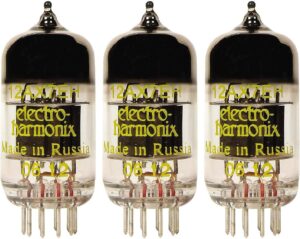
The Hot Rod Deluxe’s solid-state rectifier does not need a replacement rectifier tube. Check the exact amp’s chart before ordering: special versions such as the George Benson model use a different small-signal complement. The Electro-Harmonix 12AX7 trio is the overall choice here for a standard three-12AX7 setup; the power-tube pairs belong in the output stage and need a bias check.
Best Sounding Tubes for Fender Hot Rod Deluxe
| Image | Model | Price |
|---|---|---|
| Electro-Harmonix 12AX7 (Editor's Choice) | Check Price |
 | JJ ECC83S/12AX7 | Check Price |
 | Tung-Sol 6L6GC-STR | Check Price |
 | Electro-Harmonix 6L6EH | Check Price |
Electro-Harmonix 12AX7 (Editor’s Choice)
The Electro-Harmonix 12AX7 trio is the practical small-signal choice for a standard Hot Rod Deluxe. Its spiral filament is designed to reduce a particular source of heater-induced hum, and the 12AX7/ECC83 family is the right starting point for the amp’s specified small-signal sockets. The appeal is a familiar electrical type with attention to noise, rather than an exotic substitute.
The three-tube set is matched for gain and conductance, giving a complete set for the standard amp’s three positions. That is convenient for a planned refresh, although a single diagnosed faulty valve does not make every healthy tube obsolete. It is the overall choice for the combination of the correct family, useful set size and noise-conscious construction.
A spiral filament does not eliminate grounding problems, worn components or every source of hiss. Nor does fitting three new tubes guarantee more gain or a particular overdrive texture. Choose this set when the small-signal valves need renewal, with the exact amp version and the actual fault kept in view.
Pros
- Three-tube set for the standard 12AX7 complement.
- Matched for gain and conductance.
- Spiral filament designed to reduce heater-induced hum.
Cons
- Not every special Hot Rod version uses three 12AX7s.
- Cannot eliminate noise caused elsewhere in the amplifier.
JJ ECC83S/12AX7
The JJ ECC83S is the alternative small-signal choice, supplied here as a three-pack. JJ describes it as a high-gain double triode designed for low noise and microphonics. Its compact internal structure is useful in a speaker-loaded combo, where vibration matters just as much as an impressive-sounding gain claim.
This is the standard ECC83S, not the separately named ECC83MG or a gold-pin version. The ECC83/12AX7 designation places it in the family specified by the standard Hot Rod Deluxe’s tube chart. The three-pack is convenient when a complete set is wanted, while keeping the amplifier’s existing circuit and controls rather than trying to change its basic design.
A three-pack does not by itself establish matching, and a published amplification factor of 100 does not mean every installed stage provides a hundredfold voltage increase. Noise and microphonics still depend on the individual tube and its position. Choose the JJ set as a straightforward alternative with a clear type identity, without expecting a brand change to cure an unrelated amp fault.
Pros
- Three-pack of the standard ECC83S/12AX7 type.
- Manufacturer targets low noise and microphonics.
- Compact construction suited to small-signal combo-amp use.
Cons
- Three-pack does not by itself establish matching.
- Individual noise performance still needs assessment in the amplifier.
Tung-Sol 6L6GC-STR
The Tung-Sol 6L6GC-STR pair is the output-stage option for retaining the Hot Rod Deluxe’s 6L6GC format. The STR name refers to Special Tube Request specifications, and this is a modern reissue rather than a pair of vintage American tubes. The linked Apex-matched pair gives the two output valves a more useful starting relationship than unrelated singles.
Tung-Sol positions the design around the construction and overdrive character associated with its STR line. That makes it an interesting choice for restoring a tired output stage, but the amplifier’s bias, speaker and operating level remain central to the result. It should be judged as a correctly specified power-tube pair, not as a guaranteed shortcut to a new clean-channel voicing.
Have the bias and amplifier condition checked when changing the pair. Matching is not a guarantee of identical current in every circuit, and the 6L6GC-STR should not be confused with another Tung-Sol tube merely carrying 6L6 or 5881 in its name. Choose it when an appropriate matched output pair is needed, with installation treated as part of the job.
Pros
- Matched pair for the two-valve output stage.
- Specific 6L6GC-STR identity.
- Modern reissue of the manufacturer’s STR approach.
Cons
- Bias and amplifier condition still need checking.
- Not every 6L6-family tube has the same operating limits.
Electro-Harmonix 6L6EH
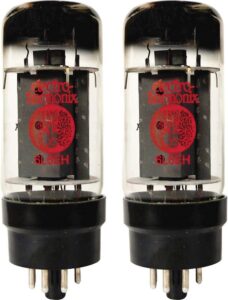
The Electro-Harmonix 6L6EH pair is the other output-stage choice. Its design uses large plate dimensions and a revised grid structure, with construction inspired by the RCA 6L6GC blackplate. Mica spacers and metal springs support the internal assembly to reduce the risk of rattling in a vibrating combo cabinet.
The linked Platinum Matched pair is computer-matched by the manufacturer. That is a useful basis for replacing both output valves together rather than mixing unrelated examples. Its 30-watt plate-dissipation limit describes heat at the tube’s plate; it does not turn the Hot Rod Deluxe into a 60-watt amplifier or establish how loud the speaker will play.
The mechanical support is a design feature, not a promise of complete immunity to microphonics or damage. As with the Tung-Sols, the amplifier needs the correct bias and an assessment of any underlying fault. Choose the 6L6EH for its specific construction and factory-matched pair format, with realistic expectations about what a service replacement can change.
Pros
- Factory computer-matched power-tube pair.
- Large plates and revised grid structure.
- Spring-supported mica spacers intended to reduce rattle.
Cons
- Requires a bias check in the amplifier.
- Plate-dissipation rating is not amplifier output power.
What Tubes Are Used in a Fender Hot Rod Deluxe?
The standard Fender Hot Rod Deluxe uses three 12AX7/ECC83-family tubes and two 6L6-family output tubes of the specified grade. Its rectification is solid-state. Check the chart and manual for the exact version, particularly a special edition or a modified amp; the George Benson version is one example with a different small-signal lineup.
The 12AX7s handle small-signal amplification and phase-inverter duties, while the 6L6GC pair drives the output stage. A tube’s amplification factor is a device parameter, not a promise of the same gain in every installed stage. Similarly, plate dissipation is a thermal limit, not the amplifier’s speaker-output rating.
Fender advises checking the original output-tube markings and having a qualified technician assess changes of type or grade. A matched pair still needs an appropriate operating point. The 6L6 tube comparison explains other family members, but a shared base or similar name does not establish a suitable substitution.
Replace diagnosed worn or faulty tubes rather than assuming every noise requires a complete set. Persistent hum, loss of level or repeated failures can have other causes. Internal work and bias adjustment belong with a qualified technician because dangerous voltages can remain after the amplifier is switched off.
So, Which Are the Best Tubes for Hot Rod Deluxe?
The Electro-Harmonix 12AX7 trio is the overall choice for renewing the standard small-signal set. The JJ ECC83S three-pack provides another clear 12AX7-family option. For the output stage, the Tung-Sol 6L6GC-STR and Electro-Harmonix 6L6EH pairs offer different constructions with matched-pair convenience.
Choose the right section and tube type first, then have the amplifier set up correctly. The best result is a healthy, predictable Hot Rod Deluxe, with its familiar controls and playing response intact.