Looking for the best tubes for Fender Twin Reverb? The ’65 Twin Reverb Reissue uses four 12AX7-family tubes, two 12AT7s and four 6L6GC output tubes. These six choices provide two options for each family, with the right selection depending on which part of the amplifier needs attention.
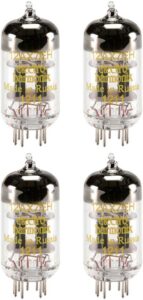
The Electro-Harmonix 12AX7 set is the overall choice for a small-signal refresh. The 12AT7 options serve reverb-drive and phase-inverter positions, while the 6L6GC sets belong in the four-valve output stage. Check the exact model’s tube chart: vintage revisions, modified amps and the solid-state Tone Master should not be treated as the same design.
Best Replacement Tubes for Fender Twin Reverb
Electro-Harmonix 12AX7 (Editor’s Choice)
The Electro-Harmonix 12AX7 is the straightforward all-rounder for the Twin’s four 12AX7-family positions. Its spiral filament is intended to reduce heater-induced hum in applicable circuits, while the familiar ECC83/7025 equivalence keeps the choice within the specified tube family. Noise-conscious construction is a more useful starting point than a promise that every new valve will outperform vintage stock.
A matched four-tube set is convenient for a planned small-signal refresh. These positions cover more than the first gain stage: the Reissue also uses the family for reverb recovery and tremolo functions. Choosing the correct type preserves that circuit layout rather than treating every socket as an independent way to add distortion.
The filament design cannot cure hum from grounding or worn amplifier components, and individual microphonics still matter. Replacing a single diagnosed noisy valve may be more sensible than changing all four. It earns the overall choice for its useful construction and correct-family set format, with the condition of each valve judged in the amplifier.
Pros
- 12AX7/ECC83/7025-family design.
- Spiral filament intended to reduce heater-induced hum.
- Four-tube format suits the Reissue’s specified count.
Cons
- Noise elsewhere in the amp may remain.
- A complete set may be unnecessary for one faulty tube.
JJ ECC83S/12AX7

The JJ ECC83S offers a different current-production 12AX7-family option. JJ designs it as a high-gain double triode with attention to noise and microphonics, making it a sensible candidate for a working combo amplifier. Its compact construction is useful when the valves operate near the vibration of two speakers.
The standard ECC83S should not be confused with JJ’s separately named ECC83MG or gold-pin versions. A four-tube set makes it possible to renew the specified 12AX7-family complement without changing tube families. The useful comparison is the actual sample’s behavior in the required position, rather than a claim that one logo guarantees a warmer or brighter Twin.
A published amplification factor is not the gain of every installed stage, and matching does not establish freedom from microphonics. If one position is noisy, diagnose that position first. Choose the JJ set for a clearly identified, conventional replacement family with a low-noise design priority, while retaining the amp’s normal controls and circuit behavior.
Pros
- Standard ECC83S/12AX7 family.
- Manufacturer targets low noise and microphonics.
- Four-tube set covers the specified family count.
Cons
- Matching does not guarantee low microphonics.
- Individual samples still need assessment in the relevant position.
Tung-Sol 12AT7/ECC81
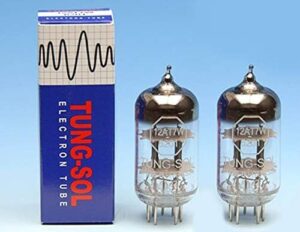
The Tung-Sol 12AT7/ECC81 is aimed directly at the kind of work the Twin assigns to this family: reverb drive and phase inversion. Tung-Sol emphasizes low microphonics and selection for close tolerances. That makes its application more specific than treating it as a generic lower-gain substitute for every 12AX7 socket.
In the ’65 Reissue, one 12AT7 drives the spring-reverb circuit and the other splits the signal for the output stage. A two-tube set is therefore a useful way to cover those positions. These are supporting roles with electrical demands of their own, not simply two more preamp stages that should be fitted with the highest-gain tube available.
A replacement can address a fault traced to the valve, but it will not repair a damaged reverb tank, cable or coupling component. The attraction is the manufacturer’s driver-circuit focus and noise-conscious selection. Choose it for the specified 12AT7/ECC81 positions and preserve the original tube roles.
Pros
- Manufacturer identifies reverb and driver-circuit use.
- Selection emphasizes close tolerances and low microphonics.
- Two-tube format covers both 12AT7 positions.
Cons
- Not a universal substitute for 12AX7 positions.
- Will not repair a faulty reverb tank or other circuit component.
Electro-Harmonix 12AT7
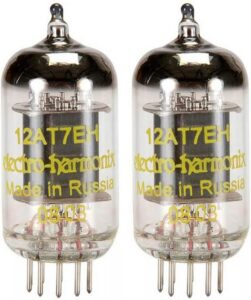
The Electro-Harmonix 12AT7 is the large-plate alternative for the same two specified positions. Its twin-triode construction is intended for driver and reverb circuits, with plate dissipation part of the design’s appeal. It offers a purpose-built driver valve while keeping the amplifier within the specified tube family.
It provides another way to renew a tired reverb-driver or phase-inverter valve while staying with the intended tube family. The larger internal plates distinguish its construction, but they do not by themselves establish a tonal advantage over the Tung-Sol. The practical aim is stable operation in the circuit rather than an unsupported claim of extra clean headroom.
Keep the 12AT7 and 12AX7 roles separate, even though their nine-pin bases look similar. A persistent reverb or balance problem may require more than a valve change. Choose the Electro-Harmonix for its driver-oriented design and suitable type, with normal diagnosis taking priority over replacing healthy parts.
Pros
- Large-plate twin-triode construction.
- Manufacturer identifies reverb and driver applications.
- Correct 12AT7 family for the specified positions.
Cons
- Plate size alone does not prove better sound.
- A tube change may not resolve a fault elsewhere in the circuit.
Electro-Harmonix 6L6EH

The 6L6EH is the Electro-Harmonix output-stage choice, with large plates, a revised grid structure and construction inspired by the RCA 6L6GC blackplate. Mica spacers supported by metal springs are intended to reduce internal rattle, a useful concern in a high-output combo rather than just a decorative specification.
A four-tube set covers the Twin Reverb Reissue’s complete output stage. Using a properly matched quartet gives the technician a more consistent starting point than mixing unrelated output valves. It does not alter the amplifier’s design rating, and a 30-watt plate-dissipation limit is a thermal specification rather than the sound power produced by each tube.
The operating point still needs checking in the amplifier. Mechanical supports do not make any glass valve immune to vibration or failure, and recurring problems need diagnosis. Choose this set for its specific construction and four-valve format, with installation and bias assessment included in the plan.
Pros
- Large plates and revised grid structure.
- Spring-supported mica spacers intended to reduce rattle.
- Four-tube format for the complete output stage.
Cons
- Bias and amplifier condition still need assessment.
- Plate-dissipation rating is not amplifier output power.
JJ 6L6GC

The JJ 6L6GC is the alternative for the four-valve output stage. It is a current-production design from JJ Electronic in Slovakia. Its octal-base beam-power design carries a 30-watt plate-dissipation rating and belongs to the 6L6GC grade used in the ’65 Reissue.
A matched quad is the practical format for a complete output-stage renewal. That helps avoid combining four unrelated operating characteristics, while leaving the technician to establish the correct bias in the actual amp. JJ describes a robust design with substantial headroom, but the finished result also depends on circuit condition, speaker load and level.
The 30-watt rating should not be multiplied by four to claim a new amplifier-output figure. Nor should a 6L6GC be treated as interchangeable with every earlier 6L6 or 5881 on the strength of the name. Choose the JJ quad as a clearly identified output-stage set, with the correct setup valued more than a promise of an automatic tonal transformation.
Pros
- 6L6GC grade used in the Reissue output stage.
- Matched four-tube format.
- Current-production design from JJ Electronic in Slovakia.
Cons
- Needs an operating-point and bias check.
- Not every 6L6-family tube shares the same limits.
What Tubes Are Used in a Fender Twin Reverb?
Fender specifies four 12AX7-family tubes, two 12AT7s and four 6L6GC output tubes for the ’65 Twin Reverb Reissue. Its service information identifies V1, V2, V4 and V5 as 7025/12AX7 positions, V3 and V6 as 12AT7 positions, and V7–V10 as the output valves. The 12AT7s serve reverb-drive and phase-inverter duties; they are not interchangeable with every 12AX7 merely because the bases fit.
The Twin Reverb’s model history includes different revisions. Use the exact amp’s chart and manual, especially with a vintage or modified example. A Tone Master Twin Reverb does not use this valve complement.
Small-signal matching, balanced sections and a matched power-tube quartet describe different tests. None removes the need to assess noise or the amplifier’s operating condition. A comparison of 12AT7 options can give more context, but the required circuit role comes first.
Have output-tube changes and bias assessment handled by a qualified technician. Dangerous voltages can remain inside a switched-off amp. Replace parts according to a diagnosed need rather than assuming every old valve is worn out or that new tubes will cure every source of hum.
So, Which Are the Best Sounding Tubes for Fender Twin Reverb?
The Electro-Harmonix 12AX7 set is the overall choice for a small-signal refresh, with JJ ECC83S as the alternative in that family. Tung-Sol and Electro-Harmonix provide the two 12AT7 options, while Electro-Harmonix 6L6EH and JJ 6L6GC sets address the output stage.
Choose the correct family and set size for the work being done, then have the amplifier checked and set up correctly. Correct setup helps preserve the Twin’s familiar clean platform and playing response.