Are you looking for the best auto-wah pedal? These four options cover touch-responsive funk sweeps, rhythmic filtering and more vocal effects, with different ways to shape the response around a guitar or bass.

A touch-sensitive filter follows the strength of the notes rather than the movement of a foot treadle. Some pedals also add tempo-driven movement or optional expression control. Start with the kind of wah effect needed, then compare how much adjustment the pedal gives over its trigger, sweep and decay.
Top 4 Best Auto Wah Pedals:
| Image | Model | Dimensions (") | Weight (lb) | Price |
|---|---|---|---|---|
| BOSS AW-3 (Editor's Choice) | 2.88 × 5.13 × 2.38 | 0.95 | Check Price |
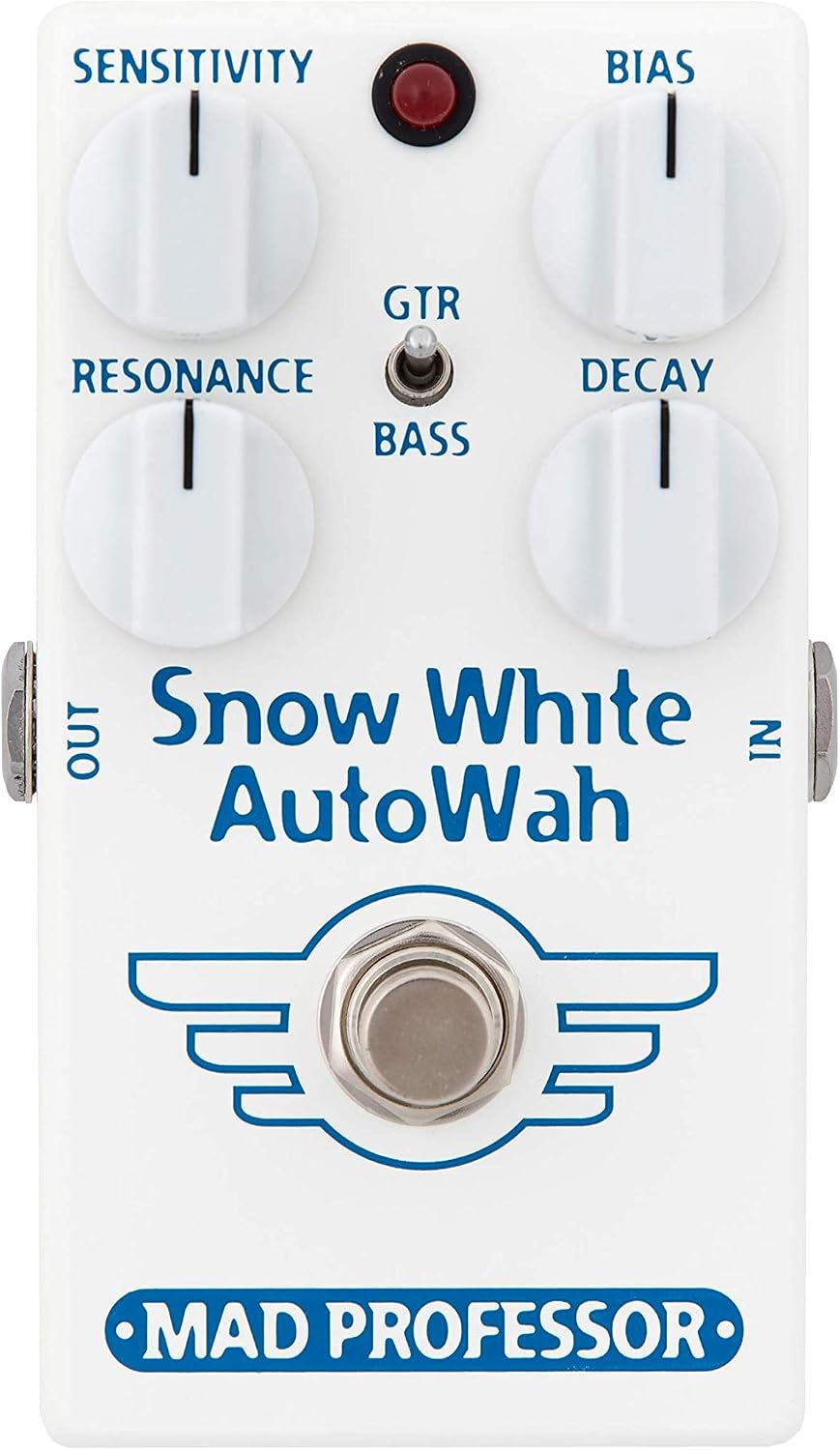 | Snow White GB | — | — | Check Price |
 | Keeley Neutrino | — | — | Check Price |
 | Xvive V17 | 1.81 × 3.70 × 1.97 | — | Check Price |
BOSS AW-3 Dynamic Wah (Editor’s Choice)
The BOSS AW-3 Dynamic Wah remains the overall pick for the variety of effects it puts into one familiar stompbox. Up, Down and Sharp modes provide contrasting touch-responsive sweeps, while Tempo mode supplies rhythmic auto-wah movement. It is a useful choice when the effect needs to serve several different parts rather than one fixed funk sound.
Humanizer mode is the distinctive extra. Instead of a conventional sweep, it moves between selected vowel-like sounds, giving single-note lines a more vocal character. Separate guitar and bass inputs adapt the response to the instrument, and the EXP/CTL connection accepts a compatible expression pedal or footswitch for further control.
The trade-off is learning how the shared controls change with the selected mode. An expression pedal can turn it into a foot-controlled wah, but that accessory is separate, and the guitar and bass inputs are for alternate use. For a player who wants rhythmic, dynamic and vowel-like filtering in one box, the range of modes is a stronger reason to choose it than any promise of a particular vintage sound.
Pros
- Dynamic, rhythmic and Humanizer modes
- Dedicated guitar and bass inputs
- Compatible expression-pedal or footswitch control
Cons
- Shared knobs change function between modes
- Expression pedal and external footswitch are separate accessories
Keeley Neutrino Envelope Filter
The Keeley Neutrino Envelope Filter is the more focused choice for a classic, touch-driven filter sound. Its opto-coupler-based analog design puts the emphasis on the sweep itself, with controls that let the player move from a restrained vowel-like accent to a sharper funk quack.
Gain sets the input level that triggers the effect, making it central to matching the pedal to the pickups and playing strength. Peak adjusts the resonance character, and the filter selector offers low-pass, band-pass and high-pass responses. A high/low Range setting changes the register emphasized by the filter, while the direction switch changes the sweep movement.
Those choices make it more adaptable than a single fixed auto-wah voice, but they interact. High-pass filtering can remove much of the bass foundation, and a strong Peak setting may be too pointed for an already bright setup. Choose it for detailed control of a dynamic envelope sound; the original version here does not provide the AW-3’s tempo or Humanizer modes.
Pros
- Analog, opto-coupler-based filtering
- Low-pass, band-pass and high-pass options
- Input Gain, Peak, Range and sweep-direction controls
Cons
- Controls need to be balanced against the instrument’s output
- No tempo-driven or Humanizer modes
Mad Professor Snow White AutoWah GB
The Mad Professor Snow White AutoWah GB is the choice for shaping a natural-feeling envelope sweep around either guitar or bass. Its GTR/BASS switch selects the instrument-specific response, while the four main controls give direct access to the trigger, resting frequency, resonance and return speed.
Sensitivity determines how readily the playing opens the filter. Bias sets the filter’s resting point, Resonance controls how pronounced the peak becomes, and Decay controls how quickly the sweep falls back. A faster return can make separate notes more distinct; a slower one lets the movement carry across a phrase instead of restarting so abruptly.
The appeal is that control over phrasing, rather than a large menu of effects. It has true bypass and keeps the interface visible on the pedal, but it does not store presets or provide a rhythmic LFO mode. For players who want the hand’s dynamics to do the work, the combination of Bias and Decay is particularly useful for making the sweep fit the part.
Pros
- Guitar/bass switch adapts the response
- Separate Sensitivity, Bias, Resonance and Decay controls
- True bypass with a direct front-panel layout
Cons
- No preset recall or rhythmic LFO mode
- Sensitivity needs adjustment when the instrument level changes
Xvive V17 Singing Autowah
The Xvive V17 Singing Autowah puts a double-peak envelope filter into a small pedal. It is a practical option when space is limited and the goal is an obvious, responsive wah effect rather than a collection of programmable filter sounds.
The Fast/Slow switch changes the initial upward sweep, giving a choice between a more immediate response and a slower opening movement. Its Staccato envelope-reset design is intended to discharge the envelope between notes, helping the effect respond to more closely spaced picking or bass phrasing. Sensitivity, Sustain and Depth controls provide the main adjustments around that response.
The compact format is the attraction and the compromise: the smaller controls are less convenient for quick changes, and there is no preset memory or expression-pedal input. It also needs an external power supply. Choose it for a small board and focused envelope-filter work, with the Fast/Slow setting used to match the movement to the phrase.
Pros
- Compact double-peak envelope filter
- Fast/Slow control changes the initial sweep
- Envelope-reset design suits more closely spaced notes
Cons
- Small controls are less convenient for quick adjustment
- No presets or expression input; external power required
How to Pick the Best Auto Wah Pedal
Touch-Driven or Rhythmic?
An auto-wah can be driven by the instrument’s changing level or by a repeating modulation signal. A touch-responsive envelope filter makes accented notes open the sweep differently; a tempo-driven mode creates a more regular pattern.
The AW-3 offers both kinds of behavior. The Neutrino, Snow White and V17 concentrate on envelope response. Choose according to whether the playing hand or a repeating rhythm should control the movement.
Match the Trigger to the Instrument
Set sensitivity or input gain with the guitar or bass at its normal playing volume. Test soft notes, accents and the loudest part of the passage. If the filter stays wide open or barely moves, adjust the trigger before changing every other control.
Changing pickups, turning down the instrument or placing a boost before the filter can change that response. A setting that works for guitar may also lose too much low end on bass, so use the instrument-specific input or mode where available. Our bass envelope-filter guide compares options with that foundation in mind.
Shape the Sweep Around the Phrase
Resonance determines how pronounced the filtered peak sounds, while response and decay settings affect how notes connect. Fast staccato playing often benefits from a sweep that can reset between notes; a longer phrase may sound better with a slower return.
A manual wah pedal still gives direct foot control. The AW-3 can also use a compatible expression pedal, while the other three focus on the automatic response. Neither approach replaces the other for every musical task.
Conclusion: What’s the Best Auto Wah Pedal?
The BOSS AW-3 Dynamic Wah remains the overall pick for its mix of dynamic sweeps, rhythmic filtering and Humanizer effects. It offers the widest set of control methods in this group.
The Keeley Neutrino suits players who want several analog filter responses, the Snow White GB gives direct control of the envelope for guitar or bass, and the Xvive V17 keeps a double-peak filter in a small enclosure. Match the pedal to the part and the playing feel rather than assuming that more modes or a boutique label automatically means a better result.