Are you looking for the best 2A3 tube? These six power triodes compare conventional clear-glass designs, coated-bottle models and different published operating limits for a compatible amplifier.

The 2A3 is a directly heated triode often used in low-powered single-ended amplifiers. Efficient loudspeakers, including well-matched horn systems, can make good use of that output. The complete amplifier and speaker combination matters more than expecting one valve brand to guarantee a particular sound.
Here is what distinguishes the specific models, including their construction, set selection and practical trade-offs.
Best 2A3 Tubes – Comparison Table
Sovtek 2A3 (Editor’s Choice)
The Sovtek 2A3 is the overall starting recommendation for its conventional power-triode design and accessible electrical data. Its clear, shouldered envelope shows the broad internal plate assembly, while the black four-pin base keeps the presentation traditional. It is a modern-production option for an amplifier that specifies this type, rather than a collectible piece of old stock.
The manufacturer’s current datasheet specifies a 17.5W maximum plate-dissipation limit. That is the heat the plate may dissipate under the stated limits, not the audio power delivered to the speakers. The distinction matters in a low-powered single-ended amplifier, where the operating point and output transformer set the available output.
The version compared here contains two valves, making it useful for equipment requiring a pair. Choose the selection and matching the amplifier needs; two valves should not automatically be treated as a measured matched set. The Sovtek’s appeal is straightforward: a clearly identified 2A3 with documented requirements and a familiar physical format.
Pros
- Conventional directly heated power-triode design
- Published exact-model electrical data
- Two-valve version for a pair-based installation
Cons
- Quantity alone does not establish matching
- Plate dissipation is not the amplifier’s audio output
Electro-Harmonix 2A3 EH Gold Grid

The Electro-Harmonix 2A3 EH Gold Grid has a concrete construction feature behind its name: a gold-plated control grid. Its white base and clear shouldered bottle also give it a different visual character from the black-base Sovtek. For an exposed-valve amplifier, those details make it an attractive comparison without relying on vague promises of a larger soundstage.
The version here is identified as a Platinum Matched duet. That selection is relevant when the amplifier requires valves chosen to work together, though the equipment’s own bias and setup instructions still apply. A matched pair does not make every circuit universal or remove the need for the correct operating conditions.
The exact-model datasheet specifies a 17.5W plate-dissipation limit, the same stated limit as the Sovtek compared here. The EH is worth shortlisting for its grid construction, white-base presentation and selected-pair format. Its practical advantages are specific; a fixed reduction in noise or improvement in every amplifier’s dynamics is not established by gold plating alone.
Pros
- Gold-plated control grid
- Platinum Matched duet version
- White base and published electrical data
Cons
- Matching does not replace the amplifier’s setup requirements
- Gold plating alone does not guarantee an audible improvement
PSVANE 2A3-TII Mark II

The PSVANE 2A3-TII Mark II is the distinctive coated-bottle option. PSVANE identifies its gray carbon-crystal coating and ceramic-composite baseplate as key construction features, with the baseplate designed to resist moisture absorption. The dark glass finish and contrasting metal collar make it visually different from the clear-envelope designs in this group.
Its published specification gives a 2.5V, 2.5A filament supply and a 25W plate-dissipation limit. It is a directly heated power triode, with the filament serving as the emitting cathode. That puts the quality and suitability of the amplifier’s filament supply firmly in the picture, especially where low hum is important.
The matched-pair version suits equipment requiring two selected valves. Choose the TII for its identified coating and baseplate construction, with enough clearance for the bottle and collar. The coating hides much of the internal assembly, so it trades a clear view of the plates for a more distinctive finish.
Pros
- Manufacturer identifies carbon-crystal coating
- Ceramic-composite baseplate designed to resist moisture absorption
- Matched-pair version with published filament requirements
Cons
- Coating obscures the internal plate assembly
- Physical and electrical fit remain circuit-specific
PSVANE ACME 2A3

The PSVANE ACME 2A3 takes a more open approach to the same family. Its clear, broad-shouldered glass reveals the plate structure, with a substantial base and plated contacts completing the presentation. It is a striking choice for an open-chassis amplifier where the valves are a visible part of the design.
PSVANE specifies a 2.5V, 2.5A filament and a 25W plate-dissipation limit for the ACME model. Those are the same headline filament and dissipation figures published for the TII here, so the ACME name alone should not be read as a promise of extra amplifier output. The attraction lies in its distinct construction and finish within the ACME range.
The pair compared here is identified as matched. It is worth considering for an approved 2A3 application when its shape and clear-glass presentation appeal. Allow room around the broad bottle for clearance and cooling. Speaker sensitivity and the amplifier’s output transformer remain central to the system’s bass response and useful listening level.
Pros
- Clear glass exposes the internal construction
- Matched-pair version
- Published 2.5V filament and 25W plate-dissipation specification
Cons
- Broad bottle needs suitable space
- Shared headline ratings do not establish extra amplifier output
JJ Electronic 2A3-40
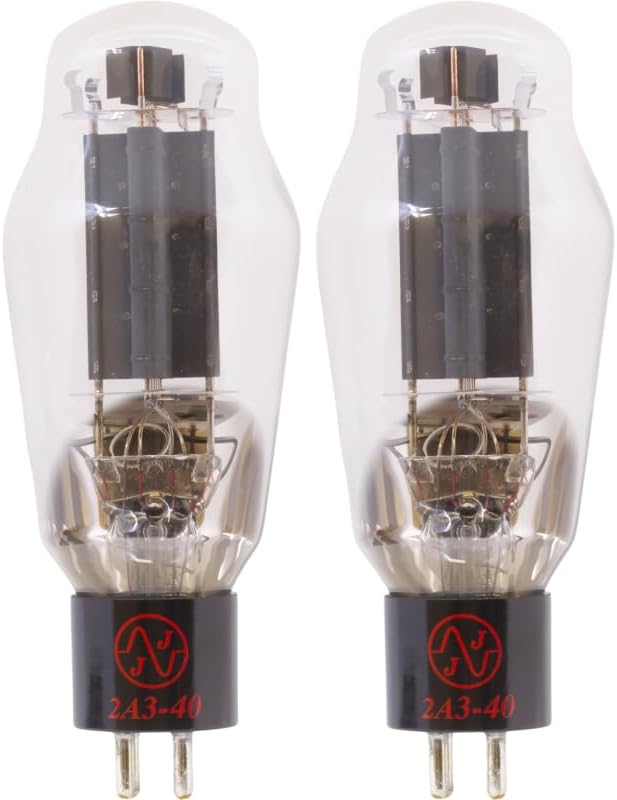
The JJ Electronic 2A3-40 is the option with the highest published plate-dissipation limit in this comparison: 40W. JJ specifies it as a directly heated audio-frequency triode on a four-pin ceramic base. The clear bottle and red markings give it a purposeful modern appearance, while the selected version here is a matched pair.
The important numbers are a 2.5V, 2.5A filament and a maximum overall height of 165mm, with a maximum envelope diameter of 63mm. That makes clearance a serious consideration around a cage or adjacent valves. Measure the available space rather than assume every four-pin power triode occupies the same footprint.
The 40W figure is a plate heat-dissipation limit, not a promise of 40W audio output or permission to raise the amplifier’s operating conditions. The JJ is worth shortlisting for its clearly documented design and substantial envelope where the amplifier approves it. Its main trade-off is physical size; the ratings must be considered as a complete set.
Pros
- Published 40W plate-dissipation limit
- Specified 2.5V, 2.5A filament
- Matched pair with four-pin ceramic bases
Cons
- Large 165mm maximum height and 63mm maximum diameter
- Higher dissipation does not automatically increase amplifier output
Shuguang Treasure 2A3C-Z

The Shuguang Treasure 2A3C-Z is the dark-coated alternative with a traditional shouldered outline. Its nearly black envelope, white base and gold-colored contacts create a strong visual contrast with the clear-glass valves. For an exposed-valve system, that distinctive finish is its most immediately recognizable feature.
The version compared here is one valve. That can suit an installation needing a single replacement, while equipment requiring a selected pair needs the appropriate matching arrangement. Keep the exact 2A3C-Z designation in view when comparing models; similar Treasure names can identify different valve types.
The coating conceals much of the internal assembly, making this a choice for someone who prefers the dark-bottle presentation. It remains a power triode for a compatible amplifier, and its practical appeal should be weighed alongside physical fit and the required selection. The coating alone does not establish a particular frequency balance, service life or noise level. For related reading, see the guides to 6V6 power valves and 5AR4 rectifiers, which cover other valve types and circuit requirements rather than direct 2A3 substitutes.
Pros
- Distinctive dark-coated Treasure presentation
- Traditional shouldered bottle and four-pin format
- Single-valve version for an appropriate replacement
Cons
- One valve does not provide a matched pair
- Dark coating obscures the internal assembly
What’s the Difference Between 2A3 and 300B Tube Amps?
The 2A3 and 300B are different directly heated power-triode types. Their common four-pin format does not establish interchangeability. The models with published filament data in this comparison use 2.5V heating, while the conventional 300B uses a 5V filament supply. Applying the wrong supply can damage a valve.
Filament current, bias, output-transformer requirements and the other operating limits also need to suit the exact type. Some amplifiers are specifically designed to support both families with the appropriate configuration; that capability must not be assumed for other single-ended amplifiers.
Many conventional 2A3 designs deliver only a few watts, so loudspeaker sensitivity and impedance deserve attention. Neither the 2A3 nor the 300B has a fixed musical-genre preference or an inherent inability to reproduce bass. The output transformer, operating point, speaker load and room all contribute to the result.
For small-signal valves as well as output triodes, distinguish the valve’s component ratings from the amplifier’s finished performance. A larger plate-dissipation limit does not by itself produce more audio output. Have a qualified technician assess an unapproved substitution or a fault; dangerous voltages can remain inside a valve amplifier after switch-off.
Conclusion: The Best 2A3 Tube
The Sovtek 2A3 remains the overall starting recommendation for its conventional design and published electrical data. Electro-Harmonix adds a gold-grid, selected-pair option; PSVANE offers distinct TII and ACME constructions; JJ provides a clearly documented 40W plate-dissipation design; and Shuguang retains the characteristic dark Treasure finish.
Choose the model, quantity and matching that suit the amplifier. With those fundamentals in place, the practical differences in construction and physical fit give these six models a useful basis for comparison.