Looking for the best passive Jazz Bass pickups? These six sets cover a stronger attack, vintage-rooted character and different approaches to hum reduction for compatible four-string J-style basses. The right choice depends on the response you want and the pickup sizes already in the instrument.
The Seymour Duncan Quarter Pound set remains the overall choice for extra punch without a battery-powered pickup circuit. Ultra Jazz adds a more percussive hum-canceling option, Model J and Bartolini lean toward warmer voices, and the two Fender sets offer traditional single-coil and Noiseless approaches. Compare those differences before choosing a replacement for a Fender, Squier or another J-style bass.
Best Replacement Pickups for Fender Jazz Bass
Seymour Duncan Quarter Pound Jazz Bass Set (Editor’s Choice)

The Quarter Pound set remains the overall choice for a Jazz Bass that needs more punch and a stronger attack without an active-electronics conversion. Its quarter-inch Alnico 5 pole pieces and hotter winding create a full, assertive voice while retaining enough upper detail to keep a line from becoming indistinct.
The appeal is the balance of output and definition. Fingerstyle parts can have more weight, while pick playing gets a firm leading edge. These are still passive pickups, so there is no battery to add; wax potting helps control microphonic squeal. They suit a player who wants the familiar Jazz format with more attitude rather than a delicate, low-output vintage response.
The neck is reverse-wound and reverse-polarity relative to the bridge, so hum cancellation comes when the matched pair is used together in balance. Either pickup alone can still hum. The set also uses the appropriate neck and bridge sizes, which need to match the bass’s actual routes. Choose it for the bolder voice, accepting that quiet solo-pickup operation is not its main strength.
Pros
- Stronger output with a firm, detailed attack.
- Alnico 5 poles and wax-potted construction.
- Passive neck-and-bridge pair needs no battery.
Cons
- Single-pickup settings can still hum.
- Hotter voice may be too assertive for a vintage-focused player.
DiMarzio Ultra Jazz DP149 Set (Close Runner-Up)

The Ultra Jazz set is the alternative for a player who wants more percussive highs and a broader response while keeping a traditional-looking Jazz Bass. Its hybrid Alnico 5 and ceramic magnetic structure combines a clear low end with a rounded midrange, making it an appealing choice for articulate fingerstyle or pick work.
Each pickup cancels hum on its own. Rather than stacking a second coil underneath, the design has each coil sense a pair of strings. That matters when favoring the bridge or neck: reducing one pickup’s volume does not remove hum cancellation in the same way it does with a conventional matched single-coil pair.
Four-conductor wiring allows additional wiring arrangements, but the physical sizes still need attention. The set follows the original shorter-neck, longer-bridge Jazz layout; not every Squier or Fender variant shares it. Choose the Ultra Jazz for its more open, percussive direction, rather than expecting the rounder character of the Model J or the more forceful Quarter Pound attack.
Pros
- Hum cancellation in either pickup position.
- Percussive highs with clean low-end definition.
- Four-conductor wiring supports additional options.
Cons
- Neck and bridge sizes must match the bass.
- Brighter response may not suit a deliberately darker sound.
Fender Custom Shop ’60s Jazz Bass Set

Fender’s Custom Shop ’60s set suits the player who wants a familiar Jazz Bass voice with extra punch rather than a completely different pickup design. The coils are based on vintage pickups but wound for more output and midrange growl, giving the set a stronger personality than a strictly restrained vintage reproduction.
Alnico 5 magnets and Formvar-coated wire are joined by cloth-covered leads and fiber bobbins. The flush pole pieces keep the traditional appearance uncluttered and are intended to support an even string response. The practical attraction is that recognizable combination of low-end body, midrange character and clear attack.
These are conventional passive single coils, not a Noiseless set. They do not require a battery, but solo-pickup settings can still pick up electrical hum. As with the other replacements, match the actual neck and bridge dimensions before installation. Choose them for a vintage-rooted Fender sound with more push, while accepting the noise trade-off of the traditional design.
Pros
- Vintage-rooted Fender voice with extra punch.
- Alnico 5 magnets and Formvar-coated wire.
- Traditional cloth leads, fiber bobbins and flush poles.
Cons
- Conventional single coils can hum when used alone.
- Not the gentlest low-output vintage reproduction.
DiMarzio Model J DP123 Set
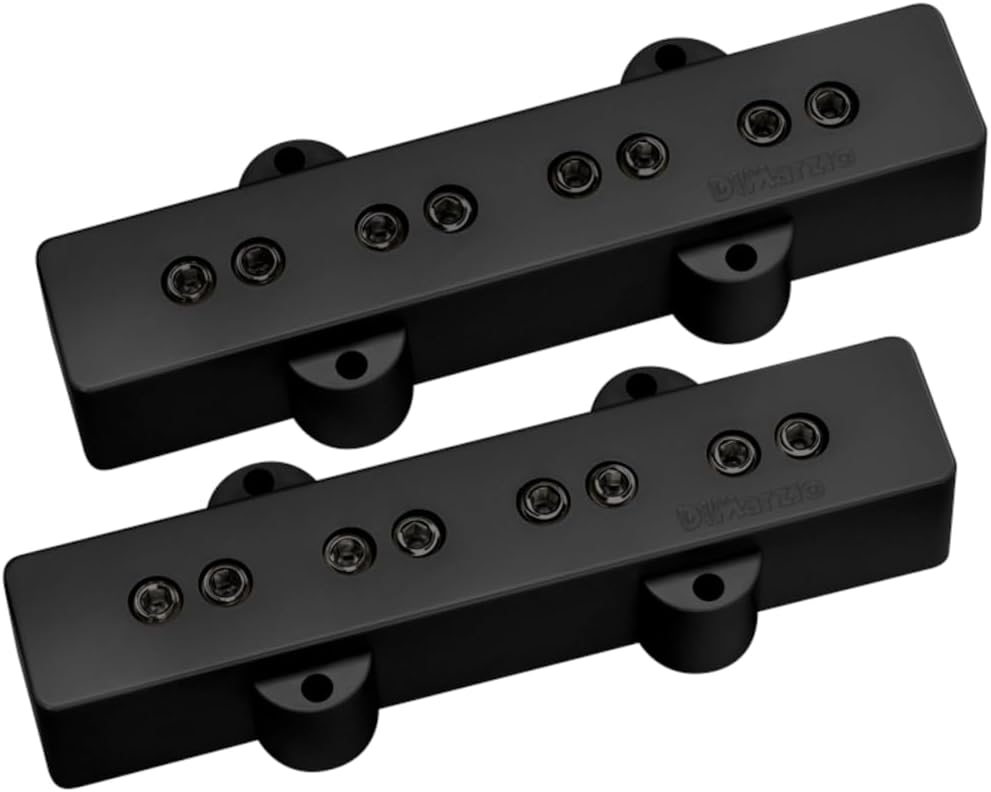
The Model J set is the rounder, warmer option for a player who wants the traditional Jazz Bass shape with individual hum cancellation. Its ceramic magnetic design favors body and a woody character, making it a useful contrast to the more percussive Ultra Jazz. It is also worth considering for a fretless bass where a smooth line matters more than an aggressive top edge.
Like the Ultra Jazz, each pickup uses coils that sense separate pairs of strings rather than a stacked construction. That preserves hum cancellation when the neck or bridge is used alone. Four-conductor leads give the installer wiring flexibility, while the passive design works without adding a battery-powered pickup circuit.
The DP123 set has a shorter neck pickup and a longer bridge pickup. DiMarzio also makes individual sizes for instruments that use a different arrangement, so the set is not a universal drop-in for every J-style bass. Choose it for a fuller, rounded voice and quieter solo-pickup use, rather than the sharper, higher-output emphasis of the Quarter Pounds.
Pros
- Hum cancellation in each pickup individually.
- Warm, rounded voice offers a different option from Ultra Jazz.
- Passive design with four-conductor leads.
Cons
- Short-neck/long-bridge format must match the routes.
- Less suited to a deliberately sharp, aggressive top end.
Fender Gen 4 Noiseless Jazz Bass Set

The Gen 4 Noiseless set is the Fender option for a player who wants a recognizable Jazz Bass voice with less conventional pickup hum. It pairs a tight low end with clear highs and punchy mids, making it a practical alternative when the traditional Custom Shop set’s single-coil noise is unwelcome.
Alnico 5 magnets, flush poles and shielded leads keep the construction focused on a clean, familiar-looking replacement. The pickups are passive: the Noiseless name does not mean they need a battery. That makes the set attractive for a bass that should retain straightforward passive controls while reducing the hum associated with conventional J pickups.
Check pickup depth and the neck and bridge routes rather than assuming every Jazz-shaped housing is identical. Noise reduction also does not remove amplifier hiss, a bad ground connection or every form of interference. Choose the set for its Fender voicing and quieter operation while retaining the bass’s straightforward passive controls.
Pros
- Hum-reducing design with a familiar Fender character.
- Passive operation without a battery conversion.
- Alnico 5 magnets and shielded leads.
Cons
- Route depth and dimensions still need checking.
- Cannot eliminate noise from the rest of the rig.
Bartolini 9J1 L/S Original Jazz Bass Set

The Bartolini 9J1 L/S set is the warmer choice for a player who wants strong lows and low mids with a smoother upper edge. Its dual inline-coil construction cancels hum in each pickup, so the fuller voice is available without relying on both volume controls being matched.
Ceramic ferrite magnets drive a blade-core structure beneath the closed covers. There are no exposed pole pieces to line up visually with each string, and the sealed, epoxy-encapsulated coils help control microphonic behavior. The result is a deliberately different approach from the open-pole Fender and Duncan options, both in appearance and tonal emphasis.
The L/S set pairs the standard long bridge housing with the short neck housing. Bartolini offers other length combinations, so the suffix matters when matching the bass. Choose this pair for warmth and low-mid body, accepting that a player seeking maximum brightness and a hard, immediate edge may prefer the Ultra Jazz or Quarter Pound direction.
Pros
- Hum cancellation in each pickup.
- Warm voice with strong lows and low mids.
- Blade cores and sealed, epoxy-encapsulated coils.
Cons
- Warmer balance may be too subdued for a bright, aggressive sound.
- L/S housing combination must suit the instrument.
Passive Pickups vs. Active Pickups for Fender Jazz Bass
A passive pickup generates its signal without a powered circuit inside the pickup. That does not dictate the rest of the bass: passive pickups can feed either conventional passive controls or a battery-powered onboard preamp. An active bass and an active pickup are related ideas, but they are not the same thing.
Passive Basses
A typical passive Jazz Bass sends the pickup signals through volume controls and a tone circuit to the output jack. The usual tone control uses a potentiometer and capacitor to roll off treble; it does not actively boost frequencies. The advantages are simple controls and no battery requirement for that circuit, while cable loading and control values still influence the sound.
Active Basses
An onboard preamp can buffer the signal and provide the EQ functions built into that particular circuit. Some active basses use passive pickups, so installing one of the sets above does not automatically require removing a compatible preamp. A powered system needs the right battery, wiring and headroom, and its available controls depend on the design rather than a promise to boost any frequency.
Active Pickups vs. Passive Pickups
An active pickup includes powered circuitry as part of the pickup system. It is not simply a weak passive pickup made louder by adding a battery. Output, noise, response and control compatibility vary with the model; neither category guarantees a better tone for every player.
Advantages of Passive Pickups
Passive pickups offer a direct way to shape the bass through winding, magnets and control values without a powered pickup circuit. The Quarter Pounds emphasize punch, the Custom Shop set keeps a more traditional Fender approach, and the other options provide different ways of combining voicing with hum reduction. Choose the response that complements the bass and the music.
Advantages of an Active System
A suitable preamp can provide onboard EQ and a buffered output, which can be useful with longer cables or direct connections. The trade-offs include battery maintenance and matching levels to pedals, amplifiers and recording inputs. More output is not automatically more usable headroom, so set gain for the complete signal chain.
Hum Cancellation and Physical Fit
Passive does not mean single-coil. Ultra Jazz, Model J and Bartolini use hum-canceling coil arrangements, and the Gen 4 set is designed to reduce pickup hum while retaining passive operation. The Quarter Pound pair cancels hum when both pickups are used together in balance; a soloed conventional single coil can still hum.
Measure the neck and bridge housings, mounting ears and depth. Many Jazz Bass sets use a shorter neck pickup and a longer bridge pickup, but some instruments use equal-length routes. Brand or body shape alone does not establish compatibility, and higher DC resistance alone is not a reliable comparison of output across different designs.
So, the Best Replacement Pickups for J-Bass Are…
The Quarter Pound set remains the overall choice for a stronger passive Jazz Bass voice with a firm attack. Ultra Jazz brings a more percussive hum-canceling alternative, Model J and Bartolini offer rounder directions, the Custom Shop ’60s set keeps a traditional single-coil approach, and Gen 4 Noiseless supplies Fender-style hum reduction. Match the housing sizes and wiring first, then choose the character that makes the bass more useful to play.